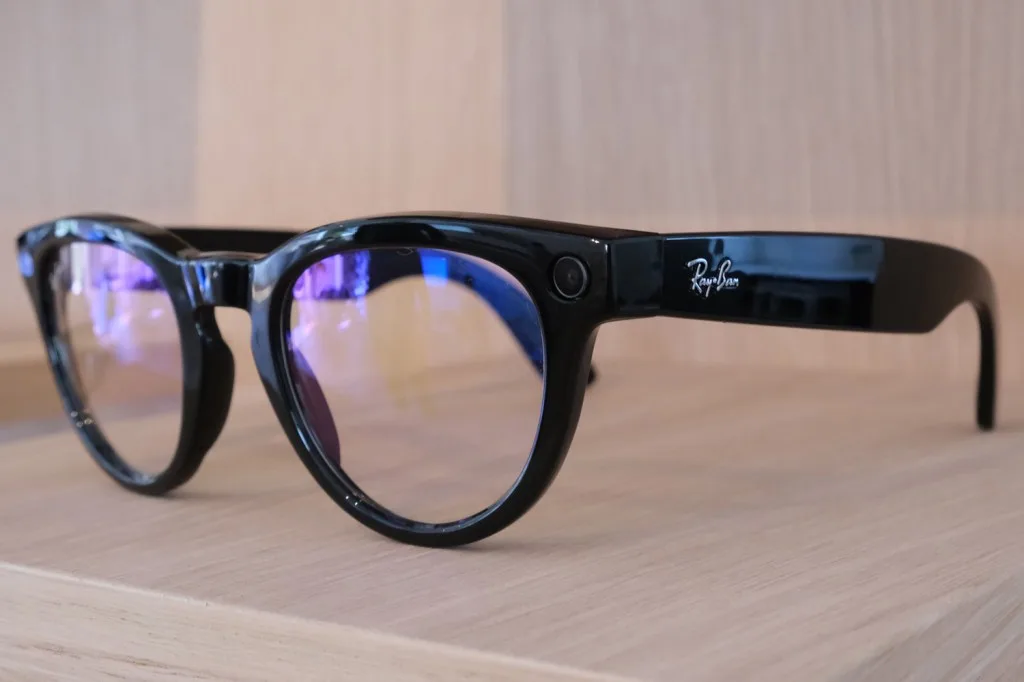
It’s always struck me as a little strange—borderline absurd—how much energy people put into reacting to smart glasses. “Creepy spy glasses.” “Invasion of privacy.” “This is where I draw the line.” And I get it, at least on the surface. There’s something unsettling about a camera sitting on someone’s face, pointed wherever they look. It feels intentional. Directed. Personal.
But the reaction never quite lands for me. Not because I love the idea. Not because I want more surveillance in the world. But because I had a quiet reckoning with all of this a long time ago, somewhere in the early 2000s, sitting between curiosity and inevitability, when it became clear that privacy—at least in the structural sense—was already gone.
Cameras weren’t coming. They were here. Satellites weren’t theoretical. They were operational. The internet wasn’t neutral. It was memory: permanent, searchable, expanding. You could fight it. You could go full DEF CON mode—VPNs stacked on VPNs, virtual machines, digital smoke screens, a constant low-level paranoia humming beneath every click. Or you could accept it.
Not endorse it. Not celebrate it. Just recognize the trajectory and decide where your energy actually mattered. I chose the latter. And interestingly, that choice didn’t make me numb. It made things clearer.
Once you accept that you are, in some broad systemic sense, always potentially observable, something shifts. The ambient anxiety drops out. The background noise quiets. You stop scanning the horizon for invisible watchers and start paying attention to the moment in front of you. More importantly, you stop misplacing your reactions.
I’ve never felt anger toward individuals with cameras. Not auditors. Not people filming in public. Not someone wearing smart glasses walking down the street. That never made sense to me. Because if you zoom out even slightly, they’re not introducing something new. They’re just a visible node in a system that’s already fully online. Getting upset at them would be like yelling at a single pixel for being part of the screen.
But over time, I’ve realized that what people are reacting to isn’t the system. It’s the shift in proximity. There’s a difference between knowing you’re being recorded in some abstract, distributed, machine-level way and feeling like you’re being recorded right now by that person standing three feet away from you. It’s the difference between, “I exist in a system that captures data,” and, “I am being selected in this moment.” That second one hits differently.
It’s not just surveillance anymore. It’s attention. And attention feels like a kind of claim.
Even then, for me, it never quite crossed into outrage. Maybe because by the time I noticed the distinction, I had already moved through the earlier layer. As I got older, something else changed too. When I was younger, being seen carried risk. Not existential risk, but the everyday kind—doing dumb things, testing limits, brushing up against lines I probably shouldn’t have crossed. Being observed meant the possibility of being caught, judged, or corrected.
But that gradually fell away. Not because the system changed, but because I did. My life became more aligned with itself. Less split between who I was and what I was doing. Less need to hide. Less fear of exposure. And when that internal gap closes, external observation loses a lot of its power. Being seen stops feeling like a threat and starts feeling mostly neutral.
Which is why I’ve never really framed this whole thing in terms of privacy. At least not in the way it’s usually discussed. Because what I’ve come to realize is that privacy, for me, isn’t about invisibility. It’s about authorship.
It’s not, “No one can see me.” It’s, “Not all of me exists in every context.”
That distinction matters. Even in a world where everything is technically recordable, that doesn’t mean everything is expressed. When I write, I’m not constructing a version of myself. I’m selecting from what’s already there, bringing certain layers forward, giving them space, letting them breathe in a way they don’t always get to in real-time conversation.
Same with painting. There are things that show up on the canvas that don’t lead in day-to-day life. Not because they’re hidden, but because they’re quieter. Background processes. Latent structures. Honest parts that don’t always have a reason to surface until you give them one.
Those moments—writing, painting, building something—feel fundamentally different from being passively observed. Not because they’re more true, but because they’re authored. They are chosen exposures.
In a world of constant potential visibility, that choice becomes the real axis. And I think that’s what gets lost in the broader conversation. We keep talking about surveillance as if the core issue is being seen. But being seen was never the problem.
The problem, if there is one, is being seen without context, without framing, without intention. Being turned into a fragment, a clip, a moment divorced from the larger structure it belongs to. That’s what people feel when they react to the glasses, the cameras, the constant recording. Not just exposure, but lack of authorship.
For me, the line has always been simpler. The world can watch. But I decide where I stop being available to it. And more importantly, I decide which parts of me step forward, and when.