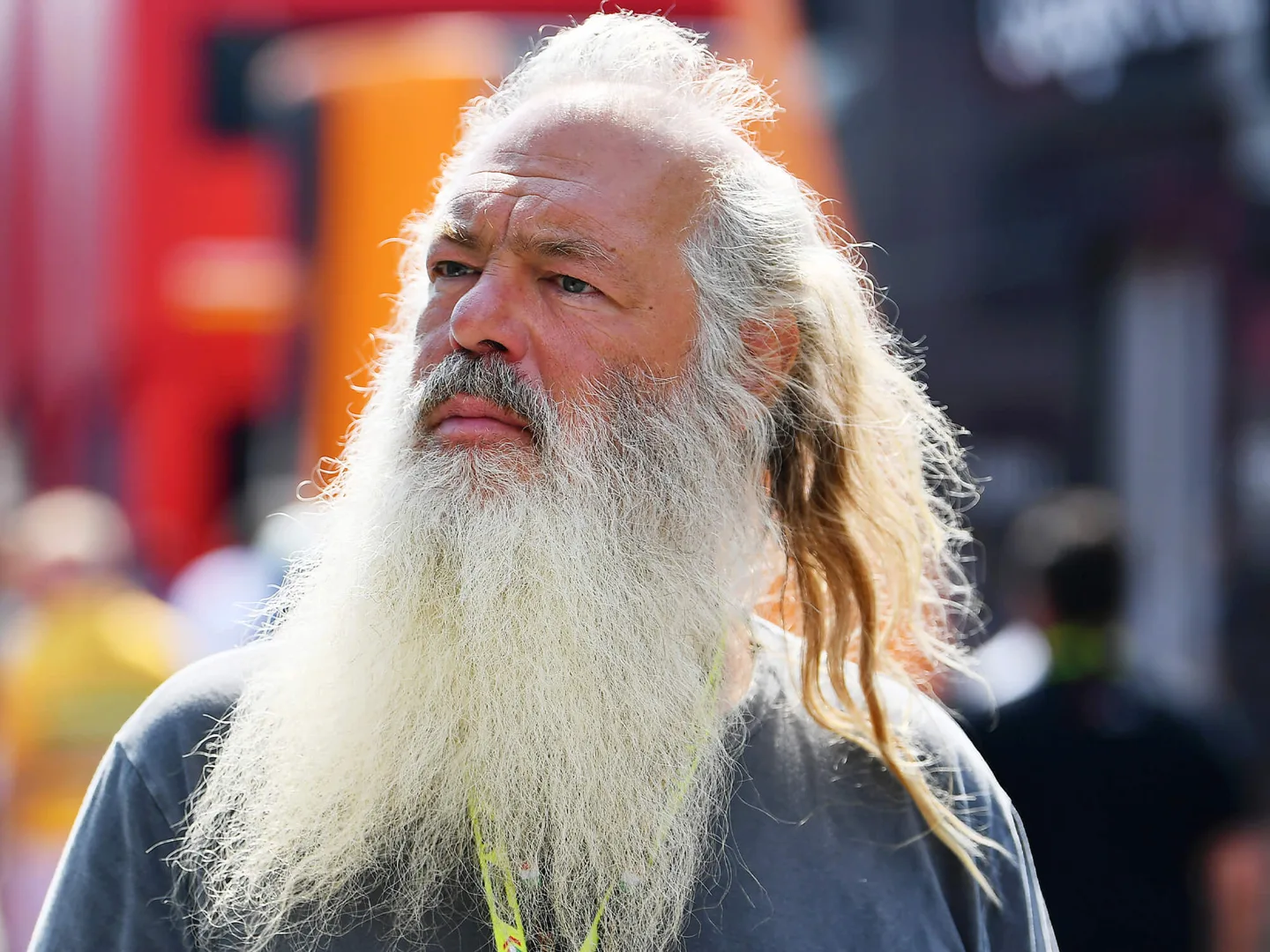
I decided to go full Rick Rubin. Not spiritually, not musically—just follicularly.
I’ve shaved my head for fifteen years. Not as a statement or surrender, just logistics. My hair thinned, balding showed up, and I shaved it. End of story. It never bothered me—not once. At some point I wondered if maybe I’d been hiding behind hats, using them as both literal and metaphorical cover, so I tested it. Six months without one. Nothing happened. No insecurity surfaced, no identity wobble. Just a head. Which made the next decision feel obvious in a way that only makes sense after the fact: I stopped shaving everything.
I was already about eight months into a beard—something I’ve done in cycles for years, including a two-year run in my thirties—but this time I added the head and removed the exit ramps. No trimming, no shaping, no cleaning it up. Just let it go. As of now, I’m at a year of beard and four months of hair, with a commitment to carry both through at least 2027 before reassessing. It’s objectively ridiculous, and it’s been incredible. I have to tie my beard in the wind now. My hair is longer than it’s been since I was a teenager. My daughter braided my beard for the first time last weekend. If I puff it out just right, I look like a deranged Bozo the Clown. It rules.
There’s something deeply satisfying about a commitment that solves nothing. No optimization, no improvement arc, no narrative of becoming better—just the simple question of what happens if you don’t stop. Most change is reactive: fix the flaw, improve the image, resolve the insecurity. This isn’t that. I checked first. There was nothing to fix. And that creates a strange kind of freedom. When you’re not solving a problem, you’re free to create one—a voluntary constraint, a long slow experiment, a joke that takes years to land.
But there’s a thought that’s been quietly humming in the background, something I picked up from Chögyam Trungpa years ago. He talked about hair and beards as disguise—not morally, just mechanically. Anything held onto long enough becomes a kind of shield, a way to hide in plain sight. That wasn’t why I started this. If anything, I had already tested the opposite: no hat, no hair, no problem. But the question has shifted. It’s no longer why I started. It’s what happens if I don’t stop.
Committing to 2027 is long enough for something to form—for a look to become familiar, recognizable, expected. Long enough for other people to start seeing it as me. And somewhere in there, it won’t just be my experiment anymore. The reflection will start to stabilize.
There are moments it would be easier to clean it up. To tighten it. To make it make sense again. But that would end the experiment.
So I keep going.
At what point does a playful choice harden into identity? When does a costume become a face? When do you stop growing the beard, and the beard starts growing you?
I don’t have an answer. For now, it’s still fun—absurd, unnecessary in the best way. But I am watching for the moment it stops feeling like play and starts feeling like me. Because that’s the real edge of it—not the hair or the beard, but the line between expression and disguise, and how long you can walk it before it disappears.
And if that line disappears slowly enough, you might not notice it at all.