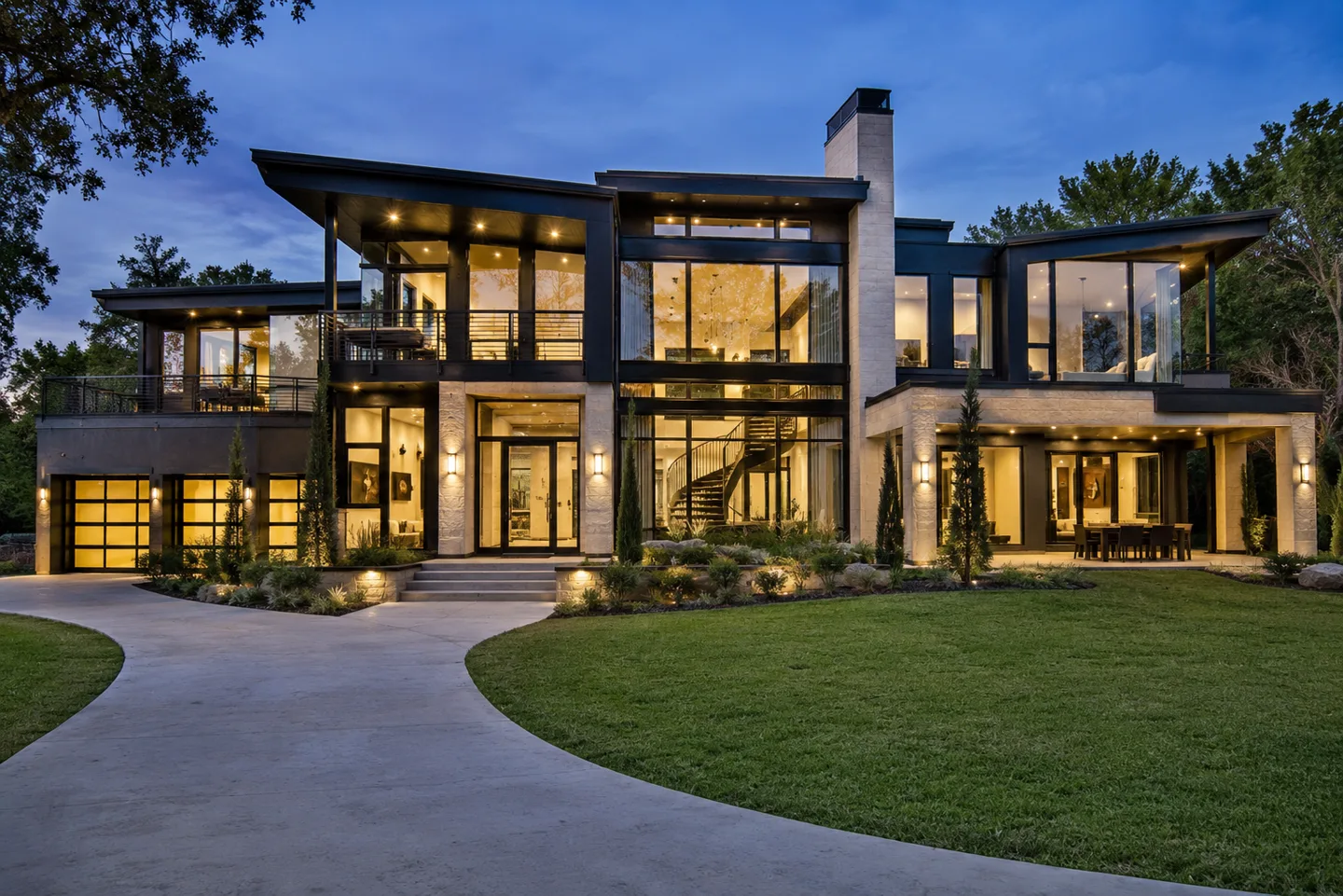
I’ve spent a lot of time in houses that don’t feel like homes. They’re beautiful—open, intentional, dialed in to a degree that borders on surgical. Every object has a place. Every surface feels considered. But there’s something else moving through these spaces that I can’t quite unsee once I noticed it: there’s always someone there.
If it’s not the family, it’s a cleaner. If it’s not a cleaner, it’s a contractor. If it’s not a contractor, it’s someone installing, upgrading, optimizing, maintaining. The door is a revolving mechanism for functionality. Life isn’t just being lived—it’s being continuously adjusted in real time.
At first, it just felt like a different rhythm. A higher-resolution version of daily life. But after enough time moving through it, a quieter question started to creep in, the kind that doesn’t announce itself so much as linger in the corner of your awareness like a half-remembered dream. When does anyone here actually sit alone?
Not scroll alone. Not “relax” between tasks. Not collapse into sleep after a day of well-managed logistics. I mean sit—without interruption, without utility, without the low hum of something about to happen. Just sit with their own mind.
I don’t judge it. I try not to judge much of anything anymore. If anything, I understand the appeal. A life where friction is minimized, where problems are solved quickly, where the machine runs smoothly and quietly in the background. There’s a real elegance to that. A kind of engineered grace.
But I’ve started to wonder if something else gets engineered out along with the friction. Not intentionally. Not maliciously. Just as a side effect of building a life where nothing is allowed to stall out long enough to feel uncomfortable.
Because that’s where the strange part begins. I’ve started to think that privacy isn’t what we usually think it is. It’s not just space away from other people. It’s not even silence, exactly. It’s something more confrontational than that. Privacy is a condition where there is nowhere left to hide from yourself.
And that’s a different game entirely. Because when nothing is happening—when there’s no conversation to slip into, no task to complete, no small optimization to occupy the edges of your mind—something starts to surface. Not always something profound. Not always something you’d post about. Sometimes it’s restless, sometimes it’s weird, sometimes it’s just the mental equivalent of pacing in a room with no doors.
But it’s you. Unfiltered. Unmanaged. Unimpressed with your schedule.
And what I’ve noticed, moving through these endlessly active homes, is that wealth seems to offer something subtle but incredibly effective: an infinite number of completely reasonable hiding places.
Nothing dramatic. No one is running from themselves in some obvious, cinematic way. It’s just life. Someone arriving. Something needing attention. A minor upgrade. A quick fix. A conversation. A decision. Each one perfectly valid. Each one part of what looks like a well-functioning, successful existence.
But stacked together, they create a system where you are almost never cornered by your own mind. And if you’re never cornered, you never have to turn around.
There’s a reason the story of Siddhartha begins with leaving. Not because wealth is evil, and not because comfort is wrong, but because his world was so complete, so well-constructed, that it never forced him into contact with anything outside of it. No decay, no disruption, no long stretches of nothing where deeper questions could begin to echo.
So he stepped out. Not to reject the world, but to finally encounter himself without insulation.
It’s not that wealth prevents reflection. It’s that it makes it optional. And what’s optional has a funny way of being postponed indefinitely, not out of weakness, but because nothing demands it.
And if I’m being honest, this isn’t just a “wealthy people” thing. This is a human thing with better funding. Most of us are building our own smaller versions of this system all the time. Phones, noise, constant input, tiny escapes disguised as normal life. Same mechanism. Different budget.
We’re all, to some degree, filling the gaps. But those gaps are where things happen. That’s where the mirror shows up. That’s where the strange, recursive process of actually meeting yourself begins—not as an idea, but as an experience you can’t quite dodge.
So I don’t think the answer is to reject comfort or romanticize struggle. That feels like another trap. But I do think there’s something worth protecting, maybe even something sacred, in a very unglamorous way: a space where nothing is happening.
No one coming in. No one fixing anything. No subtle sense that you should be doing something more useful with your time. Just a closed door and an open interior.
Because without that, it’s entirely possible to build a life so full, so functional, so beautifully maintained that you never actually meet the person living it.