I’ve sold a lot of things in my life.
At different points, I’ve sold cars, owned stores, ran admissions offices, and moved over 10,000 items on Whatnot. I understood the mechanics of the close. I knew how to position something, create urgency, and speak the language that turns maybe into yes. I wasn’t guessing. I was good at it.
And then at some point, quietly, almost without announcement, I realized I didn’t want to sell things to people anymore. But I didn’t immediately replace that with some grand artistic vision. I didn’t stop selling other people’s things and heroically declare, “Now I shall sell my soul on canvas.” That would make for a much cleaner story, but it wouldn’t be true.
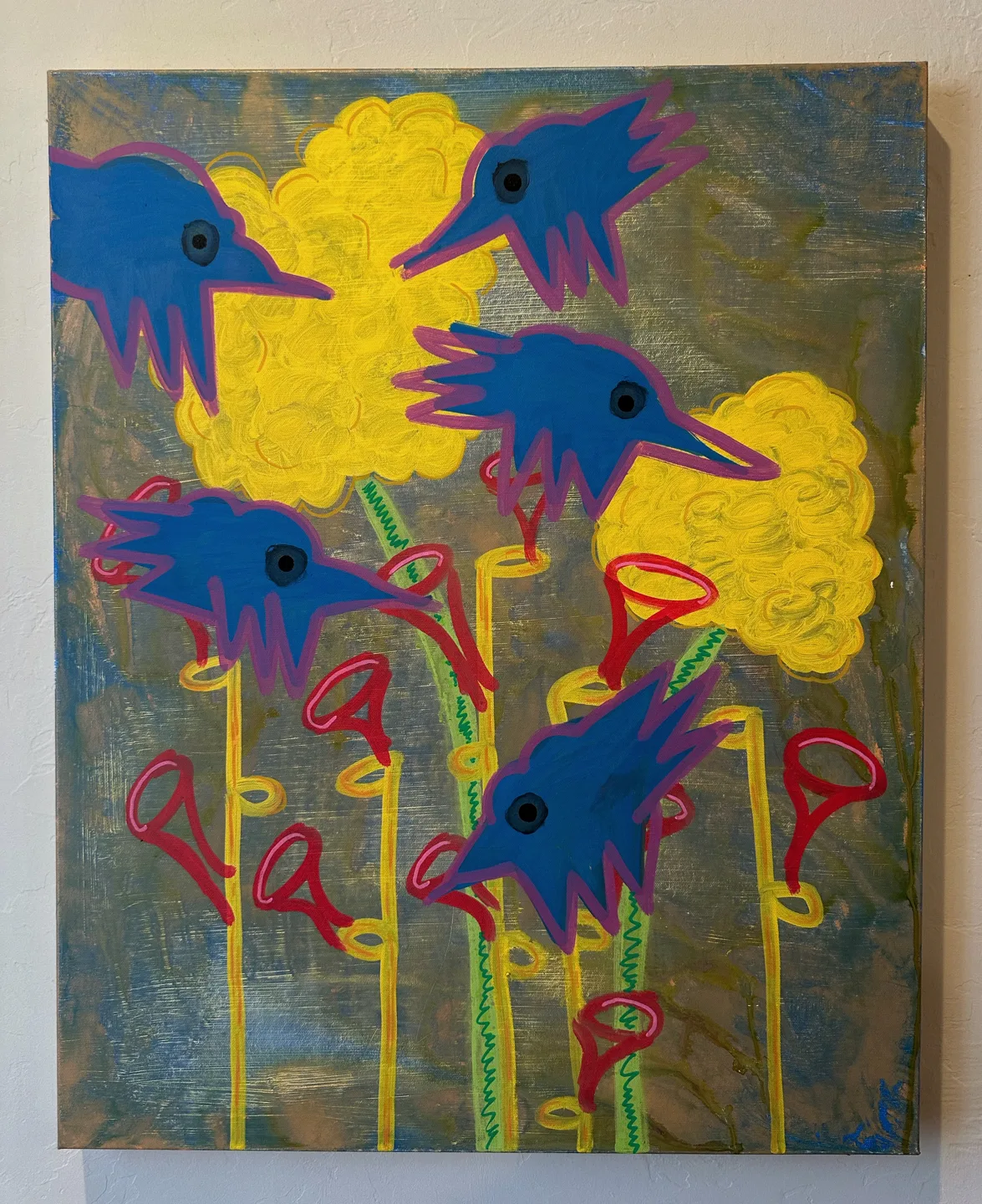
What actually happened was much stranger, less efficient, and significantly more feral. It has been roughly 460 days since I published my first piece on Substack. I haven’t missed a morning since. About 100 days into that streak, the writing wasn’t enough, so I started painting. It began with sketchbooks, moved to acrylics on paper, and eventually bled onto large canvases and found objects.
I wasn’t thinking about selling any of it. I am not a “good” writer in the traditional sense; I never have been. I didn’t arrive at the canvas like Michelangelo in the night. It was more like a caveman playing with color for the first time. I pushed ideas into the ether and paint onto cloth for no other reason than a persistent sense that I must.
For a long time, that was enough. Then something unexpected happened. People I love and respect started paying attention. Not in a polite, encouraging way—but in a way that made me stop and take it seriously. They told me there was something there. They asked if they could buy pieces for their homes.
That’s when the contradiction started to reveal itself. I had spent years selling things to people, only to discover that what I actually wanted was to create things people might choose for themselves. And somewhere in that shift, without realizing it, I removed something from the process.
Before, even when I believed in what I was selling, the structure was always the same. I wanted the outcome. The sale mattered. So I shaped the message, adjusted the tone, leaned into whatever angle would move someone from maybe to yes. Nothing nefarious—just the mechanics of selling.
But there was always a subtle split in it: a part of me doing the thing, and a part of me watching the thing. A quiet internal question humming underneath it all: would I say this if I didn’t need them to buy?
Now, that question is gone. Not because I became more honest, but because the structure no longer requires me to be anything else. Now it looks more like this: I make something, I put it out, and if it resonates, it moves. The sale isn’t the goal—it’s the byproduct of recognition.
That shift sounds small, but it changes the entire experience. When you remove manipulation—even the soft, socially acceptable kind—you also remove the need to steer the outcome. There’s no optimizing the pitch, no adjusting mid-sentence, no subtle pressure hiding behind enthusiasm.
There’s just the work. Here it is. Take it or don’t. And weirdly, that feels better. Cleaner. Quieter in the mind. But also, if I’m being honest, a little more exposed.
Because there’s no buffer anymore. When I was selling other things, there was always a layer of separation. If something didn’t land, it wasn’t me—it was the product, the timing, the audience, the algorithm—there were plenty of places to put the miss.
Now, if something connects, it feels like I was seen. And if it doesn’t, it feels like I wasn’t. There’s no clean way around that. And I’m not sure I’d want one. Because the flip side of that exposure is something I never really had before: alignment.
I’m no longer convincing someone of value. I’m offering something that already contains it—at least to me. And if it doesn’t translate, that’s not a failure of persuasion. It’s just information. Signal. What’s landing, what’s not, where the energy actually moves when it leaves my hands.
That’s a very different relationship to selling. It’s less about influence and more about listening. Less about closing and more about opening. I didn’t move from selling to creating. I merged them.
The thing I’m offering is no longer separate from me, and because of that, I don’t have to contort myself to get it across the line. The work either carries something real, or it doesn’t. No amount of clever phrasing is going to fix that long-term. Which, strangely, is a relief.
Because it simplifies everything. No tricks. No angles. No hidden levers. Just make something worth meeting. Put it into the world. Let reality decide what happens next.
And yeah, I still want things to sell. I’m not pretending otherwise. But that desire feels different now. It’s not about proving anything or extracting value. It’s about connection. About someone, somewhere, seeing something in the work and deciding they want to bring it into their life.
Not because I convinced them. Because they recognized it.
That’s a completely different exchange. And maybe that’s the upgrade. Not that I stopped selling. But that, for the first time, I don’t have to step away from myself to do it.