We are floating in the middle of something so vast it doesn’t just resist comprehension—it reshapes what comprehension even means.
For centuries, we pictured the universe as a dome: a fixed ceiling of stars painted for the gods. Then came the rupture. Telescopes turned sky into memory. We saw not space, but time behind it. And the stars began to move—drifting, colliding, devouring each other in slow cosmic hunger. The heavens were not a painting. They were a process.
In the 2010s, we learned that our Milky Way is part of a 500-million-light-year basin of attraction called the Laniakea Supercluster, pulling over 100,000 galaxies into its gravitational current. Then in 2023 and 2024, astronomers discovered something stranger still: a billion-light-year-wide spherical ripple—Ho‘oleilana—a fossilized sound wave from the early universe, suspended in space. And beyond even that, perhaps, a gravitational corridor linking us to the Shapley Supercluster, one of the largest known structures in existence.
It may be that we sit on the outer skin of a cosmic bubble, itself caught in the pull of a still greater domain.
And this might not be the largest.
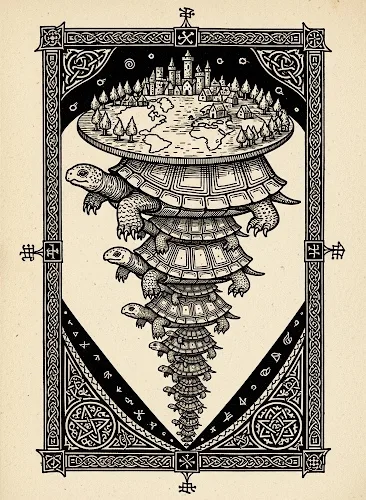
Turtles. All the way up.
These discoveries don’t just render us small. They undo the very idea of scale as hierarchy. They don’t ask us to feel insignificant. They ask us to feel interwoven.
Because once you grasp the sheer magnitude of what is, the question becomes unavoidable: is consciousness local... or inevitable?
Maybe we’re not a fluke. Maybe we’re a function. If gravity, entropy, chemistry, and time could braid themselves into thought once, perhaps they did it more than once. Perhaps everywhere. But not like us—not carbon bipeds with memory and Spotify. Maybe somewhere, consciousness is the slow friction of magnetism across filament walls. Maybe it’s a nebular womb, pulsing with thought too slow for us to detect. Maybe it’s something so vast it takes a billion years to finish a single sentence.
When we speak of the size of the universe, we’re not just talking about distance.
We’re talking about potential.
About scales of experience we cannot imagine.
About questions we’ll never know how to ask.
About songs that no ear like ours will ever hear—but that still are.
And yet, here we are.
One world. One moment. One narrow spectrum of conditions—temperature, chemistry, entropy—aligned just enough to open a window.
We exist.
And we know that we exist.
This, by itself, feels like a hinge in the structure of reality.
Even as Determinists—those of us who believe choice is an echo of prior cause—there’s no escaping the astonishment. The film of existence is running. The plot is baked in. The frames unfold whether we intervene or not.
But what a film.
What rhythm.
What unbearable symmetry.
So maybe the miracle isn’t that we’re central, or rare, or even right.
Maybe the miracle is that we are witnesses.
That for a flickering instant, a speck of matter became aware enough to marvel.
That something in the system turned toward itself and said: Oh.
This moment of witnessing may not alter the plot. But it feels like the point.
We are not outside the story.
We are the story, becoming self-aware.
And so we look outward—not to feel small, but to remember what we’re stitched from.
To see that the vastness out there might be echoing in here.
A billion-year ripple frozen in the structure of galaxies.
A neural flicker dancing in the folds of a primate brain.
Both real.
Both part of the same recursive echo.
Both watching.
All the way up.
All the way down.
Still waking.
Still wondering.