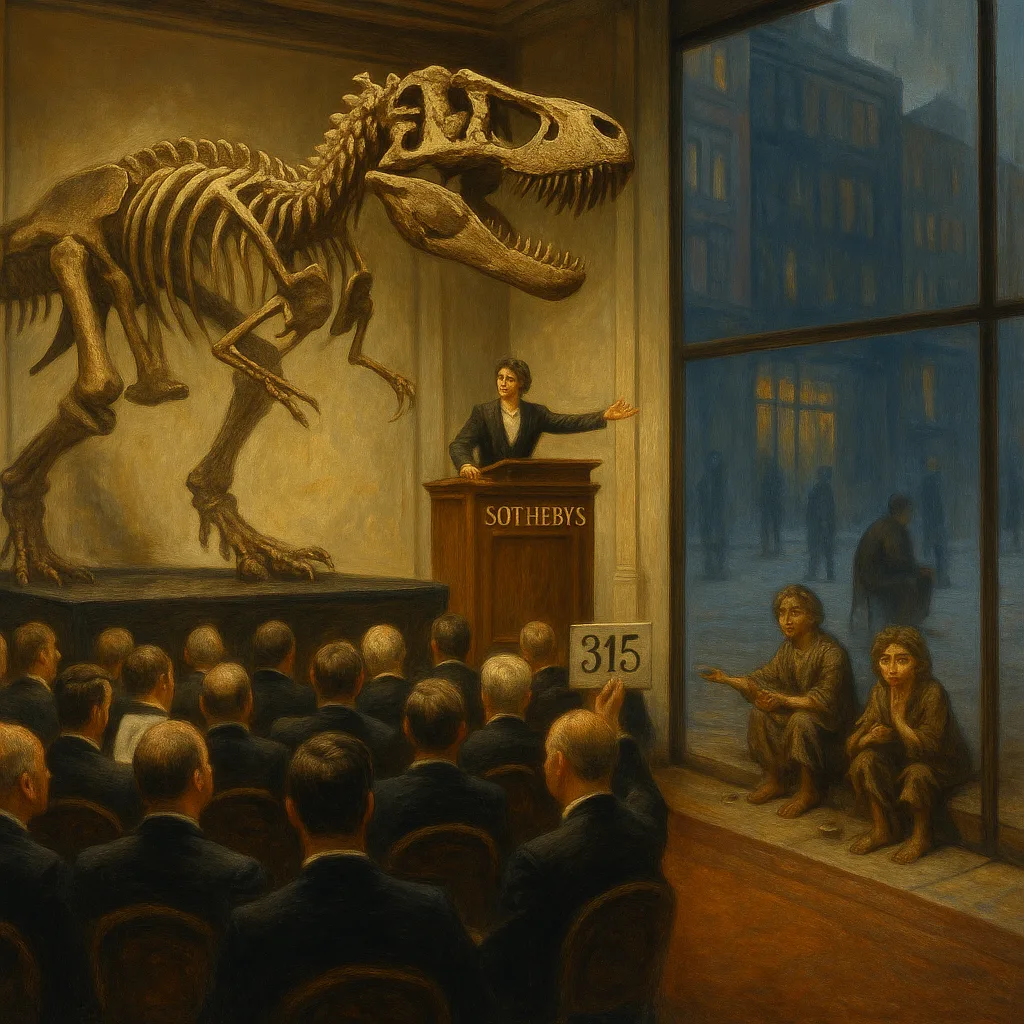
I was perusing YouTube as part of my morning ritual—coffee in hand, still half-dreaming—when I stumbled across a video titled “Watch This Rare Dinosaur Fossil Sell for $30 Million at Sotheby’s.” Naturally, I clicked. I assumed it was satire. It wasn’t.
There it was: a juvenile Ceratosaurus, fresh from the Wyoming dirt, now mounted like a martyr in the cathedral of wealth. The auctioneer, poised and priestly, invoked numbers like mantras. The bidding began modestly—$4 to $6 million, just pocket lint by collector standards. But then, a miracle: the price skyrocketed to $30,510,000. Applause. Awe. Canonization.
The video description informed me that this ancient creature—perfectly preserved down to its “43 razor-sharp teeth”—had become the third most valuable dinosaur ever sold, a metric I didn’t know existed, but now can’t stop thinking about. It “captured the imagination,” they said, as though imagination were a speculative asset on the commodities market.
And so we begin.
“Do I hear twenty million for the bones of an ancient god?”
Twenty. Twenty-five. Thirty. The gavel slams. History is sold. Again.
Somewhere in a lab, a paleontologist cries softly into their underfunded grant paperwork. Meanwhile, somewhere else, a billionaire pours a neat scotch, looks upon his new trophy, and mutters: “This will go great next to the meteorite chunk I bought to celebrate my third divorce.”
The crowd claps, as if this were a shared cultural achievement. As if this weren’t an act of necro-capitalist absurdity—a public wonder locked behind private doors.
A fossil, in theory, belongs to everyone. It is a story too old to have a narrator. A time traveler without a tongue. When we place it in a museum, we say: “This came before us. Let us learn.” But when we sell it at auction, we say: “This came before us. Let us own.”
That difference matters.
Sotheby’s calls it a “highlight of our Natural History auction,” nestled between Stegosaurus APEX and the largest piece of Mars on Earth. (Presumably available in three easy payments.)
It’s no longer science. It’s lifestyle branding for the end of days.
To spend $30 million on a Ceratosaurus is to believe you’re still in the food chain—and winning. It’s to look at a long-dead apex predator and think, “I relate to this.”
But here’s the thing: the dinosaur died for a reason. It wasn’t invincible. It was part of a world that changed too fast. A system that collapsed. Sound familiar?
The fossil isn’t just a prize. It’s a prophecy.
And now it’s been bought by someone who will probably use it as the centerpiece for a hedge fund gala themed Extinction Chic.
Let us be clear: the dinosaur did not die to become a line item on an asset sheet. It did not get buried under eons of rock and memory just to be flipped for clout.
It died under a sky so old it didn’t even know what mammals were yet.
And yet here we are, auctioning its remains like it’s a limited edition Rolex.
History, my friends, is not written by the victors.
It is bought by them.