A couple of months ago, my best friend Sam and I decided to start meeting once a week for coffee on Sunday mornings. This is the kind of thing men in their 40s do when they are trying to convince themselves they are still interesting but also need to be home before anyone notices they left. We weren’t trying to start a movement. We weren’t launching a podcast. We weren’t forming a secret society, though frankly, that’s always on the table. We just wanted a quiet place to drink coffee, talk about life, and pretend for one hour that we were not responsible for the entire emotional infrastructure of our households.
The criteria were simple: somewhere in Oklahoma City, open at 7 AM, with coffee, chairs, and a general willingness to tolerate two middle-aged men slowly becoming themselves in public. Sam, like me, is a husband and an early riser, which is a rare and sacred combination. There are not many people willing to voluntarily meet you in public at dawn on a Sunday unless they are either training for a marathon, fleeing a crime scene, or deeply committed to friendship. After some searching, we landed on Classen Cafe, which had been around for quite a while and had recently remodeled. It opened at 7, which was key, because people who meet after 8 AM are not “having coffee.” They are “already behind.”
For weeks, it was perfect. We would arrive right as the doors opened and, until we left around 8, we were usually the only people there. The staff was friendly. The place was calm. We even asked early on if they minded us coming in just to have coffee and talk, since we weren’t ordering full breakfasts every week. They said they loved having us. Beautiful. A mutually beneficial arrangement. They got two peaceful customers. We got a quiet ritual. Society continued.
Now, I should mention the coffee was not cheap. I was paying four dollars for a small cup, which already felt like the kind of financial decision that should require a second signature from my wife. But I rationalized it. Sure, four dollars for a small coffee is a lot. But if I tipped well, I was spending around ten dollars once a week. Ten dollars to see my best friend, sit in adult silence, and have a conversation that didn’t require either of us to perform competence for the world. As a stay-at-home dad with a very limited budget, ten dollars a week is honestly more than I should probably spend. But we all have our vices. Some men golf. Some buy bourbon. Some restore old cars. I sit in a remodeled café at dawn and pay too much for bean water because friendship matters.
Yesterday, we continued the tradition. We met at 7 AM. I got my normal coffee. Sam, breaking with precedent and apparently living like a Vanderbilt, ordered a small breakfast. Everything was fine. We talked. We laughed. We solved absolutely none of the world’s problems, though we did give them several strong conceptual nudges.
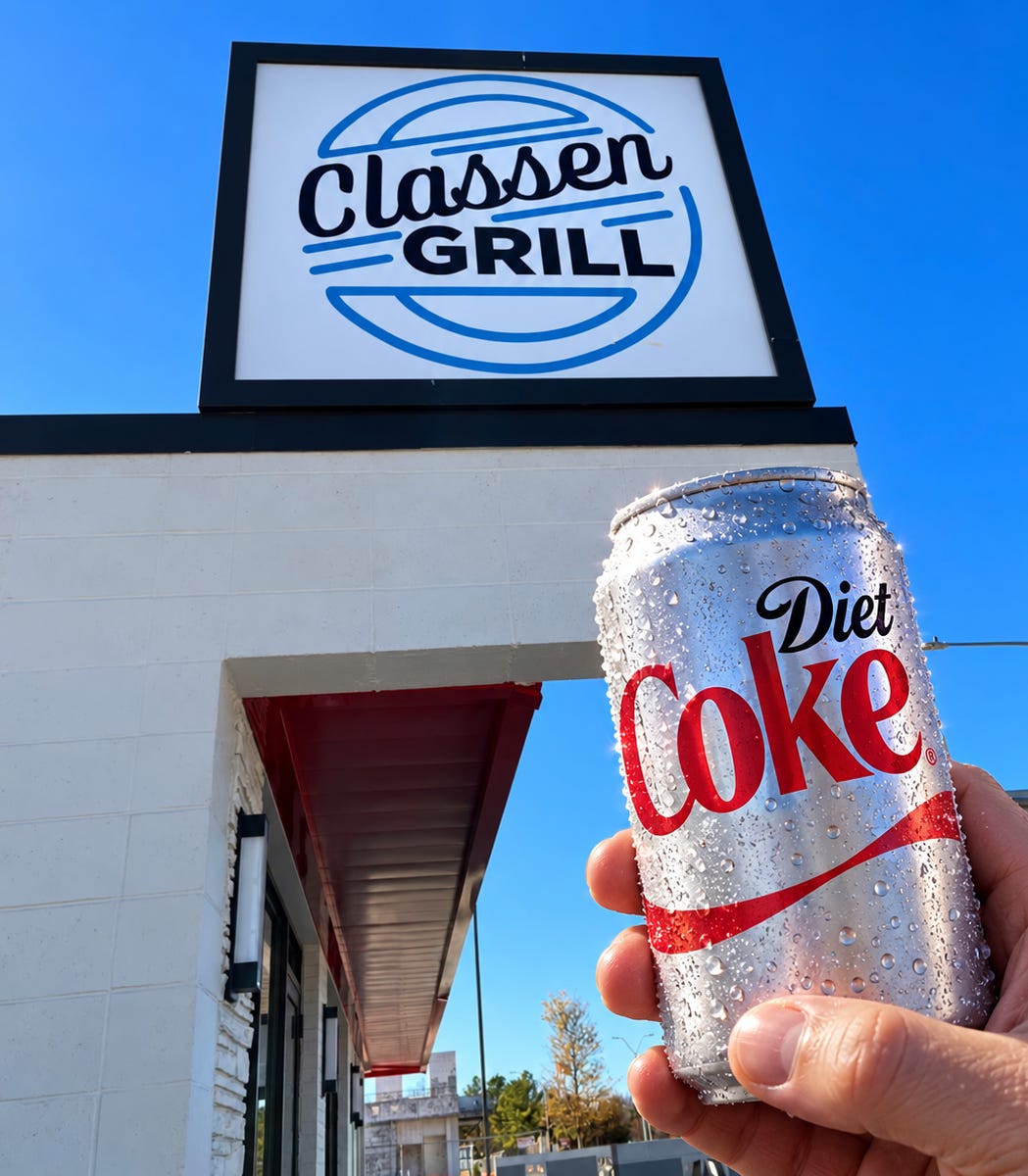
At some point, Sam decided he wanted another refill. I had already finished my coffee and, because I am currently seven months into dieting and have become the kind of person who has strong feelings about carbonation, I decided to order a Diet Coke. This is important. Over the last several months, Diet Coke and I have entered into a committed relationship. I know its moods. I know its textures. I know when it’s good from a fountain, when it’s better from a can, and when someone has handed me a Diet Pepsi and expected me not to notice, which is frankly an act of violence. So I ordered a Diet Coke. Not a rare wine. Not a hand-foraged mushroom tonic. Not a ceremonial cacao elixir stirred clockwise by a man named Forest who just got back from Sedona. A Diet Coke. One can.
When the bill came, I looked down and saw it: four dollars for one can of Diet Coke. Now, I want to be very clear here. I did not flip a table. I did not demand to speak to the owner. I did not stand up and deliver a sermon called “Mammon and the Aluminum Can.” I very politely mentioned to our waitress that four dollars seemed a little high for a can of Diet Coke. In fact, I began the exchange by thanking her for always taking such good care of us, because I am Midwestern enough to apologize before I am wronged.
She scoffed. Then she rolled her eyes. Then she said there was nothing they could do about it. Which, fine. I understand she does not personally control the carbonation economy. I was not accusing her of operating a secret Diet Coke cartel out of the back room. I know servers don’t set prices. I know restaurants have costs. I know the remodeled walls aren’t going to pay for themselves. So I said, “No worries. I know it’s not your fault. It’s just the first time I’ve thought, maybe we should find another morning spot.” And she shrugged and said, “Oh well.”
Oh well. Two words. A tiny phrase. A verbal receipt stapled to a four-dollar Diet Coke.
Over the course of the day, the whole thing stuck with me more than it probably should have. And I know what you’re thinking. Z, this is not a real problem. Correct. It is objectively not a real problem. Nobody should start a nonprofit over this. No one needs to organize mutual aid around my carbonated beverage trauma. There are wars, elections, climate disasters, medical debt, and people who still say “expresso.” But the absurdity of human life is that sometimes the thing that breaks the spell is not the big thing. It’s the can of Diet Coke.
Because it wasn’t really about the four dollars. Except, also, it was absolutely about the four dollars. Classen Cafe is a three-minute round-trip walk from a convenience store that sells single cans for seventy-five cents. It is a four-minute walk from Walmart, where a twelve-pack is around six dollars. And those are retail prices. Retail. That means someone, somewhere, looked at a can of Diet Coke that costs them less than the loose change living under a car seat and thought, “What if we charged the price of emotional closure?” Again, I understand restaurants mark things up. I understand overhead. I understand labor. I understand that a business needs to make money or it stops being a business and becomes a room with chairs. But there is a difference between a markup and a cry for help.
Four dollars for a can of Diet Coke is not pricing. It is a personality test. And yesterday, they failed it.
What made it stranger was the history. For the past two months, we had been the easiest customers imaginable. We arrived early. We were quiet. We were kind. We took up space during a dead hour. We tipped generously. Between the two of us, this waitress had probably made around a hundred dollars in tips for bringing out coffee and then mostly leaving us alone, which, to be fair, was exactly the service we wanted. It was a beautiful relationship. Low-maintenance. Respectful. Mutually beneficial.
Then came the Diet Coke. And suddenly, I saw the matrix. Not the whole matrix. Just the part where a can of soda becomes a tiny silver mirror reflecting the spiritual condition of late capitalism. There it was, sweating gently on the table. A twelve-ounce koan. What is the sound of one customer never returning? “Oh well.” That’s the sound.
And honestly, I respect it in a way. There was clarity in the moment. No negotiation. No softening. No, “Yeah, I know, it’s ridiculous.” No, “Sorry about that.” No tiny gesture of shared humanity between two people trapped inside the same dumb economy. Just: “Oh well.” Which is customer service language for: “The universe is cold, and your Diet Coke is four dollars.”
So we will not be going back. Not in anger. Not in protest. Not because I believe Classen Cafe will collapse without my weekly coffee tithe. It will be fine. We will be fine. Oklahoma City has no shortage of places where two early risers can sit before sunrise and talk about life while slowly injuring their digestive systems with caffeine. But something sacred was broken. A threshold was crossed. A carbonated Rubicon.
They lost me over a four-dollar Diet Coke.
And maybe that sounds petty. Maybe it is petty. But pettiness, when examined closely, often contains a little doorway into truth. Because we all have these moments. The tiny moment when the illusion cracks. The fee that feels insulting. The shrug that says you don’t matter. The canned beverage that becomes a symbol of every small extraction we’ve been asked to accept with a smile. Most of the time, we swallow it. We move on. We tell ourselves it’s not worth caring about. And most of the time, it probably isn’t. But sometimes the soul stands up, looks at the bill, and says: No. Not today. Not this can. Not this Diet Coke.
So now Sam and I are searching for a new Sunday morning spot. Somewhere open at 7. Somewhere quiet. Somewhere with coffee. Somewhere that understands the fragile covenant between a man, his best friend, and a reasonably priced artificially sweetened beverage. Until then, I’ll be at home, drinking Diet Coke from a can I bought myself. At market rate. Like God intended.