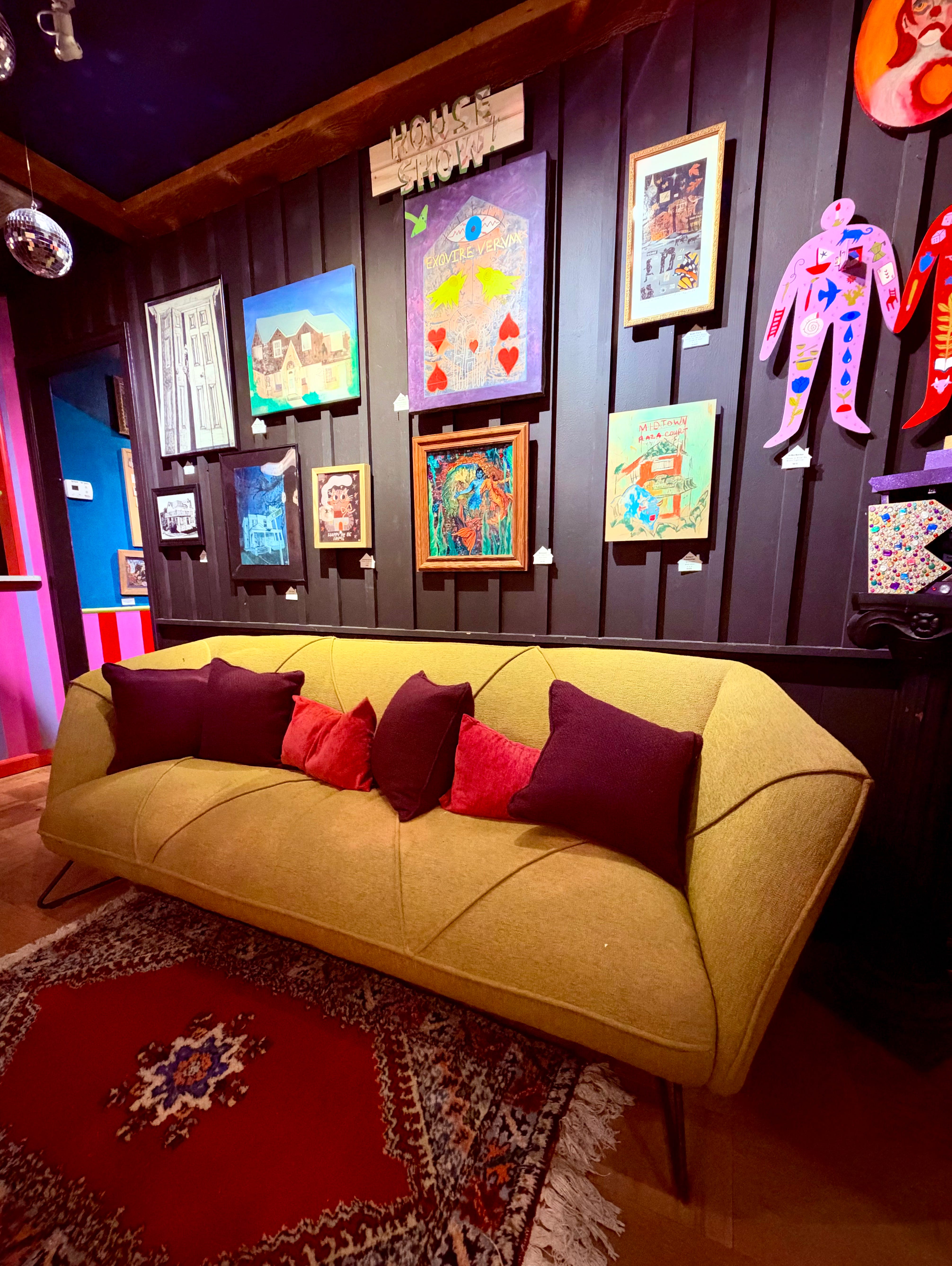
Last night I had a piece hanging in The House Show at The 4801, a group exhibition built around the idea of home and what it means to each of us. It was one of those wonderfully appropriate evenings where the theme seemed to extend well beyond the artwork hanging on the walls. From the moment I walked through the door, I felt at home.
The house was full of art, artists, friends, strangers, conversations, food, laughter, and all of the little overlapping energies that make a good art opening feel less like an event and more like something temporarily alive. Work filled the rooms from artists throughout the community, and I once again had that strange and wonderful feeling of looking around at everything surrounding mine and wondering how the hell I had been invited to hang alongside these people. I mean that sincerely. Every show seems to contain at least one moment where I stop being an artist participating in it and become a person wandering around looking at art, completely delighted that somebody let me sneak my painting onto the wall.
The theme made the warmth of the evening especially fitting. We were gathered inside an actual house looking at dozens of interpretations of home while, for a few hours, creating another temporary version of one together. I went to bed thinking mostly about the night itself. I woke up thinking about home.
“Home is where the heart is” is one of those phrases that has been repeated so often that it almost disappears into the wallpaper. It feels true, certainly. The people we love become home. The places holding our memories become home. A smell, a particular chair, the sound of someone moving through another room—these things can somehow carry more emotional weight than the entire structure surrounding them. But this morning I started wondering whether we might have the relationship slightly backward.
Before home can be where the heart is, home has to provide the conditions that allow the heart to emerge at all.
At its most basic level, a home is shelter. That sounds almost embarrassingly obvious, but I think those of us lucky enough to have one can forget how profound that function really is. I can walk into my house, close the door, turn the lock, and know with reasonable certainty that I am safe. I don’t have to continuously scan my surroundings. I don’t need to know who is approaching behind me. I don’t need to protect my possessions every second or wonder where I will sleep when the temperature drops. The door closes, and some ancient little part of the brain gets permission to stand down.
That may be one of home’s greatest gifts, and one of its least appreciated. When shelter reliably exists, its psychological function becomes almost invisible. We notice the roof when it leaks, the furnace when it quits, and the lock when it fails, but we rarely walk through the front door and consciously celebrate the fact that our nervous system has just been given an off switch.
Remove that security and its importance becomes obvious very quickly. Without a reliably safe place to retreat, there is no true end to the day. There may be places to sleep, places to sit, temporary shelters or borrowed spaces, but vigilance remains somewhere in the background. The animal is never entirely allowed to stop watching the tree line. Living perpetually in that condition—always exposed, always protecting yourself, always wondering what happens next—has to change the experience of being a human being.
Which made me realize that almost everything else I associate with home grows from that initial safety. Home is where I rejuvenate. It is where the energy spent interacting with the rest of the world gets replenished. It is where love accumulates through thousands of utterly ordinary repetitions that would look meaningless individually: eating meals, watching television, walking through rooms, laughing at something stupid, arguing, apologizing, cleaning up messes, helping with homework, feeding dogs, making coffee before anyone else wakes up. It is where growth happens quietly enough that we often don’t notice it until years have passed.
And maybe most importantly, home is where the armor comes off.
We spend enormous portions of our lives presenting versions of ourselves appropriate to wherever we happen to be. Parent. Partner. Employee. Artist. Neighbor. Friend. Interesting person at a party. Competent adult who definitely understands what is happening and absolutely did not just Google how to do something five minutes ago. Those versions aren’t necessarily false. They’re parts of us. But they still require a certain amount of maintenance.
Home is where we can put the masks down with the keys. It is where we can be exhausted without explaining why, quiet without entertaining anyone, weird without translating ourselves. We can walk around in ridiculous clothes, eat directly from containers, stare blankly into space, change our minds, fail spectacularly, create terrible things, create wonderful things, and generally exist without continually negotiating our existence with the outside world. We can simply be.
Perhaps that is why the warmth of last night’s show stayed with me after the art had been taken in and the conversations had ended. For a few hours, The 4801 managed to create something larger than an exhibition about home. It created a little temporary version of the thing itself. People opened a space, filled it with art and strangers, and somehow made it feel safe enough for everyone to bring pieces of themselves inside.
And that makes me think home isn’t really synonymous with a house at all. A house can provide home, but so can a person. A family can create home in a hotel room. Friends can build one around a kitchen table. A community can make one inside an art gallery. Someone can live in a mansion and never experience it, while someone else can find it for fifteen minutes sitting beside the right person.
Home might simply be wherever we are safe enough to stop defending ourselves.
Which brings me back to that old phrase. Maybe home isn’t where the heart is. Perhaps the heart is able to emerge where home is. Safety comes first, and from that safety comes softness. From softness comes love, and from love comes growth.
And if we’re lucky, somewhere along the way we build a place—physical or otherwise—where the people we love can walk through the door, set down whatever armor they had to wear outside, and know they don’t need it anymore.