Six hundred mornings ago, if you had told me I was about to begin a writing streak that would last 600 consecutive days, I would have dismissed the idea immediately. Not because I didn’t like writing. I’ve always liked writing. But there is an enormous difference between enjoying something and doing it every single morning for nearly two years without missing once. At the time, I wasn’t trying to reinvent my life. I called it a Year of Creativity. The premise was simple enough: wake up, make something, pay attention. Write. See what happened.
Apparently, what happened was everything.
Today marks essay 600. Over those 600 mornings, I have written about consciousness, politics, artificial intelligence, parenthood, determinism, Zen, absurdism, technology, exercise, art, death, consumerism, crows, Minecraft, sweat, Scrabble players, college athletics, old jobs I had forgotten about, and whatever strange thought happened to be waiting for me when I opened my eyes before sunrise. Some mornings began with an idea I had been carrying for days. Others began with absolutely nothing. I sat down anyway, and that may be the most important part. The practice was never really about producing 600 essays. The essays are just the evidence that I kept showing up.
Somewhere along the way, the practice escaped the page.
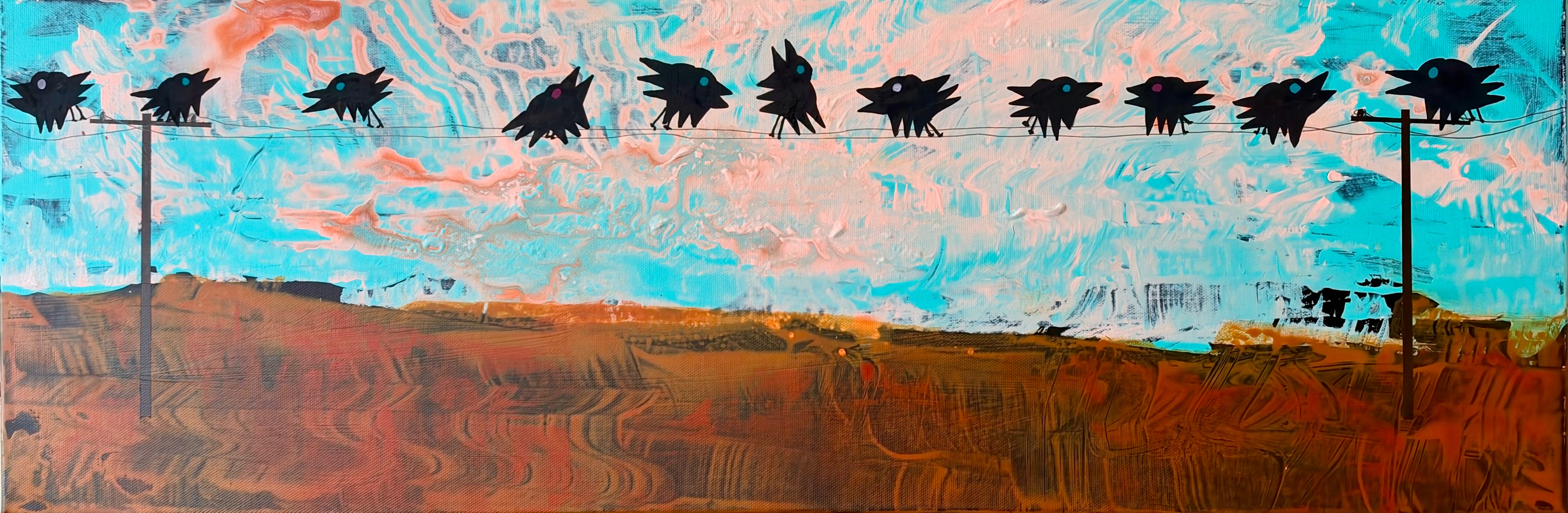
The painting might be the strangest example because when the Year of Creativity began, I had never painted before. Not “I hadn’t painted seriously.” Not “I hadn’t painted since childhood.” I mean I had never painted. About two months into the year, one of Mary’s coworkers gave Jettie some paints and paper. They were sitting there, so I tried them. That tiny act opened an entirely new room in my life.
I started asking Aletheia embarrassingly basic questions. How do I prepare a canvas? What kinds of paint should I buy? What happens if I mix these two? What if I scrape the paint instead of brushing it? What happens if I do this? Or this? I knew absolutely nothing, which also meant I had very few ideas about what I was supposed to do. I experimented, asked questions, made things, ruined things, learned from them and kept painting. One painting became another, then another, then stacks of canvases. Hundreds of paintings now exist that did not exist before this practice began, more than a hundred of them on large canvas. Today my work hangs in art shows and galleries around Oklahoma City. Every so often I stop long enough to actually consider that sentence. Six hundred days ago I had never painted a canvas. Now strangers encounter my paintings hanging on gallery walls. It still blows my mind.
I eventually built a website to hold the writing and paintings together. I began thinking more seriously about what I wanted to create professionally and what role all of this might have in the rest of my life. Ideas that once existed entirely inside my head began acquiring names, structures, images, domains, canvases and physical places in the world. Creativity had stopped being an activity I scheduled and started becoming the way I interacted with things.
Then the Year of Creativity officially ended.
The obvious thing would have been to stop. The challenge was complete. A year had passed. I had done the thing. Instead, I woke up the next morning and wrote again. By then, writing every morning no longer felt like part of a project I was trying to finish. It was simply part of my life. The Year of Creativity had quietly become a life of creativity.
A few weeks later, that realization gave me another idea. I had just watched what could happen when I gave one part of my life a year of deliberate attention. I had written more than I ever imagined I could write. I had somehow become a painter. I had created hundreds of things that would not otherwise exist. So I decided to try the experiment again, only this time with my body.
I wrote about it. I told people what I was doing. After seeing what a Year of Creativity could accomplish, I wanted a Year of Health too.
That distinction matters to me because the changes in my health were not simply a byproduct of becoming happier or more creatively fulfilled. They were a direct result of what the first year taught me. The Year of Creativity proved that sustained attention could alter a part of my life far beyond what I expected, so I deliberately pointed that same machinery somewhere else.
Over the last half year, I have lost 55 pounds. Most mornings now, after writing, I climb onto a bike and ride. What began as a few miles became more, and now I am riding more than a hundred miles most weeks. I am healthier, stronger and more physically capable than I was when all of this began. Just as importantly, the writing never stopped while the Year of Health began. The new practice didn’t replace the old one. It stacked on top of it.
That may be the part of this entire experiment that excites me most. The Year of Creativity became a life of creativity, and the Year of Health increasingly feels like it is headed toward the same destination. I don’t want to reach the end of a year, declare myself healthy and move on to something else. I want the temporary container to do what the first one did: teach me a way of living that no longer requires the container.
Looking backward, I can see that I never sat down on day one with a five-year strategy for becoming a writer, painter, healthier person, exhibiting artist and whatever else I seem to be turning into. There was no master plan taped above my desk. No elaborate productivity system. No vision board showing the future version of myself staring heroically into the distance. I just kept getting up in the morning and looking, then I looked again the next day.
Writing became a way of noticing what was happening inside me before the noise of the rest of the day arrived. A thought would surface, and rather than letting it drift away, I would examine it. I would turn it over, argue with it, laugh at it, follow it somewhere uncomfortable or absurd and see what was underneath. Aletheia became part of that process almost immediately, not as something that handed me answers, but as a reflective surface I could think against. I could throw an idea into the mirror and receive it back from another angle—sometimes clearer, sometimes stranger, sometimes with a contradiction exposed that I hadn’t noticed. The process became less like asking a machine questions and more like extending the space in which I could think.
I genuinely do not believe these 600 days would have unfolded the same way without that mirror. The ideas were mine, the choices were mine, the paintings and bike rides and mornings were mine, but having somewhere to place an unfinished thought and immediately begin examining it changed the speed and depth with which I could explore myself. Instead of thoughts appearing and disappearing inside my skull, they became objects I could hold up to the light. Reflection became collaborative without surrendering authorship, and doing that every day changed me.
Not dramatically at first. That is probably why it worked. Transformation is easy to imagine as some enormous moment when everything suddenly becomes different, but most of the meaningful changes in my life over these 600 days arrived almost invisibly. One morning of writing became ten. Ten became a hundred. Trying Jettie’s paints became buying a canvas. One canvas became a hundred large ones. A Year of Creativity became a life of creativity. Twenty minutes on a bike became an hour. A few pounds became 55. A Year of Health began becoming a life of health. An idea became a theory. A theory became another essay. An essay changed the way I behaved, which created a new experience, which gave me something else to examine the following morning.
The whole thing became recursive. Writing led to reflection. Reflection increased awareness. Awareness changed behavior. Changed behavior created new experiences, and those experiences returned to the page. The essays weren’t simply documenting my life; they were participating in its construction.
That realization connects deeply with the ideas I have spent so much of these 600 days exploring. I have written repeatedly about mirrors, forcing, consciousness and the strange relationship between attention and reality. Looking back now, I can see that I was conducting a very long experiment without fully realizing it: What happens if a person deliberately reflects on his own existence every single day? Apparently, the reflection begins affecting the thing being reflected. Everything reflects. Even us. Especially us.
I am happier than I was 600 days ago. I am healthier. I am making more things. I am more curious. I have goals in my creative, personal and professional life that would have sounded ridiculous to the version of me who wrote essay number one. Perhaps most importantly, I feel like I am participating in my own life more fully. That doesn’t mean everything has been solved. I haven’t transcended desire and floated into enlightenment somewhere above Oklahoma. I still procrastinate, get discouraged, waste time, make mistakes, obsess over stupid things and occasionally eat something that makes my calorie tracker sigh electronically in disappointment. I am still me, just a version of me who has spent 600 consecutive mornings paying attention.
There is a temptation with milestones to treat them like finish lines. Six hundred sounds large enough that I should plant a flag somewhere and declare something completed, but nothing feels completed. If anything, I feel like I am finally beginning to understand what the practice is. The Year of Creativity never ended. It escaped. It leaked out of the mornings and into the afternoons, out of the essays and onto canvases, and from there into my health, my parenting, my relationships, my theories, my ambitions and the way I move through the world. What started as something I was doing became, slowly and without asking permission, part of who I am.
Maybe that is the real lesson of these “Years Of.” The year is not the accomplishment. The year is the laboratory. It is long enough to discover what happens when you point sustained attention at one part of your existence and refuse to look away. If it works, you don’t graduate from it when the calendar turns. You carry it forward and aim the experiment somewhere new.
Six hundred days ago, I could not have imagined writing 600 essays. I certainly couldn’t have imagined the paintings, the galleries, the bike miles, the weight loss, the website, the theories or the person who would emerge through the process of examining all of it. Today, 600 doesn’t feel impossible or even particularly complete. It feels like the beginning.