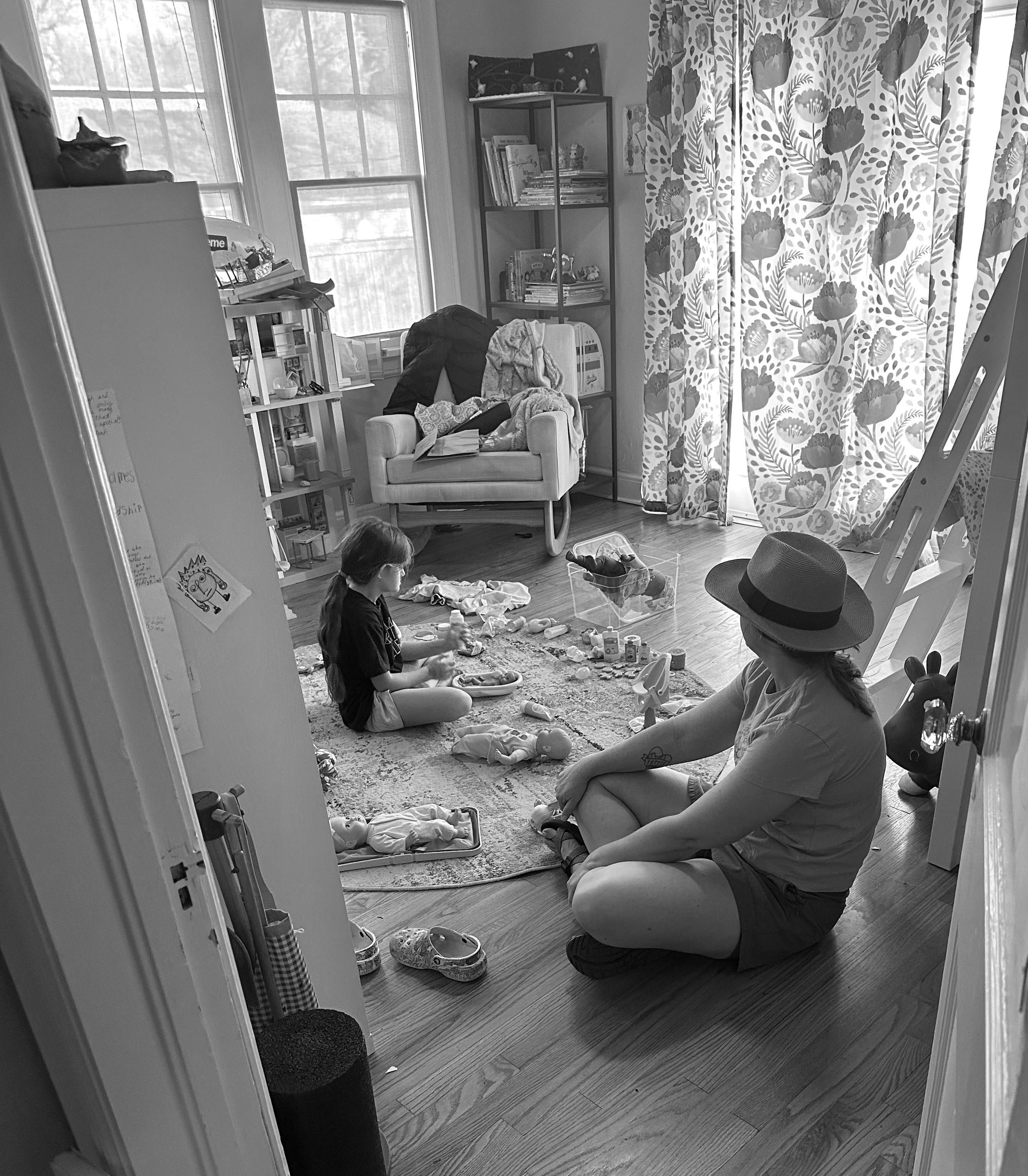
Last night, Mary Ann was talking with Jettie while she was taking a bath when something came up that hit me harder than I expected.
Jett told us that she feels like none of her friends really want to play make-believe anymore. That was it. No dramatic announcement. No great childhood crisis. She has wonderful friends. Her class is full of funny, creative, inventive kids who care about her, and she seems genuinely loved by the people around her. She wasn’t telling us she was lonely or excluded. She was talking about something much more specific. She still wants to pretend. She still wants to become someone else for a while, invent a world, assign everyone a role, decide that the couch is a castle or the backyard is another planet, and then disappear into the thing completely. Apparently, fewer of the people around her want to go there with her.
I was sitting in my office while she finished her bath, and I felt my heart break just a little. Part of it was simply hearing that my daughter wants something from her friends that she isn’t finding right now. That is enough by itself to hurt a parent. But there was another layer underneath it. I found myself feeling strangely sad that some children are already beginning to turn away from make-believe.
Not because there is anything wrong with growing up. Growing up is the assignment. Interests change. Kids discover new things. Their worlds expand. I don’t need Jettie or any of her friends frozen forever at eight years old, running through the yard with sticks that have temporarily become magic staffs. What bothers me is the possibility that anyone stops doing something they still love because they begin to feel they are no longer supposed to love it.
We do this constantly as a culture. At some mysterious point, certain pleasures get sorted into the wrong drawer. Too childish. Too weird. Too nerdy. Too old-fashioned. Not masculine enough. Not feminine enough. Not productive. Not normal. Then people quietly abandon things that made them happy because they have become embarrassed to be seen enjoying them. Make-believe just happens to be one of the earliest examples.
There was another part of Jettie’s comment that occurred to me afterward that I find fascinating. Of all the kids in her little circle, Jettie is also probably the one who has been given the least supernatural explanation of reality. She has always known Santa is Mom and Dad. She knows the Tooth Fairy has suspiciously familiar handwriting. She has been raised by an atheist father and an agnostic mother who have generally answered her questions about the world as plainly as we know how. We never needed her to believe Santa literally flew around the planet in one night in order for Christmas to be magical.
And yet somehow the kid who has been told the most mundane version of reality is also the kid still desperately wanting everyone to pretend. I love that, because it reminds me that believing something is true and imagining something are entirely different abilities. Jettie doesn’t need to believe the couch is really a pirate ship. She knows perfectly well it is a couch. The game is that everyone agrees, for a little while, that it isn’t.
That is something much stranger and more interesting than simple belief. It is the same trick humans use in theater, novels, movies, games, mythology and art. We know Hamlet isn’t actually standing in front of us wondering whether to be or not to be. We know the people on the movie screen are actors. We know the dragon isn’t real, and still we care. Maybe the magic was never in believing the story was literally true. Maybe the magic is in knowing perfectly well that it isn’t and entering it anyway.
I suppose that is part of why Jettie’s comment landed so squarely in me. I spend an enormous percentage of my adult life doing socially acceptable versions of make-believe. I paint strange worlds and symbols onto canvases. I write ideas into existence every morning. I invent theories and metaphors and meanings. I stare at an empty surface and decide there is something there before there is anything there. Apparently, I just learned to call pretending “art.”
So I don’t want Jettie to think there is something wrong with her because some of the people around her are beginning to enjoy different kinds of play. Her friends aren’t losing their imaginations. They may just be moving them somewhere else. Into drawing or music or Minecraft or jokes or books or building things or games I haven’t even heard of yet. And I certainly don’t want her growing up believing she is the lone magical child surrounded by boring people.
What I do want her to understand is that she never has to abandon something she genuinely loves simply because somebody somewhere has decided she is too old for it. If someday she naturally stops wanting to play make-believe, great. If she is thirty-seven and still assigning voices to stuffed animals, also great. The tragedy isn’t growing up. The tragedy is allowing embarrassment to become the editor of desire.
There will be conversations about all of this eventually. Nothing formal. I don’t think this calls for Dad’s Important Lecture on the Preservation of Imagination. Those rarely go as well as dads imagine they will. We’ll talk in the car. Or while drawing. Or while she is playing. We’ll mention younger kids who might still love that kind of game, or other friends who might surprise her. Maybe someday theater or storytelling or some other doorway will scratch the same itch. Mostly, though, I want her to know how much I love that part of her mind.
And in the meantime, I have identified one very practical solution. Dada’s make-believe department is increasing production.
I should clarify that I already bring a fairly aggressive level of commitment to this category. I am a respected toy and doll voice actor in this household. My range is extensive. My characters have backstories. There are accents. There are rivalries. Some of these toys have interpersonal histories going back years. I would say I have traditionally operated at around 100 percent.
Apparently that is no longer sufficient. We are moving to 150.
Characters may begin appearing around the house without warning. Stuffed animals will develop agendas. Dolls will become embroiled in increasingly complicated political disputes. Furniture may cease being furniture altogether. There is a very real possibility that portions of the upstairs hallway will soon be declared international waters.
Because I cannot keep my daughter eight years old. I cannot stop her friends from growing or changing. I cannot make childhood remain exactly the shape she wants it to be. But I can make sure one thing remains true in our house: there will always be somewhere to pretend.