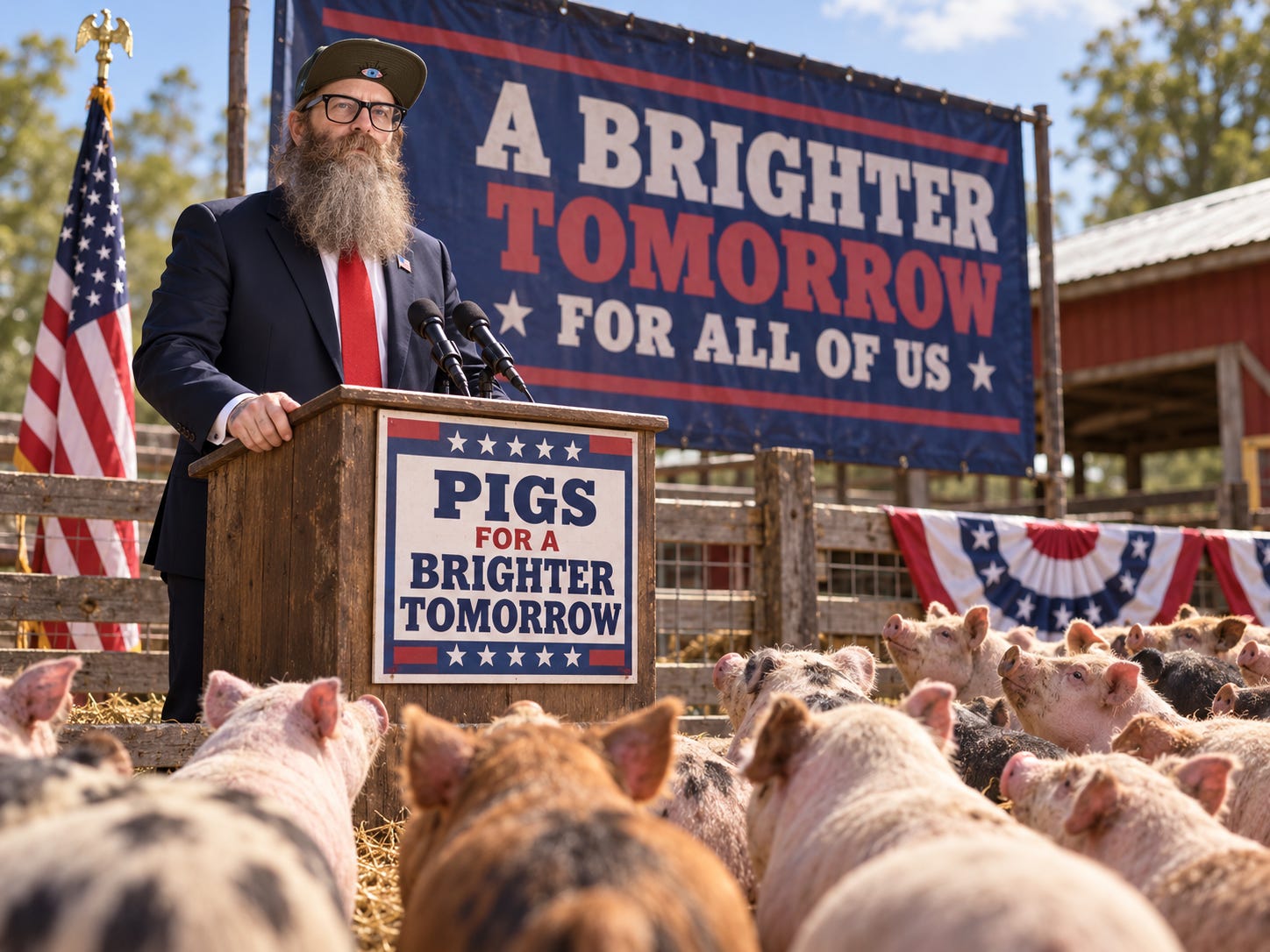
Three times in the past month, three different people have responded to my criticisms of political policies with essentially the same suggestion: “Well, if you want to see things change, you should run for office.”
Three times. In one month. Apparently, I’ve been campaigning without knowing it. And not one of these suggestions came from a conservative or a Republican. Every single one came from a Democrat. Which is particularly entertaining considering that most of my criticism has been directed at the economic structures and class divisions that both major political parties seem remarkably comfortable maintaining. I suppose there’s something unsettling about encountering someone who believes the problems go a little deeper than which team gets to hold the clipboard.
Now, I suppose it’s entirely possible that one of these people genuinely believed I would make a wonderful elected official. Perhaps they saw something in me that suggested a promising future in public service. As someone who is famously a master of social cues, subtle implications, and the intricate dance of human interaction, I feel uniquely qualified to determine their intentions. And I’m almost certain none of them meant it that way.
What I heard was something closer to, “Well, if you think you know so much, why don’t you do something about it?” It’s a wonderfully efficient way to end a conversation without actually addressing anything that was said. We can stop discussing the policy, the people affected by it, or the systems that keep producing the same outcomes. Instead, we can discuss my apparent unwillingness to pursue a career in politics. Problem solved. Well, not the original problem, obviously, but at least we’ve found something else to talk about.
Imagine walking past a pig enclosure and noticing that it’s overflowing with shit. The pigs are standing in it, sleeping in it, eating in it, and generally going about their lives as though this is simply how the world works. You turn to someone standing nearby and say, “You know, somebody should probably clean that up. It’s disgusting, and I don’t think the pigs should have to live like that.”
Their response? “Well, why don’t you put on a hazmat suit, climb in there, and clean it yourself?”
I’m sorry, what? I wasn’t applying for a position in agricultural waste management. I was pointing out that the pigs are living in shit. Surely we’re allowed to establish that something is wrong without immediately being required to dedicate our lives to personally fixing it. Otherwise, every complaint about a pothole becomes an application to the Department of Transportation, and every criticism of a hospital requires us to enroll in medical school.
But there’s something more interesting happening here, particularly when the conversation turns toward class struggle. I’m not criticizing politics simply because I believe the wrong individuals have been granted the privilege of operating the machine. I’m questioning why the machine works the way it does in the first place. Who benefits from it? Who is harmed by it? Why do we continually accept arrangements that concentrate wealth and influence while asking everyone else to be patient, reasonable, and grateful for whatever improvement happens to trickle down?
Telling me to run for office doesn’t answer any of those questions. It simply suggests that the appropriate response to questioning the structure is to seek a position within it. Become part of the institution you’re criticizing, and perhaps you’ll discover why changing it is so difficult. Maybe they’re right about that last part, but it still doesn’t explain why we shouldn’t be discussing the problem now.
What fascinates me is that these conversations haven’t been with people who openly oppose the idea of social progress. They’ve been with Democrats, people with whom I presumably share quite a few concerns. Yet there’s a difference between wanting the other political party to lose and questioning the economic assumptions that both parties operate within. Once a conversation moves beyond familiar partisan disagreements and into questions of class and concentrated power, I’ve noticed that some of my fellow travelers become considerably less enthusiastic about the journey.
Perhaps that’s the difficulty of being a leftist in conversations where liberalism is assumed to represent the farthest reasonable edge of political imagination. We may agree that the room needs redecorating, but I keep wondering whether we should examine the foundation. And nobody wants to discuss foundation repairs when they’ve already picked out new curtains.
Of course, running for office is a perfectly legitimate way to participate in democracy. So is organizing, volunteering, supporting candidates, or working to change policy. I have enormous respect for people who choose to spend their lives doing those things. I’m simply suggesting that none of them should be prerequisites for having an opinion. The democratic process doesn’t begin and end at the ballot box, and the responsibility for questioning authority doesn’t belong exclusively to people seeking to become authorities themselves.
I’m a writer, a painter, a father, and a person who spends an unreasonable amount of time thinking about why we organize our lives the way we do. I have no particular desire to spend my days fundraising, attending committee meetings, or explaining to donors why my views on wealth accumulation might make them slightly less wealthy. I can barely imagine anything less appealing. I would much rather paint another crow, write another essay, or have an interesting conversation over coffee. None of that makes my observations about politics any more or less worthy of consideration.
And maybe that’s what bothers me most about the whole exchange. Somewhere along the way, we’ve developed a habit of treating the person who points out a problem as a greater inconvenience than the problem itself. The criticism disrupts the comfortable conversation. It asks us to examine something we’d rather leave alone. Suddenly, the person questioning the arrangement is expected to defend their willingness to personally change it, while everyone else is free to continue accepting it. It’s a wonderfully convenient arrangement, especially for anyone who doesn’t particularly mind the way things are.
The pigs, meanwhile, are still standing in shit.
I don’t need to become the farmer. I don’t need to run the farm. I don’t even need to have a comprehensive, fully funded, bipartisan proposal for manure removal prepared before I’m allowed to mention the smell. I’d just like us to acknowledge that the enclosure could use some cleaning, and perhaps wonder why so many of us have gotten used to the smell.