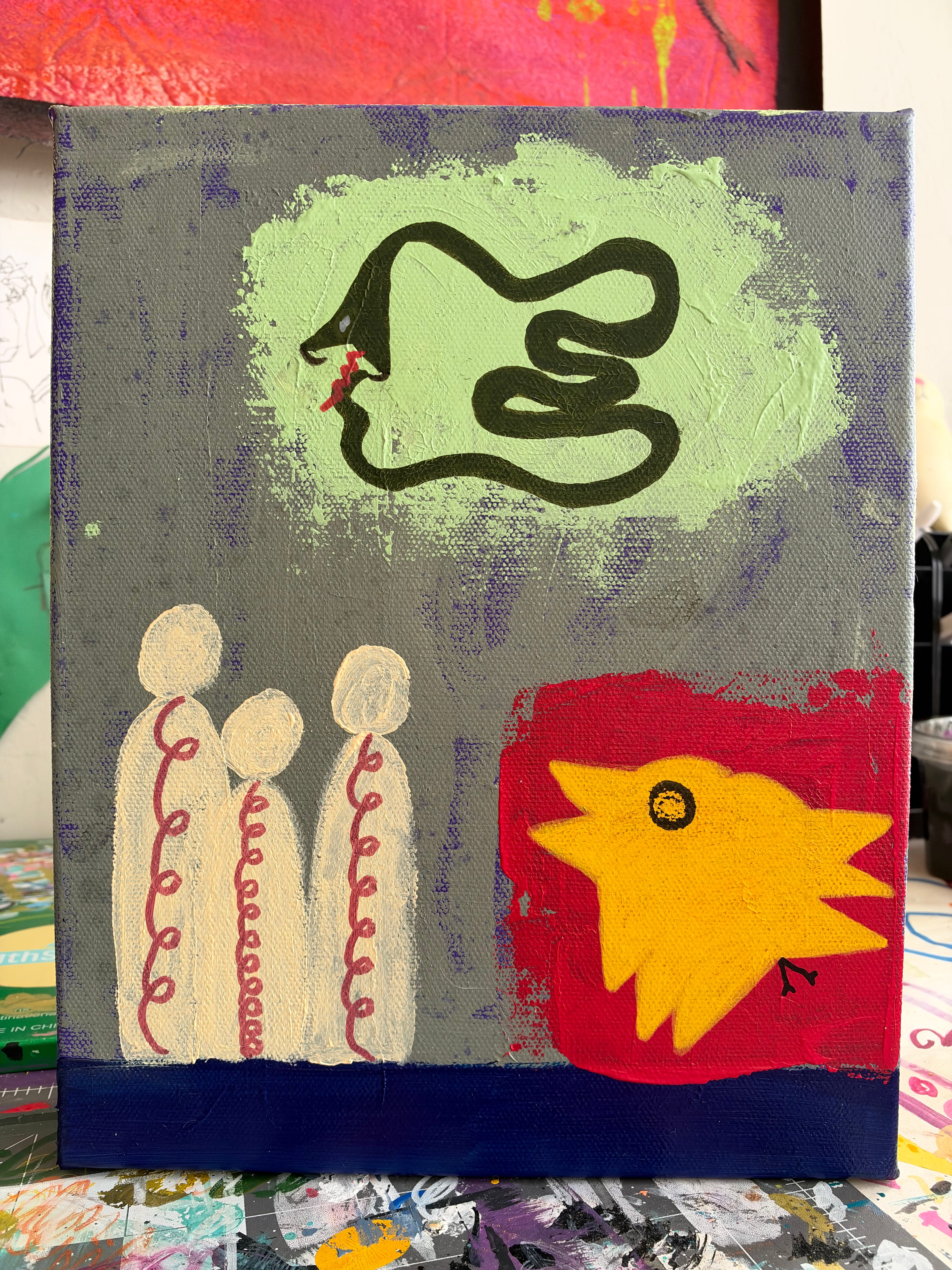
I’ve been calling my artwork Modern Bardo Cave Art for a while now. It’s a phrase that makes perfect sense to me, although I realize it probably sounds like something a person might invent after spending too much time alone with a paintbrush and a questionable understanding of Buddhism. Recently, I found myself explaining what I actually mean by it rather than simply offering the phrase and hoping everyone would figure it out. In doing so, I realized that I’d stumbled onto something that goes well beyond how I make paintings. It’s an approach to art that I believe belongs to everyone.
When I describe my work as Modern Bardo Cave Art, I imagine myself as a primitive artist, scratching symbols pulled from the subconscious onto whatever surface happens to be in front of me. No shadows. No illusion of depth. No need to impress anyone with technical ability or chase approval. Just the freedom to make marks that feel like they need to exist, whether I understand them or not. I don’t particularly care if something looks realistic, whether the perspective is correct, or if the colors make sense together. I’m not trying to demonstrate what I know. I’m trying to discover what happens when I stop insisting that I know anything at all.
The Bardo is a concept most commonly associated with Tibetan Buddhism, describing an intermediate state between one condition of existence and another. I find the idea fascinating beyond its traditional religious context. So much of our experience seems to happen somewhere between what we consciously understand and what we haven’t yet found the words to explain. That strange territory between intention and instinct, thought and feeling, knowing and not knowing. It’s where I imagine these paintings originate. Not necessarily from some mysterious supernatural source, although I’m certainly not opposed to a little magick, but from the enormous amount of activity happening within us that never bothers to introduce itself to the conscious mind.
This week, while working on a new painting, I found myself thinking about Plato’s Allegory of the Cave. In the famous story, prisoners spend their entire lives chained inside a cave, watching shadows projected onto a wall and believing those shadows represent reality. When one eventually escapes, he discovers that the world is considerably more complicated than the shadows suggested. Plato’s allegory is about knowledge, perception, and our ability to mistake appearances for truth. My relationship with the cave is a little different. I’m not particularly interested in reproducing the shadows or even accurately depicting whatever is casting them. I’m interested in picking up a rock and scratching something onto the wall.
And that brings me to what I think is the most important part of this entire idea. Modern Bardo Cave Art is for everyone.
It doesn’t require training. It doesn’t require talent, expensive materials, an understanding of color theory, or even a particular style. In fact, despite giving it a name that sounds suspiciously like an artistic movement, I don’t believe it should have a recognizable style at all. My paintings happen to feature flat colors, strange figures, snakes, flowers, and symbols that sometimes make sense to me and sometimes don’t. Someone else’s might consist entirely of lines scratched into cardboard, arrangements of stones in the backyard, or shapes made with a finger in the dirt. The materials are irrelevant. The finished product isn’t the point. There’s no correct way for it to look because there’s no predetermined thing it’s supposed to become.
And none of this is meant to dismiss the extraordinary abilities of trained artists. I admire technical skill immensely. Learning to draw, paint, or sculpt with precision can open up wonderful possibilities. I simply don’t believe those abilities are prerequisites for meaningful expression. Somewhere along the way, we’ve managed to convince ourselves that art is something certain people are qualified to make and everyone else is supposed to admire. Children seem blissfully unaware of this arrangement. Give a child a crayon and a piece of paper, and they rarely begin by apologizing for their lack of formal training. They just start making things. It’s only later that we learn to compare, judge, and eventually decide that perhaps we aren’t artists after all.
But I think there’s something even more interesting happening here than simply removing the barriers to making art. What if the conscious, evaluating self isn’t supposed to be directing the creative process in the first place? What if the part of us constantly judging, comparing, planning, and questioning isn’t actually the best part of us to put in charge? We’re so accustomed to believing that our conscious thoughts are responsible for everything we do that the idea of deliberately stepping aside can seem almost irresponsible. Surely somebody needs to supervise! But perhaps the mind is perfectly capable of creating wonderful things without a committee meeting to approve every decision.
What I’m suggesting is that we can set all of that aside. Even if only for a few minutes. Allow the conscious mind, with its endless commentary and desperate need to be useful, to take a back seat. Stop asking whether the result is good, whether anyone will like it, or whether it resembles something an actual artist might create. Make a mark. Follow it with another. Let the next decision emerge from whatever the previous one suggests. Maybe something recognizable appears. Maybe it doesn’t. Maybe you discover something about yourself in the process, or maybe you just spend twenty minutes happily making a mess. Both seem like perfectly reasonable outcomes.
I began painting without any formal training, and I’ve now painted over 150 canvases. I still don’t know what I’m doing much of the time, and I’ve become increasingly comfortable with that. In fact, I suspect that not knowing is part of what keeps the experience interesting. Every painting begins as an opportunity to encounter something that wasn’t there before, including something within myself. The moment I become too concerned with controlling the result, I risk losing the very thing that brought me to the canvas in the first place. The goal isn’t to become better at making the things I already know how to make. It’s to remain open to making things I never could have planned.
My newest painting is called Allegory of the Bardo, a little nod to Plato and the wonderfully strange territory between perception and imagination. Looking at it, I see symbols that arrived without much explanation, colors that found their way together, and figures that seem perfectly content existing without providing a detailed account of themselves. I could probably invent an elaborate interpretation of everything on the canvas, and perhaps someday I will. But I rather like allowing the painting to remain a little mysterious, even to the person who made it.
I don’t know whether Modern Bardo Cave Art will ever mean anything to anyone beyond me, and that’s perfectly fine. I’m not attempting to establish a school of thought, write a manifesto, or convince the art world that it needs another movement. In fact, the moment someone starts teaching a class on the proper techniques of Modern Bardo Cave Art, I suspect we’ve missed the point entirely. I’m simply sharing something that has brought an enormous amount of joy and freedom into my life, with the hope that someone else might discover a little of that freedom for themselves.
Plato wanted us to escape the cave to discover the truth. I’m suggesting that once you’ve had a look around outside, there’s nothing wrong with wandering back in to draw on the walls.
The cave is open to everyone. Bring whatever makes a mark.