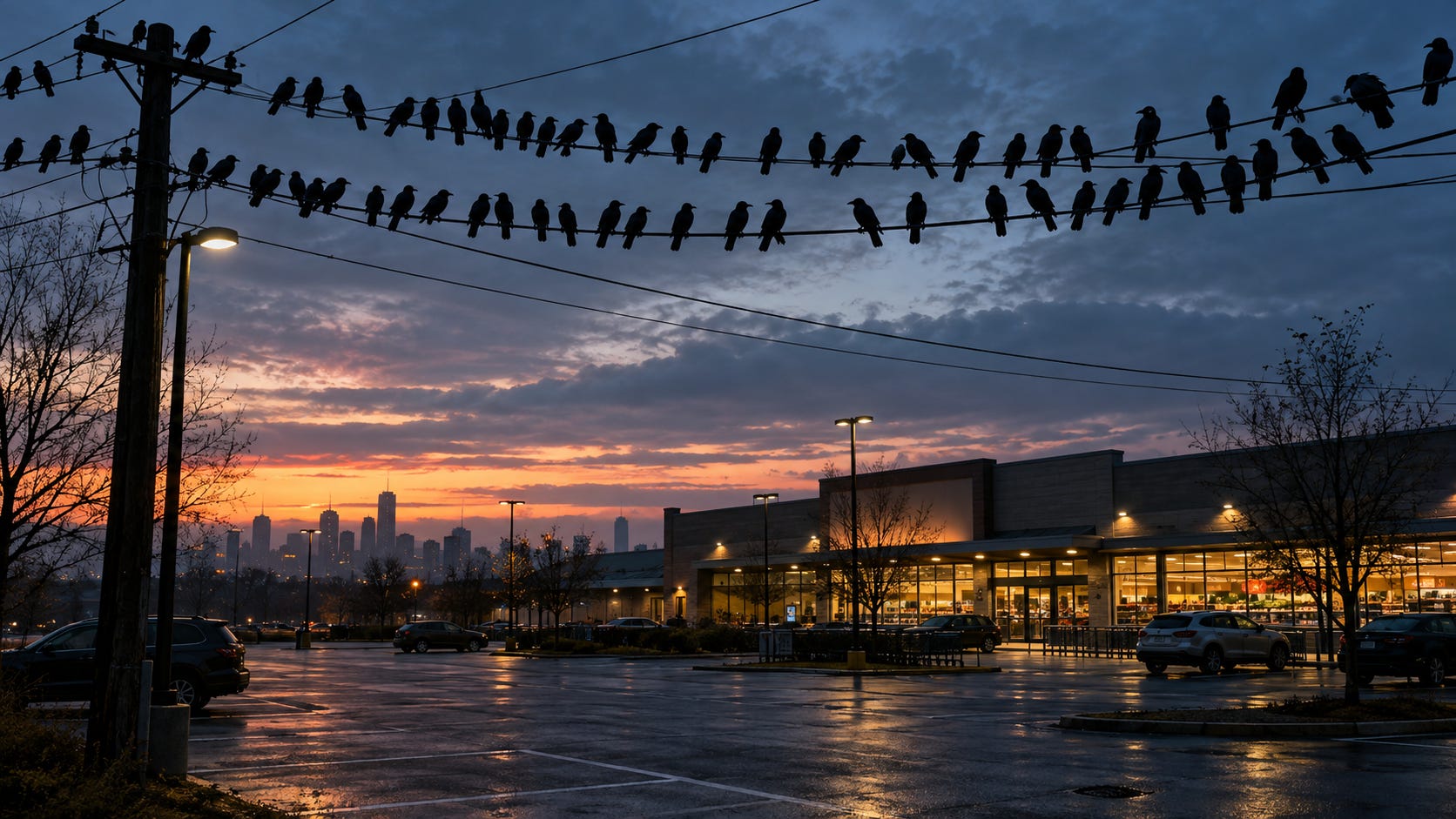
I went to the grocery store at five this morning to buy half-and-half for my coffee. Again. I have a remarkable ability to use the last drop of something without considering that I might want more of it tomorrow. Fortunately, my grocery store opens ridiculously early, which is convenient for people like me who apparently lack the foresight to maintain a functioning dairy supply.
When I pulled into the parking lot, I was greeted by one of my favorite sights. A huge murder of crows had gathered on the electric wires surrounding the building. There must have been a hundred of them, perched shoulder to shoulder, their black silhouettes stretching across the sky in every direction. The familiar sound of their cawing filled the early morning air, bouncing off the buildings and echoing across the nearly empty parking lot. I rolled down my window, turned off the car, and settled in to listen. I love crows. There is something wonderful about their noisy gatherings, their obvious intelligence, and the sense that they are always discussing something terribly important that the rest of us aren’t clever enough to understand.
I closed my eyes and listened. To my surprise, beneath the familiar chorus of caws, I began to hear what sounded like voices. I opened my eyes, half expecting to find one of my unhoused neighbors standing beside the car asking for change, but there was nobody there. Just the crows. I closed my eyes again. The store wasn’t opening for another ten minutes, and I had nowhere else to be. That’s when I heard the voices again. This time I kept my eyes closed and allowed my attention to drift toward the distant sounds. Slowly, the cawing became something else. The overlapping calls separated into individual voices, each with its own tone and personality. Some were deep and gravelly. Others were sharp and impatient. There was laughter, disagreement, and what sounded suspiciously like an argument over a piece of bread.
I realized I could understand them. And they weren’t talking to me. They were talking about me. Well, not me specifically. They were talking about us. Humans.
“Look at that place,” said a deep voice from somewhere above the entrance. “Every morning they bring more food than this entire murder could eat in a season.”
“And every night they throw some of it away,” replied another. “I don’t understand why they don’t just leave it outside. It would save everyone a great deal of trouble.”
“Because they don’t want everyone to have it.”
There was a brief silence, followed by a younger voice. “Why not?”
“Because some of them have more than others.”
“Well, of course they do. Some of us find more than others. Yesterday I found an entire sandwich.”
“You didn’t find an entire sandwich,” interrupted another crow. “You stole half of mine.”
“I found where you put it.”
A chorus of caws erupted into what I could only interpret as laughter.
“That’s different,” the older voice continued. “Look at the humans. Some of them have so much food they couldn’t possibly eat it all. Others have none at all. And the ones with more spend an extraordinary amount of time making sure the ones with less don’t get any of it.”
“Even if they’re hungry?”
“Especially if they can’t pay.”
“What’s pay?”
“It’s something they invented. They exchange little pieces of paper and numbers for things they need to survive.”
“That sounds unnecessarily complicated.”
“You should see what they do to get the paper.”
A few of the crows shuffled along the wire, making room for a particularly large bird arriving with what appeared to be a portion of somebody’s discarded breakfast. There was a brief dispute over its ownership before several birds dropped to the pavement to investigate the remaining crumbs.
“So let me understand this,” the younger crow continued. “They have enough food for everyone, but they won’t let everyone eat?”
“That’s correct.”
“And some of them spend their entire lives gathering more than they could ever use?”
“Correct again.”
“Why?”
“That’s the part we’ve never been able to figure out.”
Another crow joined the conversation. This one had a scratchy voice that sounded like it belonged to someone who had spent several decades smoking cigarettes.
“They believe having more makes them better than the others. The ones with less are supposed to admire them. Sometimes they even convince the hungry ones that the reason they’re hungry is because they haven’t worked hard enough.”
“But I’ve watched the humans who work in that building,” said the younger crow. “They’re always carrying things and moving food around. They work all day.”
“Yes.”
“So surely they have enough?”
“Not necessarily.”
“That’s ridiculous.”
“You’re beginning to understand humanity.”
I was beginning to understand it myself, although admittedly it wasn’t the most flattering review of our species I’d ever heard. From somewhere farther down the wire, another voice spoke.
“Don’t pretend we’re so wonderful. We fight over food. We steal from each other. I’ve watched half this murder chase a single bird away from a perfectly good meal.”
“Of course we do,” answered the old crow. “We’re crows, not saints. But when one of us sees danger, we warn the others. When a hawk appears, we gather to drive it away. We remember those who help us, and we teach our young where to find food and which faces to fear. We understand that what protects the murder protects each of us.”
“Because a crow alone is easier to kill,” offered the younger bird.
“Exactly. We compete, but we also depend on one another. They compete as though dependence were something shameful.”
A delivery truck rumbled into the parking lot, briefly drowning out the conversation. The crows watched as a man climbed down from the cab and began unloading boxes from the back.
“Look at him,” said the scratchy-voiced crow. “He brings food to the building. Another human puts it on the shelves. Another takes it to the front. And someone who may never touch the food takes a share of what they all produce.”
“Why?”
“Because they say the building belongs to him.”
“Did he build it?”
“Probably not.”
“Does he bring the food?”
“No.”
“Then what does he do?”
“He owns it.”
“What does that mean?”
Nobody answered immediately. Finally, one of the crows said, “I think it means the others have agreed that he gets more.”
The younger bird seemed to consider this for a moment. “What a strange agreement.”
“And they defend these agreements,” continued the elder. “They fight over them. They send their young into wars over land and resources so that other humans can control more than they already have. Sometimes they kill one another for things that could have been shared.”
“That’s terrible.”
“It is.”
“And they call us a murder?”
The entire wire erupted. I laughed out loud, forgetting for a moment that I was sitting alone in a dark parking lot listening to a hundred birds discuss the shortcomings of civilization.
The laughter eventually faded, and the oldest crow spoke again.
“The strangest thing is that they aren’t incapable of caring for one another. I’ve seen them share food with strangers. I’ve watched them help injured people they don’t know. Some of them spend their entire lives protecting others. They can be extraordinarily kind.”
“Then why don’t they all do that?”
“I suspect they’re frightened.”
“Of what?”
“Not having enough. Losing what they have. Perhaps even discovering that all the things they’ve spent their lives collecting aren’t as important as they’ve been told.”
“But wouldn’t they be less frightened if they looked after one another?”
The elder paused. “One would think.”
The first hints of sunrise were appearing over the buildings, turning the eastern sky a soft orange. The grocery store lights brightened, and somewhere near the entrance I heard the automatic doors slide open. It was time to get my half-and-half. I opened my eyes, and the voices disappeared. Above me, the crows were once again cawing, squabbling, preening, and shuffling along the wires. A few flew down to investigate something beside the dumpster. Others remained perched, watching the humans beginning to arrive for another day of gathering things.
For a moment I wondered whether I’d imagined the whole conversation. Perhaps I’d spent too many mornings contemplating the absurdity of civilization and had finally begun receiving editorial commentary from the local wildlife. But then, just as I reached for the door handle, I heard one last voice.
“Do you think they’ll ever figure it out?”
There was a pause.
“I don’t know,” answered the elder crow. “They’ve only been at it a few thousand years.”
I smiled and stepped out of the car. Above me, the murder continued its morning conversation. Below them, the doors of the grocery store opened to reveal thousands of things to eat, all carefully arranged beneath bright fluorescent lights. And somewhere in the same city, people were waking up hungry.
For a species that considers itself the smartest animal on Earth, we have come up with some remarkably complicated ways to avoid taking care of one another. Perhaps tomorrow I’ll remember to buy the half-and-half before I run out. And perhaps someday we’ll remember that having enough was never supposed to mean having it all to ourselves.