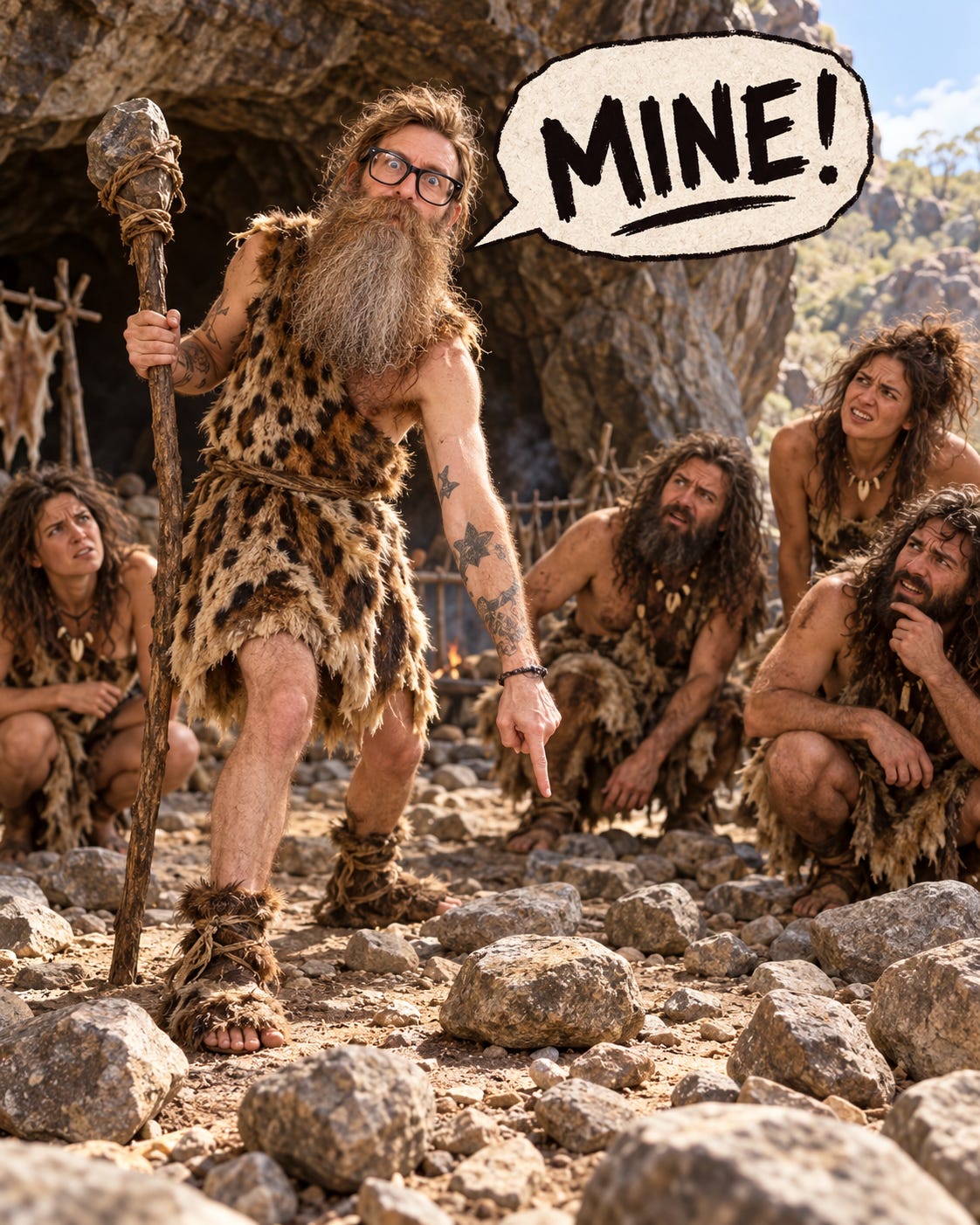
Imagine, if you will, a world before property. Before money, mortgages, international borders, homeowners associations, and the delightful experience of paying someone for permission to park your car on a piece of pavement. Our ancestors are wandering about doing whatever it was our ancestors did before someone invented the concept of being productive. The sun rises, the rain falls, the rivers flow, and the animals eat one another with the casual indifference of creatures who have yet to develop a system of moral justification for their behavior. Life is difficult, frequently short, and entirely free of paperwork.
One afternoon, beside a river, an early ancestor of ours picks up a rock. It’s a perfectly ordinary rock. Millions of years of geological activity have produced it without the assistance of a single investment banker. Another member of the group approaches, notices the rock, and reaches for it. But something extraordinary happens. The first creature pulls the rock closer, looks the other in the eye, and makes a sound that will eventually change the course of human civilization.
“Mine.”
Nothing happens. The river continues flowing. The birds continue singing. Somewhere in the distance, an animal is being eaten by something considerably larger, and neither participant seems particularly concerned with the philosophical implications of ownership. The universe, having existed for billions of years without recognizing private property, declines to acknowledge this historic development. The rock remains precisely what it was moments before. A rock.
But something has changed. Not in the rock, and certainly not in the universe. Something has changed between the two creatures standing beside the river. One has declared an exclusive relationship with an object, and the other must now decide whether to recognize that claim. Perhaps he shrugs and walks away. Perhaps he objects. Perhaps the first creature hits him over the head with the rock, establishing an early precedent for the relationship between property rights and law enforcement. Whatever happens next, the idea has been introduced. Something that previously existed in the world has been declared the possession of an individual.
Now, before anyone writes to inform me that animals already defend territory and resources, I am aware. Squirrels have been arguing over nuts for longer than we’ve had courts to settle such disputes. Nor am I suggesting this is how ownership actually began. Our ancestor is imaginary, although I suspect his personality is historically plausible. What interests me is what happens when possession becomes an idea capable of existing independently of the thing being possessed. An agreement that can be remembered, taught, enforced, inherited, and eventually written into law. A relationship between a creature and a rock that can survive long after the creature has returned to dust.
And so begins our journey. Our ancestor eventually dies, presumably without the benefit of estate planning, and the rock finds itself back beside the river. Perhaps his descendants remember that it belonged to him. Perhaps another creature picks it up and declares it his own. Either way, the rock remains entirely indifferent to its legal status. We’ll leave it there for the moment, resting beside the water, while the rest of humanity gets busy inventing civilization.
Thousands of years pass. People discover agriculture, establish settlements, and develop increasingly elaborate arrangements for determining who may use which portions of the Earth. Someone standing near our rock points toward the surrounding land and declares it his. He plants crops, builds a shelter, and eventually constructs a fence to make sure everyone understands the arrangement. This isn’t entirely unreasonable. Cooperation requires some understanding of who can use what, and it’s difficult to grow crops if your neighbor insists on eating them before they’re ready. But the idea is growing. A person can now claim not only something he can carry, but an entire piece of the planet. The Earth, having rotated around the sun for billions of years without a deed, is apparently discovering that its previous management was inadequate.
Eventually, the farmer dies. Rather than returning the land to the world, his claim passes to someone else. That person may never have planted a seed, moved a stone, or contributed anything to the field’s usefulness, but the arrangement survives. Ownership has become something that can outlive the owner. We have invented a way for the dead to continue telling the living what they may and may not do. Meanwhile, our rock sits quietly beside the river, occasionally getting wet, without the slightest understanding that it now rests on property belonging to the grandson of a man who once pointed at the surrounding dirt.
More centuries pass. Villages become cities, cities become kingdoms, and some particularly ambitious individuals begin claiming portions of the Earth so large that they cannot possibly visit them all. A man wearing an elaborate hat announces that everything from the mountains to the sea belongs to him. He has never seen most of it. He did not create the mountains, the sea, or the unfortunate people already living between them. Nevertheless, he has an army, an impressive hat, and a collection of people willing to explain why his ownership is perfectly legitimate. Other men with equally impressive hats disagree, and humanity begins the long tradition of killing one another over imaginary lines drawn across a planet that has no idea any of this is happening.
Eventually, someone draws those lines on a map. The map is beautiful. Mountains, rivers, forests, and coastlines are represented with remarkable care. Then someone takes a pen and draws a line through the middle of everything. On one side, people must obey one set of rules. On the other, entirely different rules apply. A deer walks across the line without incident. A bird flies overhead, blissfully unaware that it has just crossed three international borders without presenting a passport. A human being attempts the same journey and may find himself arrested, imprisoned, or turned away. The difference, apparently, is that the deer has failed to recognize the seriousness of the situation.
Our rock, which has now witnessed an impressive number of territorial disputes, has done nothing whatsoever to contribute to them. It has been claimed by farmers, kings, and distant governments without ever moving more than a few feet from its original resting place. At various points it has belonged to people who have never seen it, fought over it, or even known it existed. Some of those claims were agreed upon, others enforced at the point of a spear. The rock has survived all of them. The people making the claims have been considerably less fortunate.
Meanwhile, another remarkable development is underway. Humans have discovered that carrying everything they wish to exchange is inconvenient, particularly when one person has a cow and the other only wants a loaf of bread. Over many generations, increasingly sophisticated forms of accounting, exchange, and currency emerge. Eventually, someone holds up a little piece of metal and announces that it has value. Not merely the value of the metal itself, but a value everyone is expected to recognize. The coin can be exchanged for food, shelter, clothing, and other necessities of life. The extraordinary thing is that the coin doesn’t actually contain any of these things. You cannot eat it, live inside it, or wrap yourself in it when winter arrives. Its power exists in the collective imagination of the people who use it, reinforced by trust, institutions, and the increasingly serious consequences of refusing to participate.
And it works! Spectacularly, in fact. Money allows strangers to cooperate across enormous distances. Trade expands, cities flourish, and humans develop an extraordinary ability to coordinate their activities without ever meeting the people whose labor makes their lives possible. Unfortunately, we also discover that whoever accumulates enough of these little pieces of metal can acquire vast quantities of the things everyone else needs to survive. Eventually, we improve upon the invention by removing the metal entirely. Then the paper. Now a number displayed on a small illuminated rectangle can determine whether a person has access to food, medicine, or a place to sleep. Our rock, still sitting beside the river, is worth considerably more or less depending on the imaginary numbers associated with the land beneath it. The rock remains unaware of these fluctuations and has yet to express any interest in cryptocurrency.
The centuries continue to roll past. Empires rise and fall, kings lose their heads, revolutions overturn governments, and humanity repeatedly announces that it has finally established a sensible arrangement of affairs. Each generation inherits the agreements of the previous one, modifies a few details, and explains to its children that this is simply how the world works. We develop legal systems to define ownership, institutions to protect it, and armies to defend it when necessary. Some claims are negotiated, others purchased, and a tremendous number are established by taking things from people who were already using them. The distinction between agreement and obedience becomes increasingly difficult to identify once enough generations have passed.
And then something rather astonishing happens. We begin to forget that these arrangements were invented.
A child is born into a world already divided into nations, properties, currencies, and hierarchies. Nobody asks whether the child agrees with the arrangements. The child simply learns that some people own the land, some people own the buildings, some people own the companies, and some people must spend most of their waking lives working for the people who own those things. Eventually, the child becomes an adult and begins explaining these arrangements to another child as though they are fundamental properties of the universe. Gravity pulls things toward the Earth. Fire is hot. Water is wet. You need a credit score to buy a house. These are simply the laws of nature, and it would be terribly naive to question them.
By now, our species has become remarkably inventive in determining what may be owned. A person can own the rights to a melody, although the notes themselves remain available to anyone with a functioning set of vocal cords. Companies can hold patents on certain genetic inventions and applications, though nature has been assembling genetic material without a licensing department for billions of years. In some places, you can purchase development rights associated with the empty space above a building. The sky, which seemed reasonably content belonging to nobody, now has paperwork. We have taken the original concept of the rock and expanded it until ownership no longer requires something you can hold, touch, or even see.
Our rock, incidentally, is still there. The river has changed course a little, the nearby fields have become roads and buildings, and the surrounding land has been bought, sold, inherited, taxed, subdivided, and occasionally seized by people with official documents. Someone has built a bridge nearby. A developer has purchased the land surrounding the river, and an attorney has spent several billable hours determining precisely who owns the ground beneath our ancient friend. The rock itself remains completely unchanged in its attitude toward the proceedings. It has endured several thousand years of human civilization with the same level of enthusiasm it displayed on the afternoon our ancestor first picked it up.
Of course, some of these inventions are extraordinarily useful. I have no particular desire to return to a world where anyone can wander into my house and announce that my refrigerator now belongs to them. Property rights can protect people from theft and exploitation. Currency allows cooperation on scales unimaginable to our ancestors. Borders can establish jurisdictions and systems of shared responsibility. The problem isn’t that humans invented these arrangements. Inventing arrangements is one of our most remarkable talents. The problem arises when we begin treating those arrangements as though they were discovered rather than created, as though the universe itself arrived at our conclusions after careful consideration.
We have confused our agreements with reality.
And what makes this confusion especially remarkable is how fiercely we defend it. Suggest that our economic arrangements might be reorganized to ensure everyone has enough to eat, and someone will explain that such a thing is impossible. Suggest that access to shelter shouldn’t depend entirely on one’s ability to accumulate money, and someone will patiently describe why people must sometimes sleep outside buildings that remain empty. Suggest that the rules governing ownership and inheritance might be changed, and you may be accused of threatening civilization itself. Never mind that civilization has been changing these rules for thousands of years. The current arrangements have achieved the remarkable status of being both entirely man-made and apparently beyond human control.
It’s almost religious when you think about it. We have created invisible relationships, assigned them enormous power, developed elaborate rituals to maintain them, and organized our lives around their authority. We have priests in the form of economists, sacred texts in the form of contracts, and temples constructed of glass and steel where people gather to worship numbers that exist only because enough other people agree that they matter. There is even a priesthood dedicated to explaining why the people who possess the most numbers deserve to possess even more. I suspect our prehistoric ancestor would be impressed, although he’d probably be disappointed to discover that his rock has appreciated considerably in value while remaining entirely unavailable to him.
And through all of this, the planet continues doing precisely what it has always done. The rivers flow. The trees grow. The rain falls wherever atmospheric conditions dictate, without regard for property taxes or municipal boundaries. The animals migrate across invisible lines, occasionally inconveniencing the people who have paid good money to insist those lines are real. The Earth keeps spinning beneath our elaborate system of ownership, utterly indifferent to the fact that we have divided its surface into an astonishing collection of competing interpretations of what belongs to whom.
I wonder sometimes what would happen if we could see these arrangements with fresh eyes. If we could somehow forget everything we’d been taught about money, property, and borders long enough to recognize them as extraordinary products of the human imagination rather than unavoidable features of existence. Would we build the same systems again? Would we make different agreements? Would we find better ways to distribute the abundance we’ve become so remarkably talented at producing? Or would we simply reinvent landlords, credit cards, and parking enforcement because, apparently, some ideas are too magnificent to abandon?
Which brings me back to our rock.
Thousands of years have passed since that afternoon beside the river. The original ancestor is gone, along with everyone who ever knew him. The language he spoke has vanished. The people who claimed the surrounding land have come and gone, their kingdoms reduced to ruins, their fortunes scattered among descendants who may not even remember their names. The river still flows nearby, though concrete now holds portions of its banks in place. There are streets where forests once stood, buildings where animals once wandered, and signs explaining which activities are permitted on property owned by people who have never set foot on it.
One morning, a man walking beside the river notices the rock. He bends down, picks it up, and turns it over in his hand. It’s a perfectly ordinary rock, worn smooth by water and time. He likes its shape. Perhaps he’ll take it home and put it on a shelf. Perhaps he’ll give it to his daughter, who will paint a face on it and name it something ridiculous. Perhaps he’ll sell it online as a decorative river stone for $14.99 plus shipping. There are, after all, still remarkable opportunities to make money from things the Earth has been producing for free.
He slips it into his pocket and continues walking.
And there it is again. The same little act, repeated after thousands of years of human history. A creature picks up a rock and, without giving it much thought, decides that it belongs to him.
I wonder what our original ancestor would make of the world that followed his declaration. All those borders, fortunes, wars, laws, contracts, and elaborate systems governing who may possess what. All the extraordinary cooperation made possible by shared agreements, and all the suffering justified by treating those agreements as sacred. Perhaps he’d be astonished by what humanity accomplished. Perhaps he’d be horrified by what we’ve done in defense of the things we claim to own. Or perhaps he’d simply be confused that everyone took his little announcement so seriously.
After all, he only wanted the rock.
And here we are, thousands of years later, living in a civilization built from ideas so thoroughly accepted that we have forgotten they were ever imaginary. We created systems powerful enough to organize billions of people, then became so accustomed to their existence that we began insisting they could never be fundamentally different. We’ve built an extraordinary world from agreements, only to declare that our imagination has reached its limit.
And that, to me, is the strangest part of the entire story.
If humanity possesses the imagination to invent the systems by which we live, why do we so often insist that we lack the imagination to change them?
Perhaps the next great leap in human civilization won’t come from discovering something new. Perhaps it will come from remembering something we’ve forgotten. The rock was always just a rock. We were the ones who said “mine.”