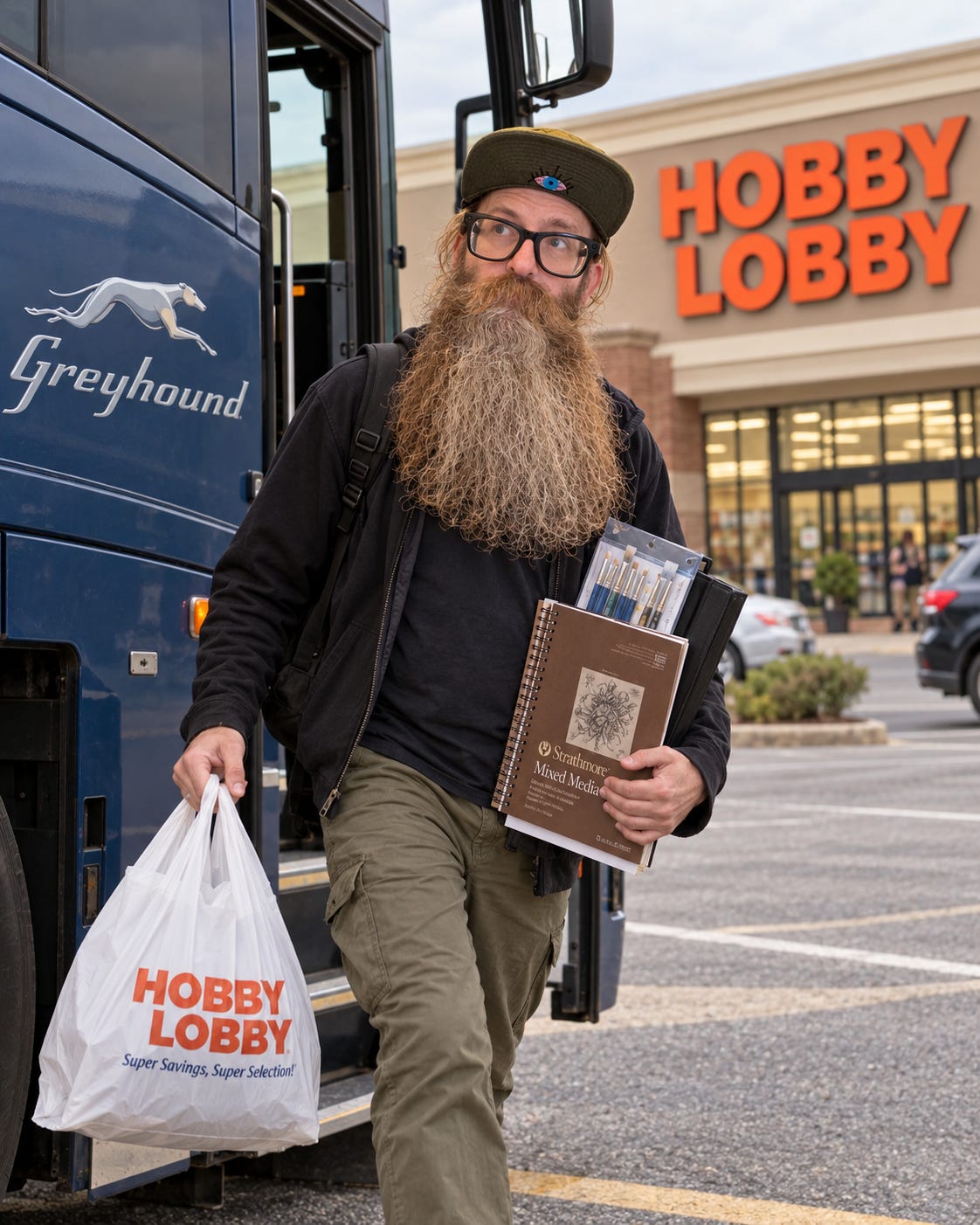
One of my oldest and dearest friends is in town this week. Todd and I have been friends since before the turn of the century, which is a wonderfully dramatic way of saying we’ve known each other for nearly thirty years. We’ve spent the last few days having meals together, enjoying morning coffee, and occasionally just running errands while catching up on life. It’s the sort of friendship where you don’t need an activity to enjoy the company. You can spend an afternoon doing absolutely nothing of importance and still consider it time exceptionally well spent. Unfortunately, his visit is temporary, and I’ll soon return to running errands without someone to talk to about everything and nothing. But before he leaves, he has already managed to help me recognize a rather substantial change in my personal philosophy. All it took was a trip to Hobby Lobby.
We pulled into the parking lot to grab a few art supplies, and Todd looked at the building with what I can only describe as genuine astonishment. “You shop at Hobby Lobby?!?” It wasn’t an accusation so much as a man discovering that someone he’d known for decades had apparently abandoned a fundamental part of his identity. Had I announced that I’d found Jesus, joined the Republican Party, and started collecting assault rifles, I suspect his expression might have been similar. And, given our history, I couldn’t blame him. The person Todd has known for nearly thirty years would never have voluntarily walked into Hobby Lobby, much less considered it a regular stop for art supplies. Yet there I was, preparing to spend money at a business whose corporate values have long been at odds with my own. The funny thing was that until he asked, I hadn’t really considered just how surprising this particular change in behavior might be to someone who had known me for so long.
For most of my adult life, I’ve been something of a professional refuser. Not in the sense that I refuse to do things generally, although my wife might offer a competing assessment, but in the sense that I’ve made a habit of withholding my participation from institutions and businesses whose actions I oppose. When the TSA arrived and airport security became an elaborate theatrical production, I rode Greyhound buses across the country rather than fly. Multiple times. If you’ve never spent an extended period traveling across America on a Greyhound bus, I can assure you that my commitment to principle was tested more thoroughly than the average airport passenger’s luggage. Over the years, I’ve stopped purchasing from countless corporations and businesses for reasons ranging from political disagreements to labor practices to general corporate assholery. I’ve always believed that if our dollars represent our participation in society, we have some responsibility to consider where those dollars go.
I still believe that. But apparently, sometime over the last couple of years, I’ve begun to see another way of putting my money where my mouth is.
When I started painting two years ago, I had a rather simple objective: create as much art as possible. I wasn’t interested in becoming a technically accomplished painter or establishing a recognizable commercial style. I wanted to make things. Paintings, sculptures, objects, strange little artifacts of consciousness. Things that expressed my ideas about existence, humanity, and the peculiar absurdity of being alive. I wanted to explore my own mind and, occasionally, leave something behind that might encourage someone else to explore theirs. More than 150 canvases later, that desire hasn’t diminished. If anything, creating has become one of the primary ways I participate in the world, rather than merely observing and complaining about it. Although, to be clear, I remain exceptionally talented at complaining.
There was, however, a practical problem. Art supplies cost money, and my budget for creating art is somewhere between extremely limited and whatever change I can find in the couch. If I wanted to make as much as possible, I needed to stretch every dollar as far as it would go. That meant finding affordable materials, taking advantage of sales, repurposing discarded objects, and occasionally painting on things that probably never anticipated becoming art. It also meant discovering that Hobby Lobby was consistently one of the cheapest places for me to purchase the supplies I needed. Not only that, but the company remains privately held and family-owned, rather than controlled by one of the private equity firms that have become so adept at extracting value from American businesses. Suddenly, the economic calculation became considerably more complicated than simply deciding whether I liked the religious and political beliefs of the people who owned the store.
To be clear, I don’t. Hobby Lobby’s history of bringing its religious convictions into corporate policy, including its legal efforts concerning employee contraceptive coverage, is not something I support. My objection has never been that the owners are religious. They’re welcome to believe whatever they like. My objection comes when those beliefs are used to influence the rights and choices of other people. That’s an important distinction, and buying inexpensive acrylic paint hasn’t changed my mind about it. But I’ve also become increasingly concerned about the influence of private equity on our economy, the relentless pursuit of extraction over creation, and the transformation of practically everything into an opportunity to squeeze another dollar out of the world. So, when faced with choosing between a family-owned business whose owners hold beliefs I oppose and a more expensive alternative tied to a financial system I also oppose, exactly which principle am I supposed to defend?
And more importantly, what am I actually accomplishing by defending it?
Suppose shopping somewhere else means I can afford to create only forty percent as much art. I’ve successfully withheld a relatively small amount of money from one company I dislike, but I’ve also eliminated sixty percent of my opportunity to make something that might express the very values motivating my opposition. I’ve reduced my creative output, supported an economic arrangement I find objectionable for entirely different reasons, and accomplished what, exactly? The satisfaction of knowing that I personally didn’t contribute to a particular corporation’s revenue? That satisfaction has value, and a boycott can certainly have consequences beyond a single transaction. But when I consider the practical effect of my own decision, I have to ask whether I’m accomplishing something meaningful or simply purchasing the reassurance of having made the morally correct choice.
And that was the realization I found myself explaining to Todd as we walked into Hobby Lobby.
For decades, my primary method of economic protest had been negation. I refused to buy, refused to participate, refused to support. I removed myself from systems I believed were harmful and hoped that enough other people might eventually do the same. There’s value in that approach, particularly when collective refusal can exert enough pressure to produce meaningful change. Boycotts have accomplished important things throughout history, and I have no intention of abandoning them. I’m certainly not going to walk into a restaurant with a “Whites Only” sign on the door because they’ve got a terrific lunch special. Some boundaries remain boundaries, regardless of convenience or price. Refusing to participate in an openly discriminatory institution is itself a meaningful expression of the principle I’m defending. I’m not searching for an excuse to abandon my convictions whenever doing so makes life easier. I’m simply recognizing that refusal isn’t the only way to act on them.
And this is where the paint becomes important, because art supplies aren’t merely the end of a transaction. They’re the beginning of something else.
A tube of paint doesn’t remain a tube of paint. It becomes a painting. That painting becomes an expression of an idea. That idea might become a conversation, and that conversation might encourage someone to reconsider something they’ve always believed. Or it might simply make someone smile, which, given the current state of humanity, is a contribution I wouldn’t dismiss. The same principle applies to writing. Every morning I sit down and attempt to put something into the world that wasn’t there yesterday. Sometimes it’s political, sometimes philosophical, sometimes just an observation about the ridiculousness of everyday life. But the underlying ambition is the same. Rather than simply refusing to participate in the world as it exists, I’m trying to participate in creating the world I’d prefer.
Creation, I’ve come to realize, can be another form of opposition. Refusal says that something should not continue as it is. Creation offers an opportunity to imagine what might exist instead. One withdraws participation from something objectionable, while the other introduces something new into the world. Neither is inherently superior, and neither guarantees change. But both belong in the same philosophical toolbox. The mistake I’d made for much of my life was treating the first as though it were the only tool available.
This isn’t a declaration that the ends justify every means. Nor does it suggest that buying paint somehow cancels out the consequences of financially supporting the business selling it. The money still goes where the money goes. There are real ethical tradeoffs involved, and pretending otherwise would be little more than dressing convenience up as philosophy. I also understand that creating a painting doesn’t guarantee meaningful social change. For all I know, some of my greatest artistic contributions will eventually end up in a dumpster behind a thrift store. But that’s the nature of trying to make things. You don’t control what happens to them once they’re out in the world. You only control whether you give them the opportunity to exist.
What has changed is that I no longer believe abstention must always take precedence over participation. Sometimes the most productive expression of opposition is to refuse. Other times, it’s to create. And sometimes creating requires participating in systems that are far from perfect, because those are the systems available to us. Living in a society means navigating contradictions. There is no magical aisle at the art supply store where every product has been manufactured by fairly compensated workers, distributed without environmental consequences, and sold by a corporation whose owners share my precise understanding of the universe. If there were, I’d probably still complain about the price.
Todd understood once I explained it. His initial surprise made sense because he was measuring my behavior against decades of fairly consistent precedent. But once I described the distinction between refusing to support something and using my resources to create something, he recognized that my underlying values hadn’t changed. I’d simply expanded the ways I was willing to act on them. And I found that enormously satisfying, not because I’d convinced him that Hobby Lobby was a wonderful corporation, but because our conversation helped me recognize something about myself that had been evolving without my consciously noticing it. There’s something rather wonderful about having friends who’ve known you long enough to notice changes in your thinking before you’ve fully recognized them yourself.
I haven’t stopped being opposed to the things I’ve always opposed. I still believe corporations should be accountable for their actions, that money is an instrument of power, and that the ways we participate in our economy have consequences beyond the individual transaction. I still believe there are institutions and practices from which we should withhold our support. I’ve simply added another tool to the arsenal. Instead of relying exclusively on what I can subtract from a world I disagree with, I’m increasingly interested in what I can add to it.
And perhaps that’s the most important change of all. I’ve spent much of my life demonstrating what I’m willing to sacrifice for my principles. Time, convenience, money, and more hours on Greyhound buses than any human being should willingly endure. But sacrifice isn’t necessarily an accomplishment. The value of a principle isn’t measured solely by how much discomfort we’re willing to tolerate in its defense. Surely, at some point, we also have to consider what our commitment to that principle allows us to accomplish. Otherwise, we run the risk of confusing the performance of our convictions with their actual consequences. We become so concerned with demonstrating what we’re against that we forget to participate in creating what we’re for.
I can spend my life trying to avoid every institution whose values conflict with mine, or I can spend more of that life making things that communicate the values I wish those institutions held. Neither approach guarantees progress, and the best answer will always depend on the circumstances. But for the time being, I’ve decided that the opportunity to make another painting, write another essay, or introduce another strange little idea into the collective consciousness is often worth more than the satisfaction of withholding a few dollars from a company that will never know I was missing.
So yes, Todd, I shop at Hobby Lobby.
I buy inexpensive paint from people whose politics I oppose, take it home, and use it to create art expressing ideas they might find thoroughly objectionable. Whether this constitutes an act of rebellion, an ethical compromise, or simply an atheist getting a good deal on acrylics is probably open to interpretation.
But I like to think I’m getting more than my money’s worth.