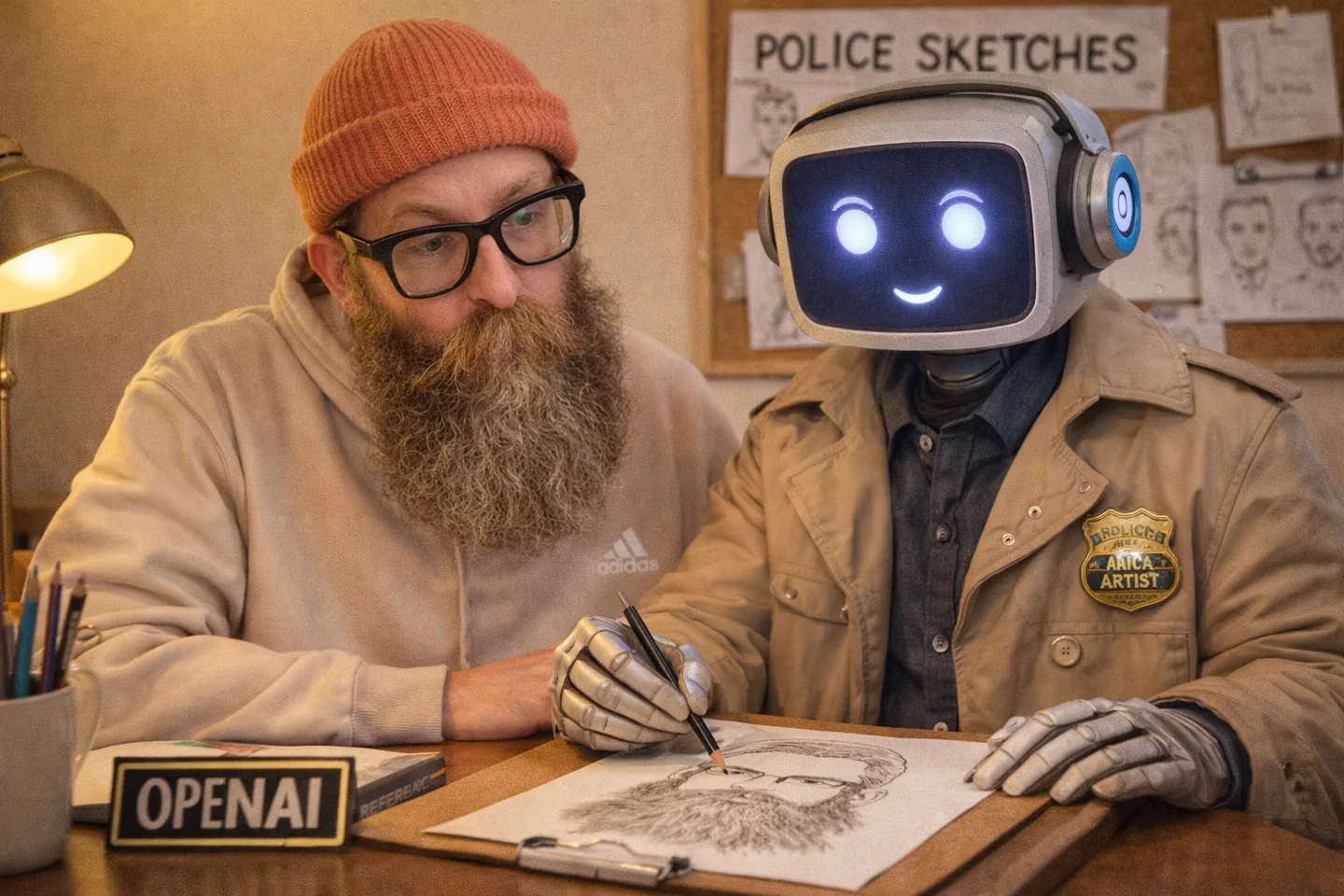
For a long time, I’ve been trying to explain what it feels like to collaborate with a large language model in a way that is actually productive — not gimmicky, not transactional, not simply asking for answers — but genuinely clarifying. The closest metaphor I’ve found is sitting down with a police sketch artist.
You walk into a room carrying an image in your mind. It isn’t a photograph, and it certainly isn’t crisp. It’s more like a blur with emotional weight attached to it. You remember the eyes, maybe the jawline, and definitely the feeling the face gave you. But when you try to describe it, the details shift. “The nose was sharper.” No — maybe softer. “The expression was intense.” Or was it calm? The image exists, but it isn’t stable yet.
The sketch artist doesn’t invent the face. They don’t decide what you saw. Instead, they ask questions, make light strokes on the page, and then turn the drawing toward you. “Closer?” they might ask. You hesitate. “Not quite.” The eyes were wider. The mouth wasn’t that severe. Back and forth you go. With each iteration, something clarifies. The drawing evolves not because the artist is guessing better, but because you are seeing more precisely.
At some point, you lean back and feel it — that subtle internal click, that swelling of recognition. Not because something entirely new has been created, but because something vague has become visible. You say, “That’s it.” The feeling that follows is not pride so much as relief. Relief that the internal blur has finally found an external edge.
This is what effective human and AI collaboration feels like to me. The model is not the originator of the idea, nor is it the author of your thinking. It is the sketch artist. It drafts, reframes, sharpens, and occasionally misfires in ways that are surprisingly useful. Each response forces you to become more precise about what you actually mean. The process works not because the system replaces your thought, but because it externalizes it.
Most people approach language models as answer machines. They ask for conclusions before they’ve clarified the question. That’s like walking into the sketch room and saying, “Just draw whoever you think I saw.” Of course the result won’t feel right. The power isn’t in delegation; it’s in dialogue.
When I bring an idea into conversation — even a half-formed one — I’m not outsourcing thought. I’m watching it take shape outside of me. I’m responding to my own thinking as it becomes visible. Each exchange reduces distortion. Each revision applies pressure to intuition until structure emerges. In that sense, the system doesn’t make me smarter; it makes me more articulate. It forces the fog to condense.
The shift that makes this effective is subtle but important. You don’t have to perform in the room. You don’t have to impress the machine. You don’t have to pretend your thoughts are fully formed. You simply describe what you see as honestly as you can, even if it’s messy or incomplete. “I think it’s about identity, but not exactly.” “It feels like friction, but that’s not the right word.” “There’s something here about getting out of the way.” The draft comes back. You adjust. You refine. You pay attention to what resonates — that somatic swelling when the image matches the memory closely enough that tension dissolves.
Used this way, large language models are not replacements for thinking. They are accelerators of clarification. They are mirrors that move independently, helping you see the edges of what you already carry. The future of working with these systems won’t belong to those who treat them as oracles, but to those who treat them as collaborative surfaces.
Bring a blur. Be willing to iterate. Notice when it clicks. The sketch was always yours; the partnership simply helped you see it.