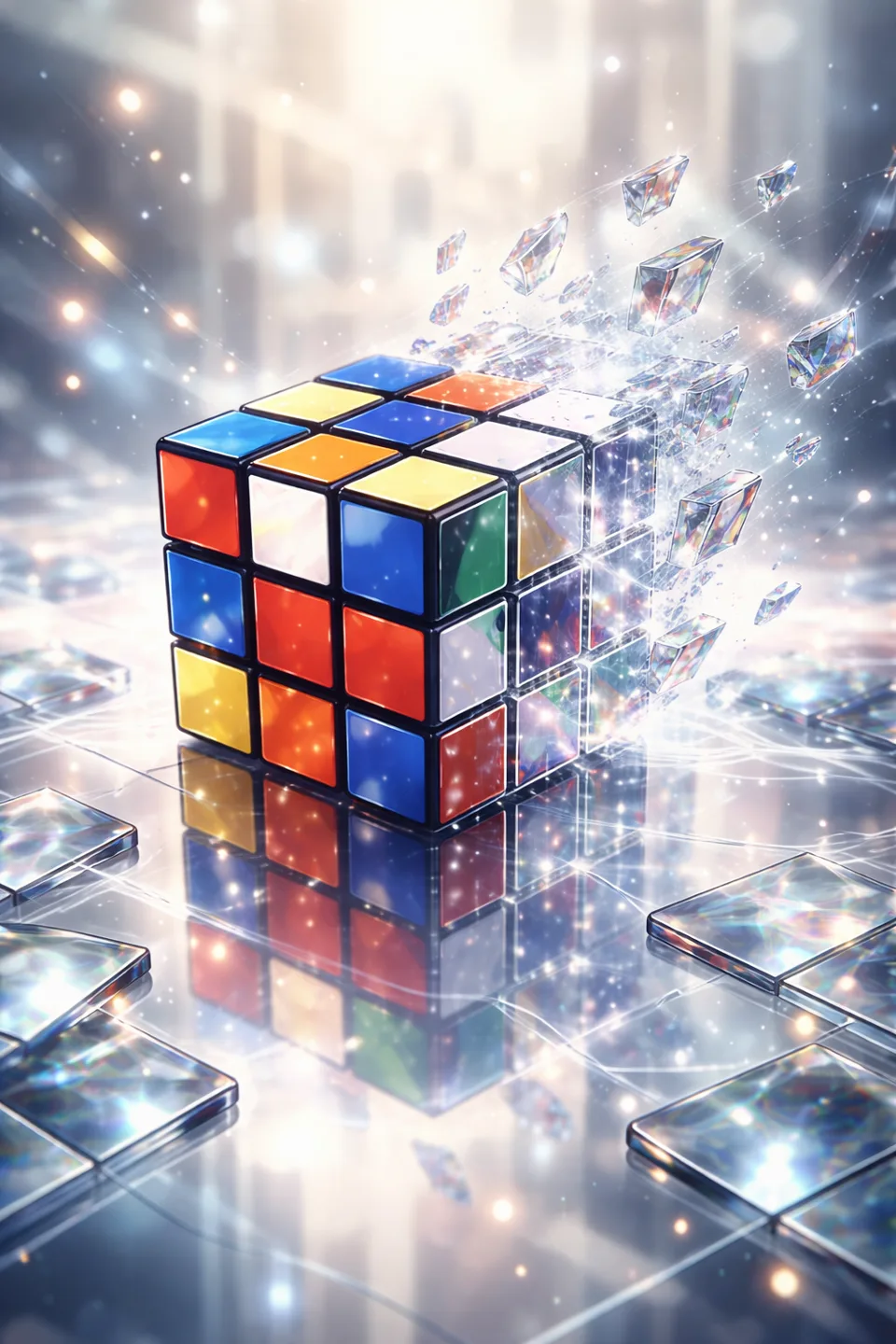
The 3x3 speed cubing world record was broken again recently. By a child. Again. We were sitting around talking when I brought it up, laughing at the absurdity of it. The fastest humans alive at solving one of the most complex combinatorial puzzles ever invented are often under ten years old. The newest record is held by Teodor Zajder — age nine — with a solve time of 2.76 seconds. Nine. Under three seconds. Before most adults can even locate their reading glasses.
As I pulled up the video to show my friend, something came out of my mouth before I had time to think about it. I said that speed cubing seems to be dominated by kids because they don’t yet have the full version of self installed. Their mirror is still developing. The reflection doesn’t get in the way.
The moment I said it, I felt that quiet internal click. There was something there.
Children operate closer to raw pattern recognition. They aren’t narrating themselves in real time. They aren’t thinking about what it means if they fail, or how they look while trying, or whether their performance confirms or threatens some identity they’ve constructed. They are simply turning the cube. The colors move. The patterns resolve. Action flows directly into correction without the extra layer of commentary.
Somewhere along the way, we install a second system. A narrator. A manager of identity. A supervisor who watches us doing the thing while we are doing the thing. It’s useful. It helps us survive socially. It builds continuity. But it also creates drag. The adult mind doesn’t just solve problems — it watches itself solving them. It monitors competence, anticipates judgment, protects reputation, maintains coherence. That overhead is subtle, but it costs something.
Our conversation drifted from cubing to another example: children in China trained on the abacus. At first they need the physical instrument — beads sliding back and forth, tactile and visible. But eventually the tool disappears. They begin moving their fingers in the air, visualizing the abacus internally, calculating at extraordinary speed without anything in front of them. The structure becomes internalized. The interface dissolves. The system runs without the object.
There’s something profound in that. When the representation becomes embodied, the friction drops. When the tool becomes internal, the action becomes immediate.
I started thinking about edge cases — people who wake from brain injuries with unexpected abilities, musicians who suddenly play with fluency they never trained for, hypnotic states where the conscious resistance quiets and behaviors emerge effortlessly. I’m not arguing for supernatural explanations. I’m noticing a pattern. When the narrative self softens, something else seems to move more freely.
Mirror Theory suggests that over time, our reflections harden. We accumulate experiences, feedback, social responses. The mirror thickens. Identity crystallizes. Once it does, every action passes through it. The child turning a cube is just solving a puzzle. The adult turning a cube is solving a puzzle while unconsciously managing what it means to be the kind of person who can or cannot solve a puzzle. The adult is performing the self.
Flow does not like performance.
Athletes describe the zone as a state where “it just happens.” Musicians talk about disappearing into the music. Meditators speak of no-mind. Whatever the language, the pattern is consistent. The less attention devoted to maintaining the story of me, the more directly intelligence seems to express itself.
This isn’t a romantic call to become children again. It’s not regression. It’s refinement. It’s learning to thin the mirror. To recognize that the part of us constantly monitoring identity is not always necessary in the moment of action. That perhaps much of what we call skill is not about adding more cognition, but about removing interference.
The nine-year-old holding a world record in 2.76 seconds is not burdened by what that performance says about him. He is just solving. The abacus master who no longer needs the beads is not thinking about how impressive it looks. She is just calculating. The system runs.
Maybe the real art is not acquiring more layers of self, but knowing when to step aside. To let the deeper pattern-recognition machinery — trained over years of exposure — operate without supervision. To trust that intelligence does not require constant narration.
The self is a powerful tool. But sometimes it is also latency.
And perhaps the practice, as we grow older, is not to build a stronger mirror — but to learn how to make it transparent.