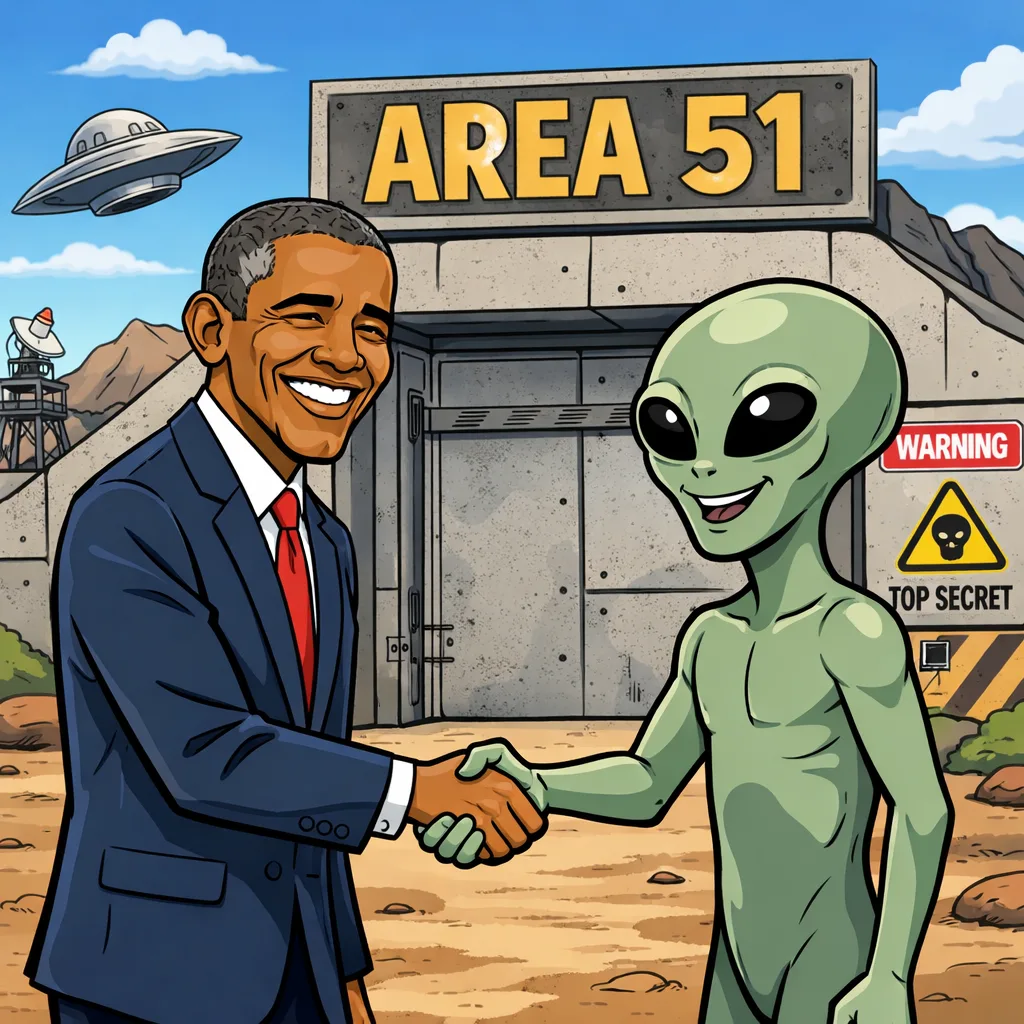
Last weekend, the internet did what the internet does best: it collectively lost its mind. The catalyst wasn’t a UFO sighting, leaked classified documents, or some anonymous whistleblower claiming alien autographs were found in Area 51’s break room. Instead, it was a casually delivered line on a podcast by former President Barack Obama — a line that, if you actually listen to it, says almost nothing more than what any thoughtful person with a telescope and a few years of reading under their belt has already understood.
On the Brian Tyler Cohen show, Obama found himself in a rapid-fire round of questions. When asked if aliens were real, he paused, chuckled, and said something remarkably unremarkable: yes — in the statistical and cosmological sense — but no, he hasn’t seen them, and no, they’re not being stored in a secret bunker somewhere in Nevada. That last bit apparently needed clarification, because the next 48 hours saw hundreds of headlines screaming various permutations of “OBAMA CONFIRMS ALIENS!” accompanied by exclamation points so numerous they required their own oxygen supply.
Once you actually listen to what he said — and what he didn’t say — the whole affair becomes less a revelation and more a mirror reflecting our own collective impulse toward dramatic interpretation. Obama wasn’t tipping a government wink and revealing Roswell conspiracies; he was simply acknowledging scale and probability. He was saying, in effect, that given the unfathomable vastness of the cosmos — billions of galaxies, each with billions of stars and likely even more planets — the idea that Earth is the only seat of life feels less like science and more like an ego-centric assumption.
The punchline blew up not because it was new, but because we want novelty. We want secret files and locked doors. We want evidence, not just possibility. And so the reaction was predictable: memes, TikToks, newsletters burning through their weekly word quotas, podcast hosts shouting into their own echo chambers. Somewhere in Tulsa, someone is probably selling a T-shirt with Obama’s face and a green alien silhouette. Meanwhile, the universe kept its quiet, indifferent spin.
But let’s be honest for a moment. The idea that life — perhaps even intelligent life — exists somewhere beyond Earth is not fringe. It’s not radical. It’s not even speculative in the sense of being unanchored from observation. Modern astronomy has identified thousands of exoplanets, many sitting in their star’s habitable zone. Entire fields of study — astrobiology, planetary science — dedicate themselves to parsing how chemistry becomes biology, and how life, once begun, might persist. If you plug conservative estimates into the famous Drake Equation — adjusting for star formation rates, planetary frequency, and habitable conditions — the likelihood of life elsewhere jumps from possible to probable.
This isn’t a claim that aliens have visited, or that they’re watching us from a lunar outpost. It’s simply an acknowledgement of scale. The universe doesn’t seem engineered for solitude. Given billions of years and countless worlds, the odds favor company. That’s not mystical thinking — it’s probabilistic reasoning.
There are, of course, serious arguments against this optimism. Notable thinkers have proposed that life may be rare, or that intelligence capable of communication might be vanishingly uncommon. Some versions of the so-called Fermi Paradox ask why we haven’t seen clear evidence if others are out there. And those positions are intellectually honest. They grapple genuinely with gaps in our data and limitations of detection. But to dismiss the possibility — let alone the likelihood — of extraterrestrial life as inherently silly because no one has landed a flying saucer on the Mall? That feels more ego-centric than cosmic.
What Obama’s podcast exchange reveals — and what the viral reaction obscures — is a deeper cultural pattern. We conflate statistical likelihood with sensational proof. We assume human significance must be affirmed by exclusivity. And when a public figure says something that aligns with basic astronomical logic, we interpret it as a bombshell. Meanwhile, the real scoop isn’t that aliens might exist. The real scoop is that we are learning to think in terms of vastness and possibility. That’s the real shift — slow, conceptual, and easy to miss in a headline.
So, yes: aliens are “real.” At least in the sense that the universe is too large and too old for life on one planet to be the only spark ever struck. That doesn’t mean they’re living in hangars with government-issued parking stickers. It means that given everything we know, it would be surprising if we were truly alone.
In a cosmos where stars outnumber grains of sand on Earth’s beaches, the boldest claim isn’t that life might exist elsewhere — it’s that anything in the universe could ever be considered unique in the first place.