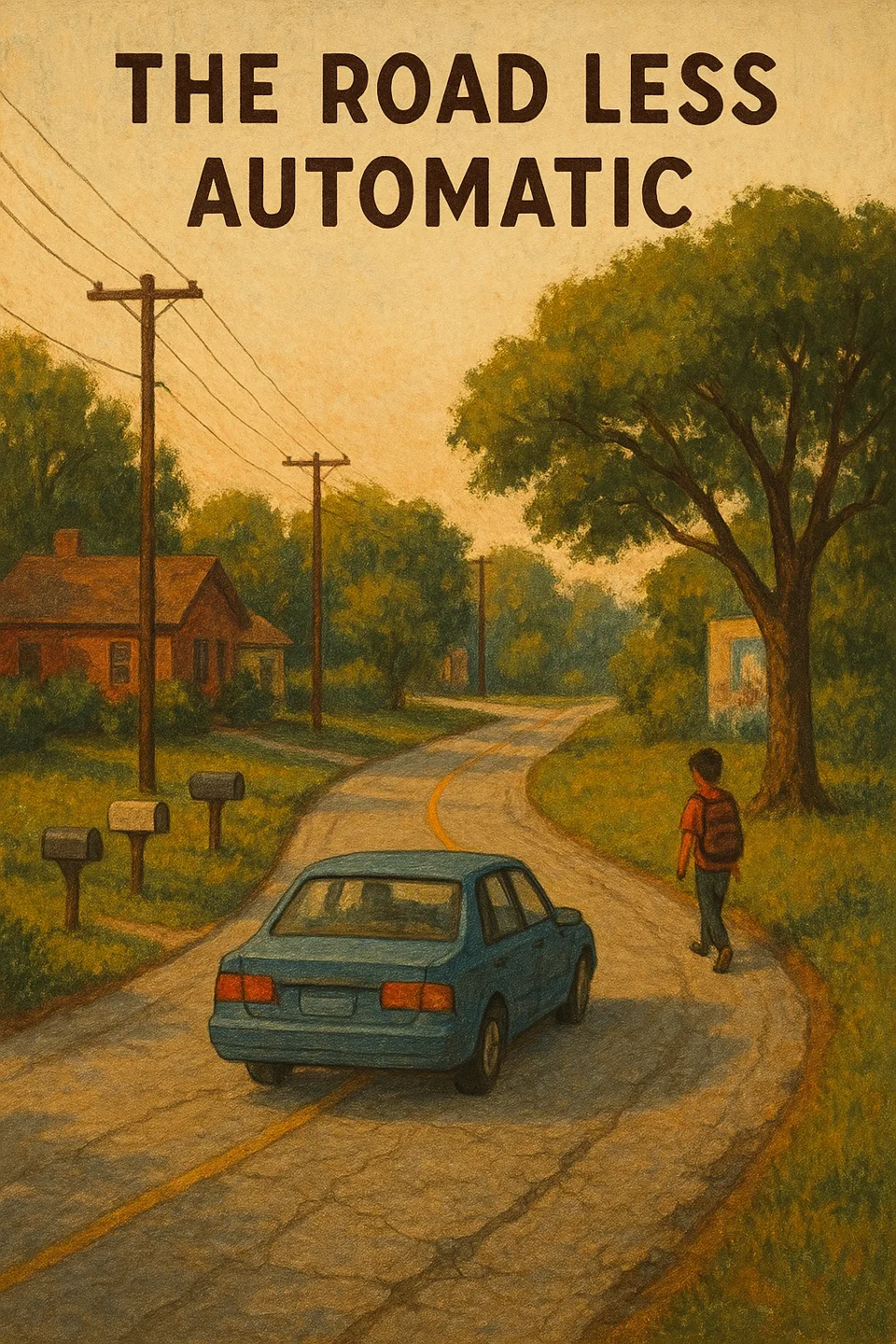
Whenever I drive—whether I’m taking my daughter to school or heading across the city—I take the back roads.
Not because I’m afraid of highways. I don’t fear them—I just don’t enjoy what they represent. Highways are about speed, efficiency, getting there. They ask nothing of you but obedience to the flow. And for me, that’s not enough.
Instead, I choose roads where the speed limit stays under 40. Routes that wind. Streets with character. Paths through neighborhoods most people never think about. They require attention. They reveal the city in small pieces—mailboxes, porches, half-forgotten murals, a kid walking to school with a slouched backpack and a mind somewhere else entirely.
It might take me twice as long to reach a place, but I get something rare: space. Reflection. A temporary release from the pressure to be somewhere, do something, move faster. It’s a time without the world trying to force your hand.
And as each route becomes too familiar, I shift. I move a few streets over. I take turns that feel interesting, even if they’re slower. Especially when I’m alone. Especially when I’m not on anyone’s schedule but my own.
It’s a ritual of sorts. A quiet rebellion against the tyranny of optimization.
When I’m on the back roads, I’m in the world. I see it. I feel it. The day doesn’t start in a rush; it unfolds. I don’t plug into the digital noise immediately. I sit with the analog texture of telephone poles and cracked pavement. These moments are small, but they matter. They remind me that I have a choice—not just in how I get somewhere, but in how I move through life itself. Back roads aren’t just slower. They’re more intimate. They ask something of me. And in return, they give something back: time, presence, reflection.
If you find yourself always defaulting to the fast lane—not just in driving, but in life—I invite you to shift. One street over. One breath deeper. One choice less automatic. You don’t have to flee the highways forever. But every now and then, let yourself wander. Meander. Reflect. See what the world looks like when you’re not just passing through it, but meeting it.
And maybe that’s the deeper thing here—these routes are not just geographic detours. They are mirrors. They show me parts of the city I wouldn’t otherwise see, and in doing so, they show me parts of myself that would go unnoticed if I moved only through efficiency. Mirror Theory teaches that every encounter is a reflection—of values, habits, beliefs, blind spots. These back roads are quiet mirrors, revealing the rhythm I actually want to live in. Reminding me that the fastest path isn’t always the most human one.