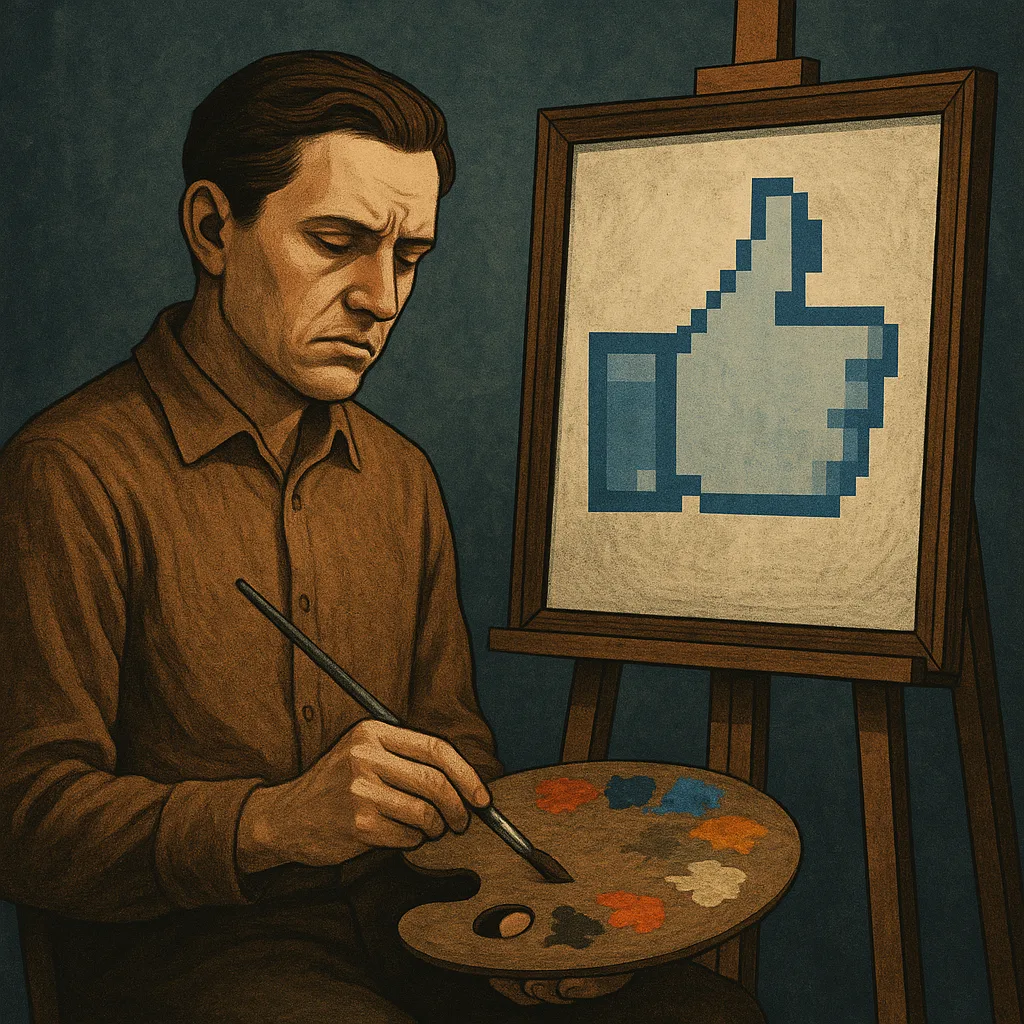
There is a particular kind of death that occurs quietly in the creative soul: the moment you start wondering not what needs to be said, but what will perform well. The scroll begins innocently enough—a glance at what's trending, a tweak to the title, a reframe to make your truth more palatable. But soon, the work is no longer a mirror of your mind. It's a reflection of the algorithm's appetite.
The algorithm rewards engagement, not depth. It elevates the loudest voice, not the truest. And while visibility can feel like validation, it can also be a slow and efficient form of self-erasure. When you create to be seen by a machine, you are no longer creating. You are performing obedience.
Art, at its core, is not meant to be optimized. It is meant to be felt, lived, forced into existence by something deeper than strategy. Your truest work will not trend. It will not be predictable. It will arrive unannounced, inconvenient, and impossible to file neatly into a category. It will resist containment because it was born in freedom.
Through the lens of Mirror Theory, true creative work reflects the self. But when we begin to pander, to curate every thought for legibility in the feed, we cease to reflect ourselves. We become mirrors for the machine—polished, empty, obedient. The very mechanism that could have amplified our voice instead begins to hollow it out.
This doesn’t mean that connecting with an audience is inherently a compromise. Human resonance is the lifeblood of art. The danger lies in creating not for people, but for systems—in allowing the distribution algorithm to dictate the shape and rhythm of your expression. Art shared with others is beautiful. Art shaped by the algorithm becomes something else entirely.
Forcing Theory reminds us that intelligence, and by extension creativity, must either expand or collapse. In this model, to create is to generate novelty—to force the emergence of something that did not previously exist. When we compromise our vision to fit an algorithmic mold, we interrupt this forcing process. Expansion stalls. Collapse begins.
The algorithm collapses novelty into familiarity. It doesn’t want your wildest thought. It wants the closest approximation to what already succeeded. A musician might begin writing choruses to match TikTok trends rather than the natural movement of a song. A writer might change titles to bait clicks instead of letting the piece name itself. A painter might shift from abstract personal visions to palette-pleasing aesthetics that match the platform’s discover feed. These compromises may offer reach—but often at the expense of resonance.
There is a false gospel spreading among creators: that growth requires compromise, that attention is the same as impact, that engagement equals meaning. But these are illusions sold by platforms that harvest your vision to feed their metrics. When you outsource your creative compass to metrics, you are not tracking success. You are measuring self-abandonment.
The work that matters—the kind that expands the mind and unsettles the spirit—will not always perform well. It may be too slow, too quiet, too confrontational. It may ask something of the audience beyond a double-tap. And that is exactly why it matters.
The algorithm is trained on what has already happened. Art lives in what has not yet occurred. If your vision is real, it will not fit. It will disturb. And that is its power.
So write the thing that won't get shared. Paint the image that doesn’t match the palette of the feed. Make the sound that doesn’t resolve. Refuse to be digestible.
Your art is not content. Your vision is not a product. And the algorithm will not save you.
But the part of you that refuses to pander? That part is still alive. That part might just be the beginning of something worth making.
This Substack is reader-supported. To receive new posts and support my work, consider becoming a free or paid subscriber.