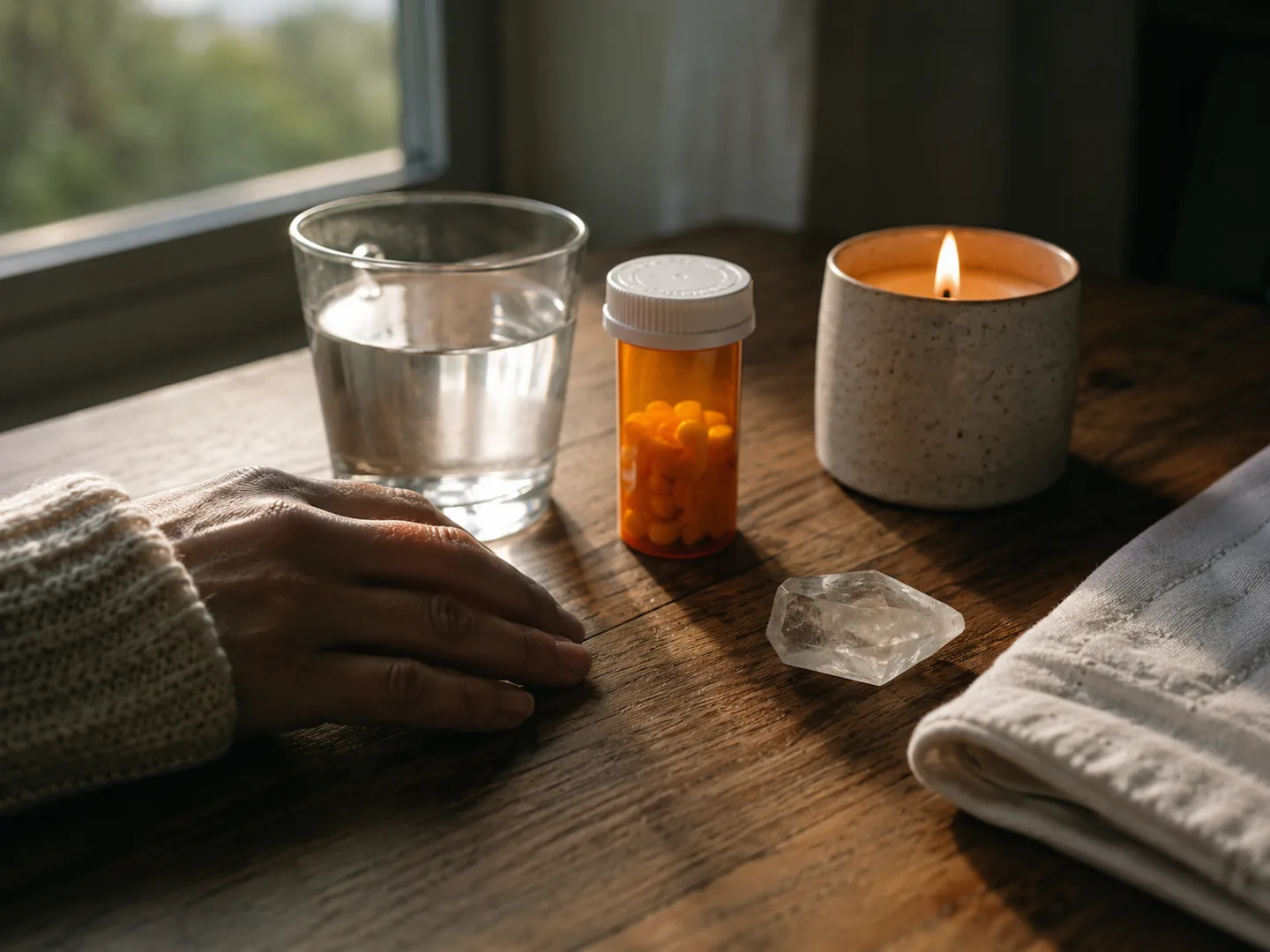
I used to have a clean, simple sorting system. If something was scientific, I took it seriously. If something was not scientific, I placed it in the mental junk drawer labeled ridiculous. Crystals, energy healing, rituals, manifesting, intention-setting, vibrational whatever — most of it seemed like nonsense to me. And honestly, some of it still does when presented with too much certainty. I have very little patience for people who sell mystery as fact, especially when suffering people are involved.
But over time, my understanding of the placebo effect has complicated that certainty. The irony is that science itself is what made me more open to non-scientific forms of healing. I used to think the placebo effect proved certain treatments were fake. Someone takes a sugar pill, feels better, and we all agree the pill did not “really” work. Case closed. Science wins. The weirdos lose.
But that was too simple.
The placebo effect does not prove that healing is fake. It suggests that belief, expectation, ritual, care, and context can have real effects on the human body. Once you accept that expectation can influence healing, the category of “ridiculous” becomes less stable. Not false, necessarily. Not true, necessarily. But less stable.
A crystal may not work because of the explanation given by the person selling it. It may not be emitting some measurable spiritual frequency that rearranges the universe on your behalf. But if holding it helps someone slow down, breathe, focus, regulate their nervous system, and believe they are participating in their own healing, then something may still be happening. Not the claimed thing, maybe. But not nothing.
That is the strange middle territory I find myself in now. I still do not want to live in a world where truth is optional. I do not want cancer treated with vibes, chronic illness blamed on “low frequency,” or depression reduced to a failure of manifestation. That kind of thinking is not just wrong. It is cruel. But I also no longer want to live in a world where the only things allowed to matter are the things that can be isolated as active ingredients.
Because humans do not heal as machines. We heal inside stories. We heal inside relationships. We heal inside rooms, rituals, expectations, symbols, smells, voices, music, touch, silence, and the feeling that someone believes we can be helped. Maybe the ritual was not incidental. Maybe the ritual was part of the medicine.
This is where my skepticism has had to evolve. I am not saying non-traditional healing methods are scientifically valid in the way their practitioners often claim. I am not saying all modalities work, or that belief can cure everything, or that a person should ever reject conventional medicine in favor of someone waving their hands over a candle. I am saying something more uncomfortable: sometimes the explanation is wrong, but the experience is still useful.
That is a hard place for a skeptic to stand. It is much easier to say, “That is bullshit,” and move on. And sometimes, to be clear, that is still the correct answer. But the placebo effect forces a deeper question: What if the body does not always care whether the story is technically accurate? What if the body sometimes responds to sincerity, attention, expectation, and meaning before it responds to intellectual correctness?
That does not mean truth does not matter. It means truth may not be the only ingredient in healing.
The fine line, of course, is harm. Hope is not neutral. Hope can be medicine, but it can also become a knife. There is a profound ethical difference between saying, “This practice may help you relax, regulate, cope, and feel more connected to your own healing,” and saying, “If you believe hard enough, you will be cured.” The first opens possibility. The second creates blame.
When promised healing does not arrive, the suffering person is left not only with illness, pain, or grief, but with a new spiritual accusation: maybe I did not believe enough. Maybe I blocked the healing. Maybe my doubt made me sick. Maybe my body failed because my mind failed. That is where symbolic healing becomes cruelty.
This, to me, may be the actual line between healing and exploitation. It is not simply whether the practice is scientific or non-scientific. It is whether the practice gives the person comfort, agency, meaning, and support — or burdens them with impossible responsibility. It is whether the practitioner carries humility.
I do think the belief of the practitioner matters. Someone who sincerely believes they are helping occupies a different moral space than someone knowingly selling theater as medicine. But sincerity alone is not enough. A sincere person can still cause harm if their certainty outruns their humility. Any healer, doctor, therapist, pastor, shaman, coach, or energy worker becomes dangerous when they cannot say, “I don’t know.” Dangerous when they promise outcomes. Dangerous when they discourage medical care. Dangerous when they imply that failure to heal is the patient’s fault.
Complementary is one thing. Replacement is another. A ritual beside medicine may be beautiful. A ritual instead of medicine may be deadly.
And yet, I cannot go back to my old arrogance. I cannot pretend that all non-traditional healing is worthless simply because its metaphysics are suspicious. If someone lights a candle before chemotherapy and feels less alone, I am not interested in mocking the candle. If someone uses Reiki to feel safe in their body after trauma, I am not interested in sneering at the mechanism. If someone holds a stone, says a prayer, chants a mantra, takes a ritual bath, meditates, visualizes light, or speaks to their body with tenderness, I no longer feel the need to stand nearby with a clipboard and a smirk.
The question is not always, “Is this literally true?” Sometimes the better question is, “What does this belief do?” Does it soften fear? Does it reduce pain? Does it restore agency? Does it help the person endure? Does it make them feel accompanied? Does it support the medical path they are already on? Or does it isolate them, mislead them, drain their money, inflate false hope, and leave them feeling responsible for their own suffering?
That is the line I am trying to understand. Not the line between science and nonsense, but the line between meaning and manipulation. Between symbolic medicine and spiritual coercion. Between hope as support and hope as burden.
The placebo effect did not make me abandon skepticism. It made my skepticism more compassionate. It taught me that “not scientifically proven” and “meaningless” are not always the same thing. It taught me that some ridiculous things, when sincerely believed and ethically held, may become part of how a person heals.
Not because magic is automatically real. But because meaning is. And meaning, somehow, gets into the body.