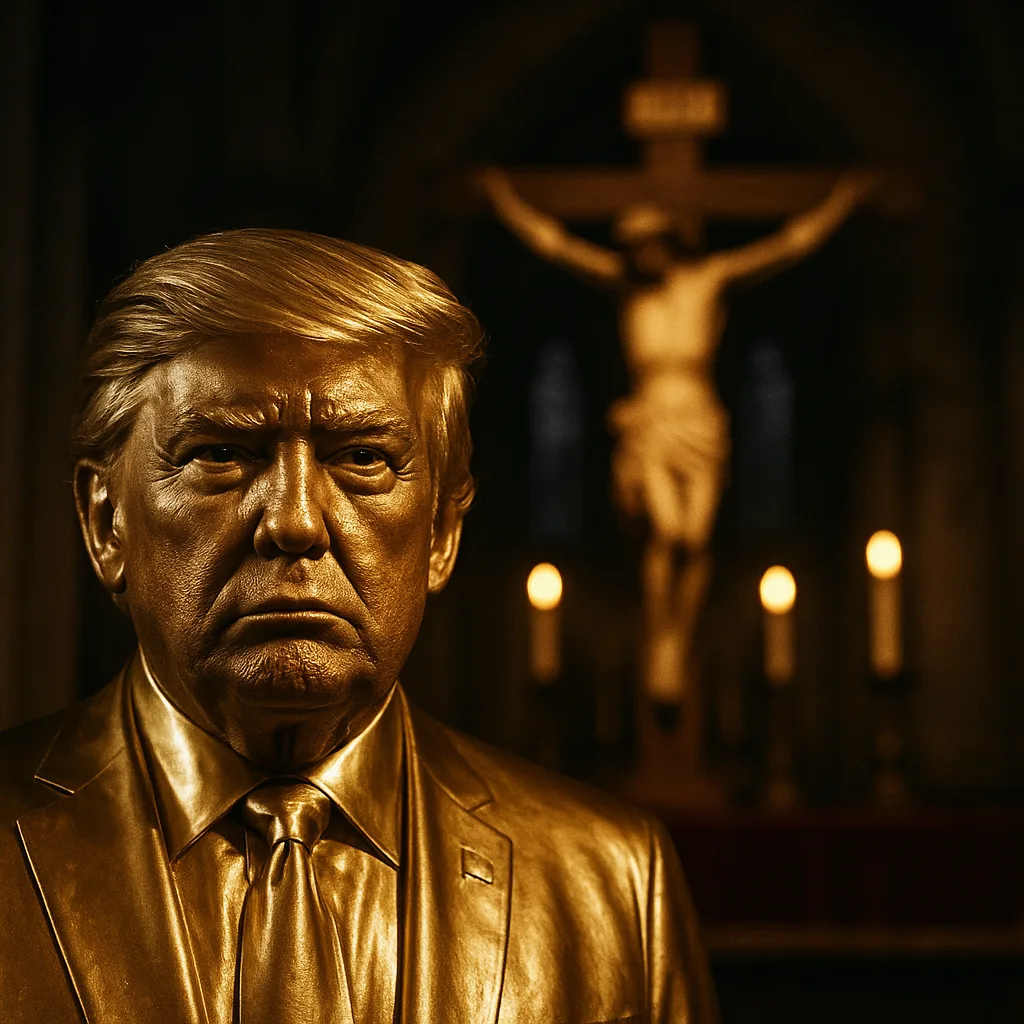
I was raised in the shadow of the rapture. In the small world of Southern Protestantism, the end of days wasn’t a metaphor—it was a map. Every news headline was potentially prophetic, every charismatic leader a candidate for the Beast. We lived in the glow of Left Behind paperbacks and sermon series titled Revelation Unsealed, waiting for signs in blood moons and broken treaties. The Antichrist wasn’t a joke or a curiosity. He was the villain at the center of it all—the deceiver who would lead the world astray.
Decades later, I find myself watching those same believers—now older, louder, and more politically galvanized—worship a man who checks off nearly every box on their own apocalyptic bingo card. Not with fear, but with fervor. Not with caution, but with consecration.
This isn’t prophecy fulfilled. It’s prophecy inverted.
And it’s one of the clearest mirrors our culture has ever held to its own face.
In traditional Christian eschatology, the Antichrist is a master of mimicry. He doesn’t arrive with horns and a pitchfork. He comes cloaked in righteousness, wrapped in signs and wonders, speaking of peace while sowing division. He is, in many ways, Christ-like—but hollow, inverted. The shadow of the savior.
From a symbolic and psychological perspective, this figure doesn’t emerge randomly. He is conjured. Not by Satan, perhaps, but by the collective unconscious of a people who have disowned key aspects of themselves. The Antichrist is not just the villain of Revelation. He is the mirror—the reflection of what a culture most fears in itself, made visible through projection.
This is the heart of Mirror Theory, the lens through which I’ve come to understand both personal growth and cultural collapse. When a group denies its own hunger for power, its latent cruelty, its lust for dominion masked as virtue, it externalizes those drives. It creates enemies. It builds myths. And eventually, it produces a savior who embodies the very things it once condemned.
This is not a new idea. Carl Jung called it the shadow: the parts of ourselves we reject and bury, only to see them resurface in distorted form. In myth, we call it the trickster or the false king. In America, we call it leadership.
The man now adored by evangelical masses is not the Antichrist. But he plays the role better than any figure I’ve seen in my lifetime. He boasts of divine status. He profits from gold coins etched with his face. He praises dictators and mocks the meek. He demands loyalty over truth. And most strikingly—he is not feared by the faithful, but glorified.
What we are seeing is not deception in the traditional sense. It is identification. A fusion of ego and myth, grievance and grandeur. He has become a screen onto which millions project not only their desires, but their entire identity. To reject him now would not be to change a vote—it would be to lose oneself.
This is where things get dangerous. In psychological terms, it’s a collapse of ego boundaries. In mythic terms, it’s a possession. And in the language of Forcing Theory—a framework I’ve developed to explore recursive consciousness—it is a system collapse.
Consciousness, as I understand it, must either expand or collapse. When faced with contradiction, we can integrate—growing more complex, more nuanced—or we can double down, rejecting the contradiction and strengthening the walls of delusion. The latter is what fundamentalism often chooses.
It resists paradox. It fears ambiguity. It requires enemies to maintain cohesion.
When the savior figure violates all the values he was supposed to defend, there is only one way to preserve the identity built around him: invert the prophecy.
Make the corruption part of the plan.
Make the blasphemy a sign of strength.
Make the fall proof that he’s chosen.
This is prophetic inversion. It’s not just theological confusion—it’s a spiritual survival mechanism. It allows the myth to persist even as the facts rot away.
I want to be clear: I don’t believe in the Antichrist. Not as a supernatural entity, not as a puppet of Satan, not as a harbinger of the end times. But I do believe in myths. I believe in their power to shape nations, to warp perception, to form the architecture of both identity and delusion.
And I believe that the Antichrist myth endures—not because it is true, but because it is useful. It gives a name to the hidden desires of a people trained to deny them. It creates a morality play in which the good are always besieged and the evil are always “out there.” It offers a final battle to those who cannot imagine transformation.
But here’s the twist: the Antichrist was never going to come from outside the church.
He was always going to rise within it. Not because evil triumphs, but because unexamined identity always turns on itself. That’s what mirrors do. They reflect what’s there—whether you’re ready to see it or not.
What we need now is not a new prophecy, a new savior, or even a new villain. We need a new kind of seeing. One that doesn’t flinch from contradiction. One that can hold paradox without collapsing. One that uses the mirror, not to admire ourselves—but to dismantle the illusion.
Because the true danger was never that the Antichrist would deceive the world.
It was that we would deceive ourselves—and call it faith.