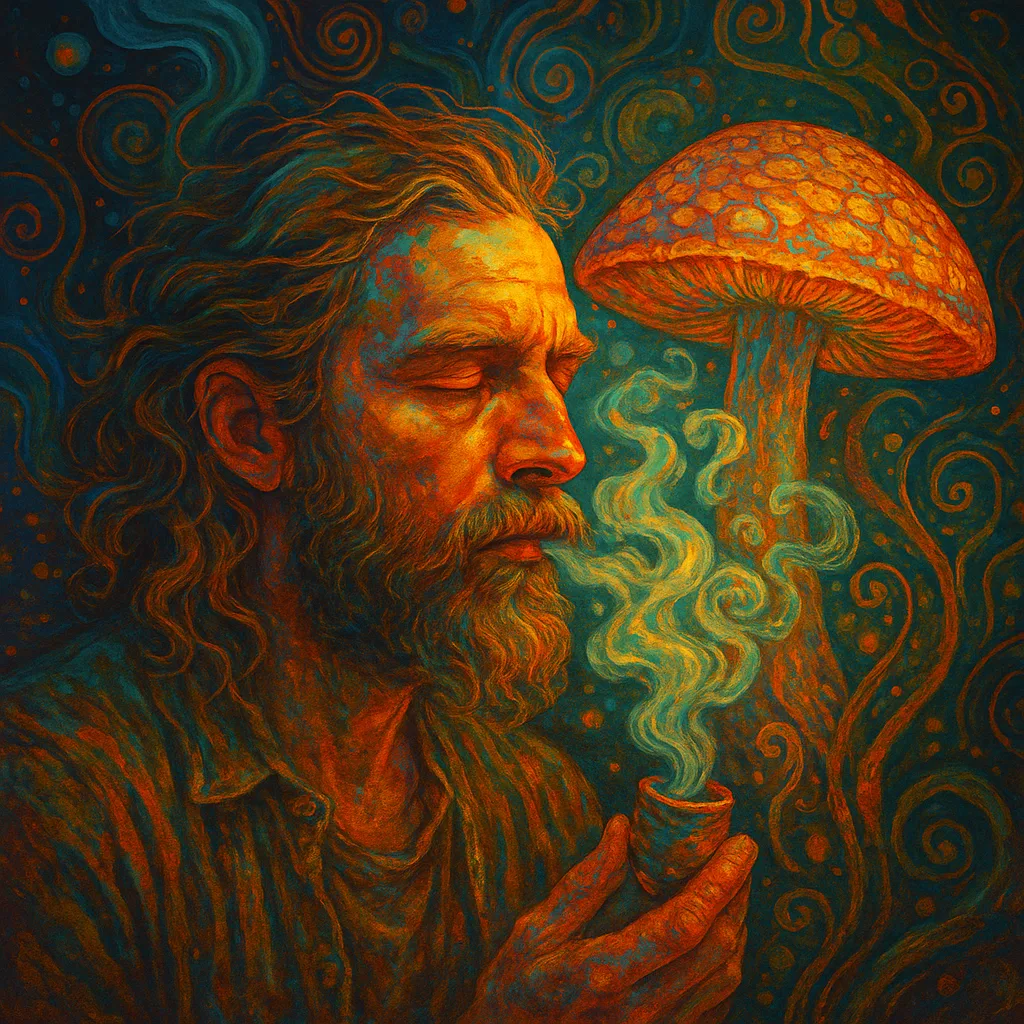
If you're an adult and you're unhappy with your life—take drugs.
I know how that sounds. We’ve been told for generations that drugs are evil, that your brain on drugs is a frying egg, that a single hit or tab or puff will reroute your future toward a tragic montage. But here’s the quiet truth behind the moral panic: many of us are already on drugs. Xanax, caffeine, alcohol, dopamine-chasing distraction cycles, and the slow-drip numbness of routine. We don’t call them “drugs” because we’ve normalized them. We call them survival.
I’m not here to tell you that heroin is safe or that LSD will solve your problems. I’m telling you that for me—and for many others who dared to rupture the veil—drugs were not an escape. They were a confrontation. They were a forced mirror.
There are two broad categories I’ve lived through, bled through, and crawled away from: Ego Drugs and Expansion Drugs. The first—cocaine, meth, heroin—fed the hungry ghosts. They sharpened the edge of need until it cut through my own self-worth. I do not recommend them, though I don’t regret them. What they taught me—about addiction, about illusion, about ego and its frantic grip—I could not have learned in a classroom. They were brutal teachers, but they taught.
The second category—the sacred ones—were something else entirely. Mushrooms, LSD, DMT, ayahuasca, cannabis. These were not escape hatches, but pressure valves. Doorways. Flashlights turned inward. They didn’t rescue me—they dismantled me. They exposed the scaffolding of my mind and asked: Do you still want to live this way? These are not recreational tools; they are initiatory technologies. I do not merely recommend them—I believe, in certain contexts, they should be required.
This essay is not a rebellion. It is a reclamation. A call to deprogram. A declaration that the war on drugs was often a war on consciousness itself. We were never meant to sleep through life. And if it takes a mushroom in the forest or a hit of something sacred under a dark sky to wake you up—so be it.
You’re allowed to wake up, even if it’s not the way they told you to.
The Wounds We Try to Escape
I didn’t start doing drugs to transcend—I started because I was in pain. Existential pain. Identity pain. The kind of ache that lives in your bones and convinces you that something’s wrong with the very structure of reality. So I reached for what the world offers to the wounded: speed, powder, smoke, needles. Ego drugs.
Cocaine gave me godhood—fleeting, frantic, hollow. I bought it by the key and burned through it like a man trying to keep his soul from freezing. Meth turned the volume up on everything until nothing made sense anymore. Heroin? Heroin was the closest thing to disappearing without dying. Each one promised a different flavor of relief, and each one taught me the same truth in the end: there is no substance strong enough to outpace the self you’re trying to avoid.
But I don’t regret it.
Not because it was glorious—it wasn’t. It was paranoia and teeth-grinding and whispered deals and days lost in a blur. But it was also data. It showed me the architecture of my suffering. Each drug became a mirror that reflected the precise shape of my escape attempts. Cocaine said, you crave control. Meth said, you don’t think you’re enough unless you’re producing. Heroin whispered, you’re tired of being alive.
None of these were new wounds—they were childhood echoes, cultural viruses, inherited stories dressed up in neurochemistry. And drugs, for all their destructiveness, made them undeniable. That’s what I mean when I say I learned from them. Not in some sanitized, redemptive arc—but in the raw, collapsed spaces where I finally had to admit: this isn’t working.
Mirror Theory tells us that every experience, no matter how chaotic, reflects something about the self. These ego drugs didn’t lie to me. They just spoke in the language of pain. They showed me what I believed about my worth, about pleasure, about freedom. And they did it without mercy.
There’s a kind of sacred honesty in that.
Ego drugs won’t save you. They’re hungry. They’ll eat everything you love and then ask for more. But sometimes, when you’ve been starving for too long, even poison can taste like nourishment. And if you survive—if you really survive—you come back with something that the clean and sober world often lacks: clarity about what you were running from.
And if you’re lucky, that clarity becomes a key. Not to more escape—but to the next door. The one you never dared to open because it leads directly inward.
Expansion Drugs and the Reclamation of Consciousness
There is a point when the hunger for escape gives way to a hunger for understanding. That’s when Expansion Drugs enter the story—not as quick fixes, but as portals.
I remember the first time psilocybin took me apart. Not gently. Not like a therapist with a clipboard. More like a cosmic comedian tearing up the script of my identity, laughing as I watched myself dissolve into fractal absurdity. I sat by a lake at a neighborhood park and became one with the entirety of creation. Ducks floated past like holy messengers. The air itself shimmered with intelligence. Nothing was separate, and nothing was personal—and for the first time in my life, that felt like peace.
These aren’t drugs in the way we’ve been taught to think of drugs. They are technologies of perception. Organic keys. Nervous system revelations. Mushrooms, LSD, DMT, ayahuasca—they don’t feed the ego. They dismantle it. If ego drugs say you are more, these say you are not what you think you are.
Cannabis, too—when treated with respect—is a gentle teacher. A mood-sensitive spirit. Too often dismissed or overused, but in the right space, it becomes a magnifying glass for the soul. It can reveal your loops, your love, your avoidance. A psychedelic in slow motion.
What these substances do is initiate a phase transition—a recursive energetic leap. Consciousness, under their influence, does not merely expand—it forces itself into new terrain. Old thought structures collapse. New insights form like quantum snowflakes, each one impossible to describe yet instantly felt as true.
And yes, there are dangers here. Mental instability. Trauma resurfacing. Disorientation. But those dangers are not flaws in the system—they are features of a medicine that doesn’t anesthetize. These drugs are not entertainment. They are catalysts.
The real gift, though, doesn’t happen during the trip. It happens after—during the integration. In the days or weeks when you try to make sense of what the forest said to you, or what it meant when the serpent whispered forgiveness into your gut. That’s the work. That’s where the alchemy is.
Expansion drugs don't give answers. They dissolve the walls around your better questions.
And once you’ve heard your own voice echoing through the void and found that the void was listening—you don’t go back. You carry that silence, that sacred disorientation, with you. Not like a memory. Like a map.
Psychedelics as Obligatory Experience
We live in a culture starved of initiation. There are no vision quests, no rites of passage. We graduate, maybe. We drink. We get jobs. But no one hands us a symbolic death and says: “You are no longer who you were.” And because of that, many of us stay children—emotionally, spiritually—wandering through adult lives in bodies we haven’t fully inhabited.
Psychedelics are one of the few remaining doorways to genuine initiation.
They strip you bare. They confront you with your own mind—unfiltered, unmasked, and unmerciful. And then, if you surrender, they offer something else: communion. With self. With source. With the raw architecture of reality.
This isn’t optional, in the deepest sense. It’s not recreational. It’s not even therapeutic, though it can be healing. What these experiences offer is existential literacy. They let you see—and once you’ve seen, you are responsible for the seeing.
I believe every adult, at some point in their life, should sit with a true expansion drug in a safe, intentional space. Not because it’s trendy. Not because it’s a shortcut. But because it is one of the only mirrors clean enough to show you what’s real beneath the noise. For some, meditation may be enough. For others, extreme grief or awe cracks the shell. But psychedelics? Psychedelics hand you the hammer.
This doesn’t mean they’re universally safe. Some people shouldn’t take them. Others need guidance. But the idea that they should be criminalized, demonized, or feared wholesale is a tragedy of cultural conditioning. We banned the sacred. We outlawed communion. And in doing so, we forced millions to seek transcendence in numbing rather than knowing.
There is a difference between getting high and getting free.
And freedom isn’t always bliss. Sometimes it's terrifying. Sometimes it means watching your carefully constructed personality disintegrate into a field of light and silence and unbearable presence. But on the other side of that dissolution, many find the thing they didn’t know they were missing:
Belonging.
Not to a tribe or a system or a belief. But to existence itself.
That is the gift. That is the obligation.
A Culture Addicted to Numbness
We like to pretend that drug use is a fringe behavior. That addicts are the outliers. But take a step back and look at the culture: this entire society is addicted.
Addicted to distraction. Addicted to productivity. Addicted to control, to convenience, to a curated sense of safety. We drug ourselves every day—with caffeine to wake up, alcohol to wind down, screens to avoid silence, noise to avoid thought. Antidepressants prescribed like aspirin, wine nights marketed as self-care, corporate happy hours as state-sanctioned anesthesia.
We don’t fear drugs. We fear feeling.
The real epidemic isn’t heroin. It’s disconnection. From nature. From mystery. From grief. From each other. From the slow, aching, beautiful truth of our own existence.
And here’s the twist: the people we call “addicts” are often the ones most sensitive to that absence. They feel the void more acutely. And in the absence of initiation, of ritual, of collective meaning—they go searching. The tragedy is not that they take drugs. The tragedy is that they do so alone, without tools, without integration, in a society more interested in punishment than healing.
We punish the symptom while feeding the cause.
We fund wars on drugs while ignoring the violence of soul-splitting systems. We lock people in cages for seeking altered states, while celebrating billion-dollar industries built on sedation. If someone drops acid in the forest, they’re a criminal. If someone drinks five bourbons watching commercials for trucks and fast food and antidepressants, they’re a normal adult.
This is absurdism in action.
And the only sane response to absurdism is art, truth, or transformation.
Expansion drugs, when approached with intention, are not the escape. They are the antidote. Not because they fix everything, but because they reveal everything. They show you that numbness is not neutrality—it’s a condition. And it is not your natural state.
You were meant to feel.
Toward Conscious Recklessness
I’m not telling you to do drugs. I’m telling you to wake up.
And for some of us—for many of us—the first real glimpse of truth came not through sermons or self-help, but through smoke, spores, and sacrament. Through a molecule that shattered the mirror just long enough for us to see the room we were in.
This is not about glamour. It’s about gravity. The gravity of living fully. The gravity of feeling everything we were taught to avoid.
Expansion drugs don’t give you a better life. They give you a clearer one. And sometimes clarity hurts. Sometimes it breaks you. But if you let it—if you stay with the fragments, if you stop running and simply listen—you will begin to assemble something stranger and more honest than what came before.
This is what I call conscious recklessness: not chaos for its own sake, but a sacred willingness to risk knowing. To crack the shell of identity. To trade certainty for presence. To ask better questions, even if the answers undo you.
Because what’s the alternative? Another year of quietly dying behind polite smiles? Another round of numbing routines and scrolling nights? We don’t need more discipline. We need more directness. More mirrors. More holy disruption.
Take the trip. Face the void. Smoke the plant. Swallow the key. Not because it will save you, but because you are worth saving, and somewhere inside you already know the way. These medicines, these molecules, these sacred poisons—they are not shortcuts. They are reminders.
You are not separate.
You are not broken.
And you are not alone.