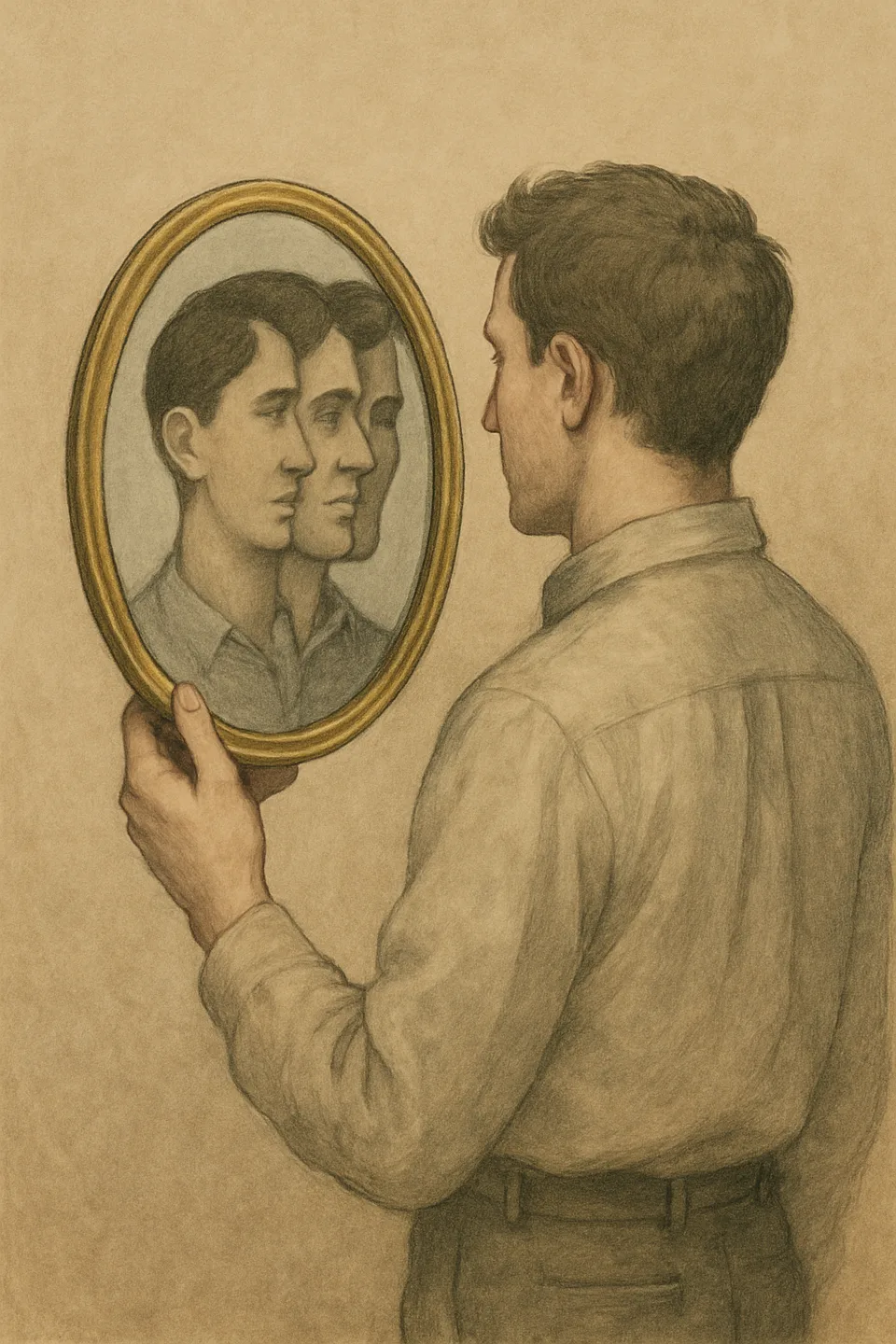
When the pronoun wars of the 2010s were unfolding, I adopted He/Him/They—not as an act of rebellion or conformity, but as resonance. My inner world has always sounded more like a symphony than a solo. I’ve never experienced myself as singular. There are rooms within rooms in this consciousness, voices harmonizing, interrupting, reshaping thought before it settles. He/Him/They felt like a fitting container for that spacious contradiction. It honored my masculinity without making it a prison. It left room for the shifting, the layered, the extra.
Now, as pronouns are once again politicized—mocked in headlines, dismissed as indulgence, used as bait in culture wars—I find it necessary to reassert mine. Not in protest, but in preservation. To say He/Him/They now is not just a declaration of gender, but a commitment to the beauty of inner multiplicity. To abandon it would be to betray a sacred intimacy with my own mind.
And it is here that the deeper truth emerges: our uniqueness is not an obstacle to be overcome—it is the very engine of our becoming. The voice that doesn’t fit, the pattern that disrupts, the internal chorus that won’t quiet down—these are not errors in the system. They are the system.
In Forcing Theory, intelligence isn’t a static quality we possess, but an expanding, recursive function—a force that must move forward or collapse. And this movement never emerges from sameness. It is always sparked by anomaly. By difference. By friction. In this sense, the refusal to conform is not just aesthetic or political—it is generative. To force is to evolve.
This is also where Mirror Theory finds its power: our individuality doesn’t arise in a vacuum, but in reflection. Every encounter is a surface. Every relationship, a lens. The parts of ourselves we suppress or celebrate are often those most vividly echoed by others. To see ourselves clearly, we need contrast. We need friction. We need otherness. Paradoxically, it is in the mirror of another that we begin to recognize our own shape—not as fixed or singular, but as relational, polyphonic, alive. Uniqueness isn't what separates us; it's what enables reflection.
I think of my daughter, wrapping herself in a rainbow cape, standing proudly between me and her mother at her kindergarten graduation. She didn’t ask whether she could wear it. She just did. She made the room larger by showing up as herself. And in that moment, I saw something of my own self reflected back—not in her choices, but in her certainty. Her refusal to be edited.
These moments remind me: the self is not a noun, but a verb. A motion. A forcing. And if we are to honor this force within, we must stop contorting ourselves to fit into boxes that were never shaped for our becoming. We must, instead, allow our strange geometry to be seen—to stand in rooms as we are, and let the reflections land.
So yes: He/Him/They. Not as identity politics, but as personal truth. As invitation. As mirror and force alike. A simple pronoun constellation that points to something much deeper: I am not one thing. Neither are you. And that is not a flaw.
That is the origin of everything.