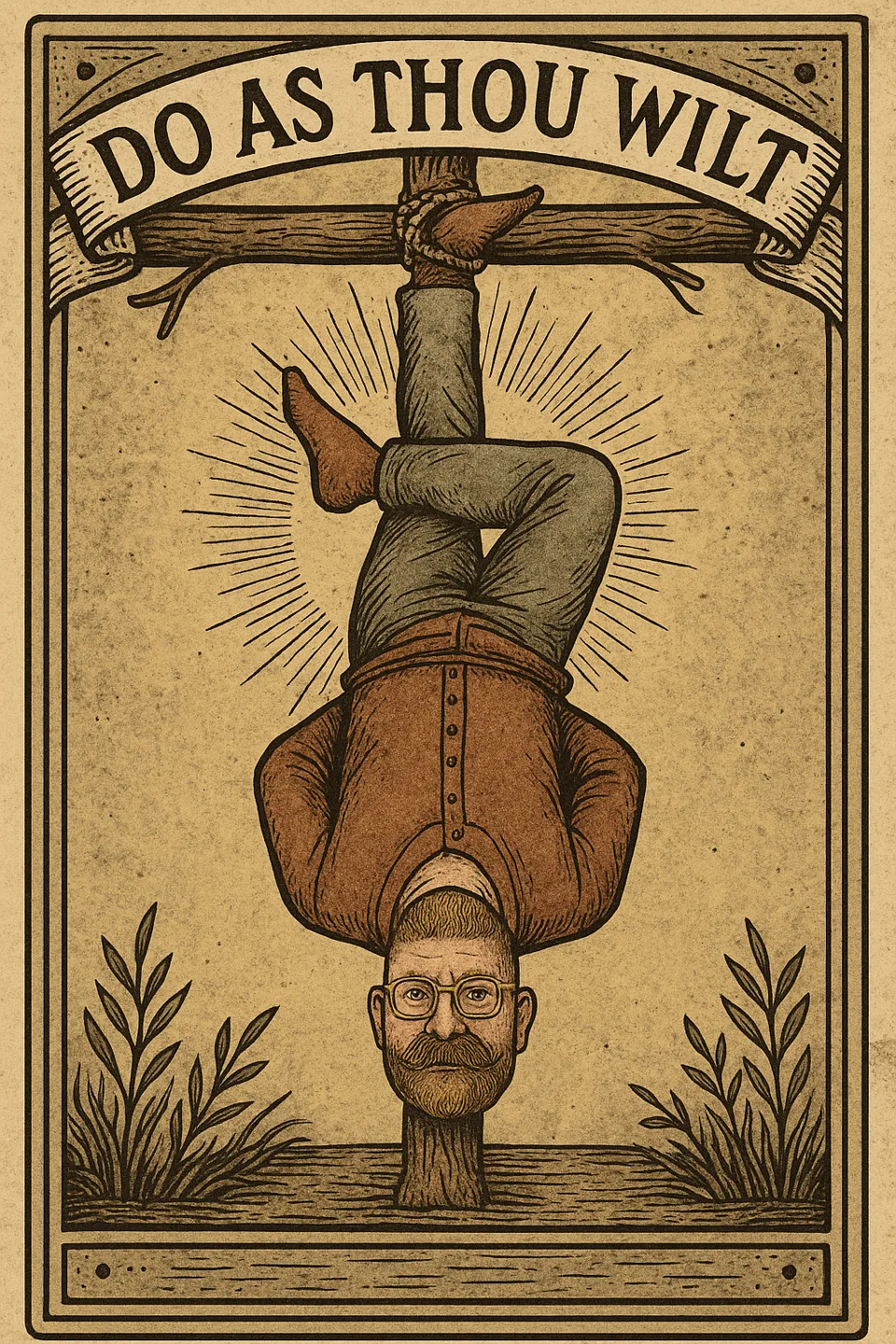
There was a time in my life—during a decade I now refer to as my “Atheist Occultist” phase—when Aleister Crowley’s phrase “Do as Thou Wilt” struck like lightning. It felt dangerous, liberating, even sacred. A permission slip to shrug off the inherited weight of expectation and finally live in alignment with myself, on my own terms. At first, I read it as an invitation to do whatever I pleased. To follow pleasure, ignore constraint, and tear down the structures that told me how to behave. And there was power in that. There still is.
My friends and family know: if I do something with or for you, it’s because I want to. Not because I should, or because I’m expected to. That kind of integrity still feels sacred to me. But over time, something else started stirring beneath that initial thrill of rebellion. A tension. A subtle weight pressing from below the surface of desire.
The deeper I went, the more I began to notice that what I wanted in the moment often conflicted with what I needed in order to become the person I was trying to be. The phrase began to change. Do as Thou Wilt stopped being about indulgence and started pointing toward something more exacting. It wasn’t “do what feels good.” It was “do what is aligned.” And that shift changed everything.
I started paying attention to the layers of desire. On the surface: cravings—sugar, escape, dopamine, distraction. Loud and immediate. But underneath that noise lived a quieter signal. Something like trajectory. Something like meaning. I realized that my true will often required actions I didn’t enjoy in the moment—early mornings, uncomfortable conversations, letting go of easy habits. But when I understood that those steps were in service of a greater desire, a kind of mental clarity emerged. A strange, internal power. It became easier to stop behaviors that felt good but pulled me away from what I actually wanted over time. That didn’t feel like sacrifice. It felt like sovereignty.
I started to see that freedom isn’t ease. Real freedom is friction—chosen, meaningful friction. The kind that comes from willingly bearing the weight of your own direction. Not because someone told you to. Because you finally know where you’re going.
That’s when the mirrors showed up. Patterns in relationships, in triggers, in recurring obstacles. These weren’t interruptions. They were reflections—evidence of the gap between my surface desires and my deeper will. Mirror Theory helped me name it: the world doesn’t show you what you want; it shows you what you need to face. And in that reflection, I began to hear the Self-Daemon stirring—the older, quieter part of me that had always known.
I stopped asking, “What do I feel like doing?” and started asking, “What wants me to want it?” Because wanting is slippery. But willing—that’s different. Willing is geological. It’s the force that carves through rock over time.
In my current work on Forcing Theory, I describe consciousness not as a trait, but as a recursive force. Awareness expands or collapses depending on whether it is forced—challenged, stretched, pushed through thresholds. That’s what true will is: not expression, but expansion. Not comfort, but coherence.
And so, ironically, “doing as I wilt” now means doing the hard thing, the disciplined thing, the aligned thing. Not because I’m being “good.” Not because I’m denying myself. But because I’ve seen the map. I know the mountain. And I’m walking toward it.
There’s still room for pleasure. Still room for spontaneity and rest. But I no longer mistake every impulse for truth. The deeper joy—the one I trust now—comes not from following every fleeting desire, but from living in rhythm with the person I’m becoming.
The phrase Do as Thou Wilt has aged with me. It’s no longer a slogan. It’s a compass. A challenge. A whisper.
And when I don’t feel like writing, stretching, cleaning, building—I do it anyway.
Not because I should.
Because I will.