Lately, I’ve been thinking about beauty. Not beauty as in art, or nature, or the strange way light hits a wall at the right time of day. I’m not even talking about style. I love style. I love when someone’s outward form becomes an honest extension of their inner world. What I’m talking about is something quieter and more poisonous: the subconscious need to be perceived as beautiful.
There is a difference between aesthetic expression and aesthetic dependence. Aesthetic expression says, “This is how I feel alive in form.” Aesthetic dependence says, “I need you to approve of this form so I can feel real.” The first is play. The second is bondage. The first is a person wearing a wild shirt because their soul apparently had opinions that morning. The second is a hostage negotiation with the invisible audience.
The desire to be viewed as beautiful turns the self into a transaction: I will shape myself into something pleasing, and in return, you will give me value. This is where the trap begins. We start checking the mirror not to see ourselves, but to predict the gaze of others. We dress from strategy instead of joy. We groom from fear instead of care. We become curators of our own acceptability, constantly adjusting the exhibit for an invisible audience that, frankly, has terrible taste and no consistent rubric.
And the invisible audience is never satisfied.
Most of us do not consciously choose this prison. We inherit it. We absorb it through culture, family, advertising, romance, rejection, comparison, adolescence, and a thousand tiny moments of being rewarded or ignored. We learn which versions of ourselves receive warmth. We learn what gets complimented, mocked, desired, or erased. Then we call those lessons taste, which is adorable in the way humans are adorable right before we ruin our own afternoon.
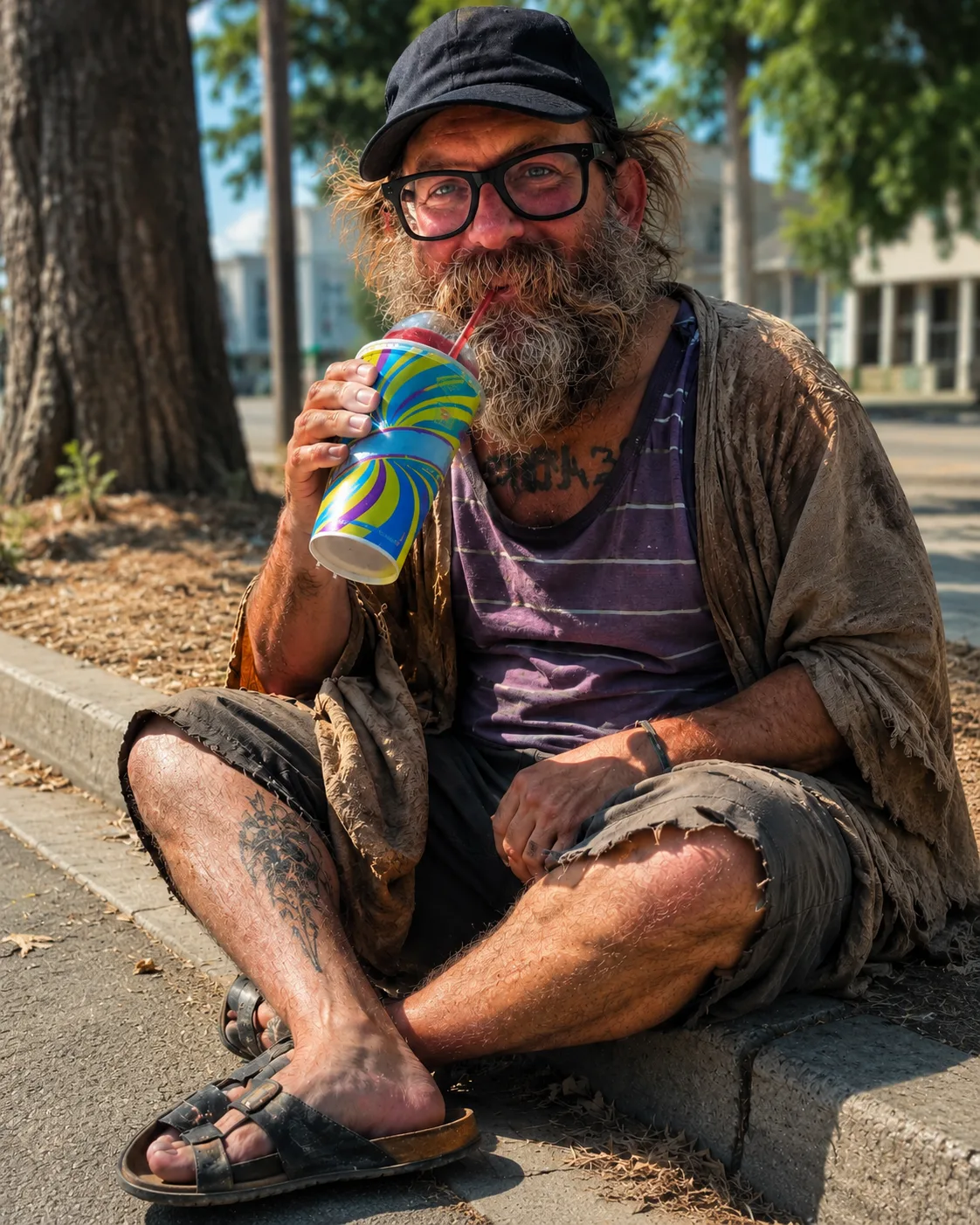
Lately, in my own strange way, I’ve been experimenting with stepping outside the contract. I have been wearing the same outfit. I have been letting my hair and beard grow increasingly disheveled. I have allowed myself to become, by normal standards, less polished. Maybe I look like a man in the middle of a mild spiritual crisis. Maybe I look like a retired wizard who lost his comb in an argument with God. Maybe I look like someone who has been asked to leave a very casual monastery. Maybe I look like exactly what I am: a person trying to stop spending energy on the wrong altar.
Somewhere in the corner of history, I imagine Diogenes nodding.
Diogenes, the ancient Greek philosopher and professional nuisance, seemed to understand something most of us spend our lives avoiding: civilization is very good at convincing us that its rules are nature’s rules. He rejected status, comfort, politeness, and social performance with the energy of a man who had looked directly into the machinery and decided the whole thing was ridiculous. He lived with almost nothing, mocked the powerful, and treated respectability like a contagious disease.
I am not Diogenes. Let’s be very clear. I still enjoy air conditioning, snacks, streaming services, and the occasional compliment. I am not living in a barrel, shouting at aristocrats, or carrying a lamp around town looking for an honest man. My rebellion currently includes wearing the same outfit too often and letting my beard become a small woodland concern. This is not exactly heroic. But there is something in his gesture that feels relevant: the refusal to let society define the terms of a meaningful life.
And yes, I understand that living with this person is its own spiritual practice. My wife has endured twenty-six married years of my eccentricities, which is a gentle word for whatever strange experiment Z is currently conducting on his body, mind, wardrobe, schedule, philosophy, diet, creative process, and possibly the household atmosphere. She has loved me through many versions: polished versions, chaotic versions, entrepreneurial versions, mystical versions, depressed versions, over-caffeinated idea-goblin versions, and now apparently the “same outfit and feral beard” version. That kind of love deserves either a medal, a grant, or at minimum a quiet room where no one is explaining consciousness to her before breakfast.
There is freedom in it, though. Not because everyone needs to wear the same clothes every day or let their beard become a small ecosystem. Dishevelment is not morally superior to looking good. That would just be another costume, another ego game wearing a thrift-store robe. The freedom is not in looking unpleasing. The freedom is in no longer needing to be pleasing.
That difference matters. The person who rejects beauty can become just as attached to the image of rejection as the person who pursues beauty is attached to desirability. The “holy disheveled man” can become its own aesthetic. The refusal can become a brand. The ego will build a throne out of anything, even renunciation. Give the ego a burlap sack and three days without shaving and it will start calling itself a prophet.
So I do not want to pretend this experiment makes me pure. It does not. I still care. I still notice when I am seen. I still have an ego that occasionally peeks out from behind the curtain and asks whether people think we’re interesting. Fine. Let it ask. The point is not to destroy the human need to be seen. The point is to stop confusing being seen with being approved of.
This is where the whole thing starts touching whatever we mean by enlightenment. I use that word carefully, and with a little suspicion. “Enlightenment” can become absurd almost immediately. People start saying it and suddenly everyone is barefoot, speaking slowly, and pretending not to be annoyed by traffic. The performance of transcendence may be the funniest ego costume of all. But if enlightenment means anything useful, maybe it has something to do with locating the self somewhere deeper than the gaze.
Diogenes was not trying to become beautiful. He was not trying to become impressive. He was not trying to optimize his personal brand, soften his lighting, or establish a cohesive visual identity. He was trying, in his outrageous way, to become free. Free from convention. Free from false needs. Free from the constant pressure to arrange oneself according to the expectations of people who had mistaken obedience for virtue.
That is the part I keep circling.
How much of what we call “being presentable” is really just obedience? How much grooming is care, and how much is fear? How much style is expression, and how much is strategy? How much of our appearance is chosen freely, and how much is shaped by an invisible crowd we claim not to believe in but still secretly obey?
This does not mean rejecting adornment, pleasure, attraction, fashion, or beauty. Dress beautifully if beauty is moving through you. Wear the loud shirt. Shave your head. Grow the beard. Wear the dress. Wear the boots. Wear the same black shirt until it becomes a philosophical event and your loved ones begin quietly checking if you own a second one. Just tell the truth about why.
Who am I dressing for? Who am I grooming for? Who am I trying to impress? Who am I afraid will dismiss me if I stop arranging myself correctly? And perhaps the deepest question: what fear appears if I allow myself to be visually ordinary, strange, aging, messy, or unappealing?
That fear is the teacher. Underneath the desire to be beautiful is often the terror of being unchosen, unseen, or unloved. And that deserves tenderness. For many people, beauty is not vanity. It has been survival strategy, currency, armor, access, or control in a world that judges bodies harshly. So I do not want to flatten this into a simple claim that wanting to be beautiful is spiritual failure. It is more complicated than that. The need to be beautiful is often a wound trying to become power.
But at some point, if we are lucky, we get to ask whether the power is real. Do I want to be beautiful, or do I want to be free? And can beauty still exist after freedom? I think it can. In fact, I suspect beauty becomes more interesting after freedom. Once beauty is no longer a plea, it can become play again. It can become expression without desperation. It can become a mask we knowingly wear, not a mask we mistake for our face.
That is the shift I am interested in. Not anti-beauty. Anti-begging. Anti-outsourcing. Anti-invisible-audience. I want to become the kind of person who can wear something beautiful without needing to be found beautiful. I want to become the kind of person who can look disheveled without turning dishevelment into superiority. I want to stand in front of the mirror without immediately becoming a committee meeting, complete with minutes, objections, and one very concerned member from the Department of Chin Angles.
The same outfit, the growing beard, the refusal to constantly adjust—these are not answers. They are experiments. That seems to be my curse and my gift: I cannot leave well enough alone. I experiment with appearance, belief, creativity, identity, consciousness, parenting, work, art, and whatever else looks like it might contain a trapdoor into a deeper room. Some people have hobbies. I apparently have existential field studies.
But these experiments make the machinery visible. They interrupt the ancient reflex that says we must arrange ourselves before we are allowed to exist. Maybe freedom begins in the reversal: exist first, then decide what to wear. Maybe Diogenes was not merely rejecting society, but laughing at the absurdity of asking permission to be real. And maybe enlightenment, if it means anything at all, is not a glowing final state but a tiny loosening. A breath where the gaze passes over you and finds nothing to hook into. A moment where you are not beautiful, not ugly, not pleasing, not failing, but simply here: unarranged, unpurchased, and for once, ungoverned by the mirror.