I started with virtual particles, as one does.
More specifically, I was watching a clip with physicist Don Lincoln talking about virtual particles and quantum fields, and I realized two things almost simultaneously. First, I sort of understood what he was saying. Second, six minutes was nowhere near enough for my brain to feel satisfied. I was planning to watch the full podcast, but before committing an hour to the noble pursuit of listening to a very smart person explain reality, I did what increasingly feels natural now: I asked an AI to give me the primer first.
This is becoming my preferred order of operations. Not because I dislike teachers. Don Lincoln is clearly a gifted one. Not because I think podcasts or lectures are useless. I have learned a tremendous amount from them over the years. But when I am in actual learning mode, I increasingly want the core structure up front. Give me the map. Give me the scaffolding. Give me the juice. Then, once the framework is in place, I can decide whether I want to wander around the cathedral for an hour admiring the stained glass.
The explanation began where quantum field theory usually begins: with the idea that the universe is not made of tiny little billiard balls bouncing around in empty space, but of fields. Particles are excitations in those fields. A real particle is a stable vibration. A virtual particle is stranger: a temporary disturbance, a useful mathematical fiction, a flicker in the field that helps physicists calculate interactions but may not “exist” in the way we usually mean exist. Already, my normal brain was taking notes while the feral little metaphysics goblin in the basement was whispering, “Interesting. So reality is made of invisible fields producing temporary appearances? Please continue.”
This is the part of my mind that hears physics and immediately tries to turn it into a model of consciousness, simulation, God, no-God, dream, illusion, information, or some absurd hybrid of all of the above. The rest of us mostly humor this part of the mind because, while it is not always useful in polite society, it does occasionally return from the woods holding something shiny. Virtual particles became, almost immediately, a doorway into the old question: what if reality is less like a pile of stuff and more like a rendered process? What if matter is the interface? What if consciousness is not observing a finished world but participating in the ongoing collapse of possibility into experience?
Then, thankfully, the conversation grounded itself. In mainstream physics, “observer” does not mean a little human homunculus staring reality into existence. Observation means interaction. A photon, a detector, a stray bit of matter: the universe does not need my personal attention to continue rendering the kitchen. This is important. It keeps the thought experiment from floating off into full crystal-shop orbit. But even with that grounding, the metaphor remains useful. Reality, at least at the quantum level, seems less solid and more relational than our everyday intuitions suggest.
And that is where the conversation unexpectedly became less about physics and more about learning.
I realized that my relationship to information has changed. I grew up loving printed material. At conferences or trainings, I often wanted people to stop talking and simply hand me the document. Later in life, science podcasts and YouTube channels became major teachers. Then digital media shortened into clips, and now large language models have entered the scene. Somehow, after all that evolution, I have returned to text—but not static text. Responsive text. Text with a steering wheel.
I read quickly, often in blocks rather than sentence by sentence. A paragraph lands less like a line of marching words and more like a shape I can absorb. That may be why long-form audio can feel painfully slow when I am actively trying to understand something. It moves at one pace. My curiosity does not. My curiosity wants a high-level overview, then a follow-up, then a drift, then a weird side tunnel into consciousness, then a return to the practical question I forgot I was asking.
This is not passive consumption. It is active extraction.
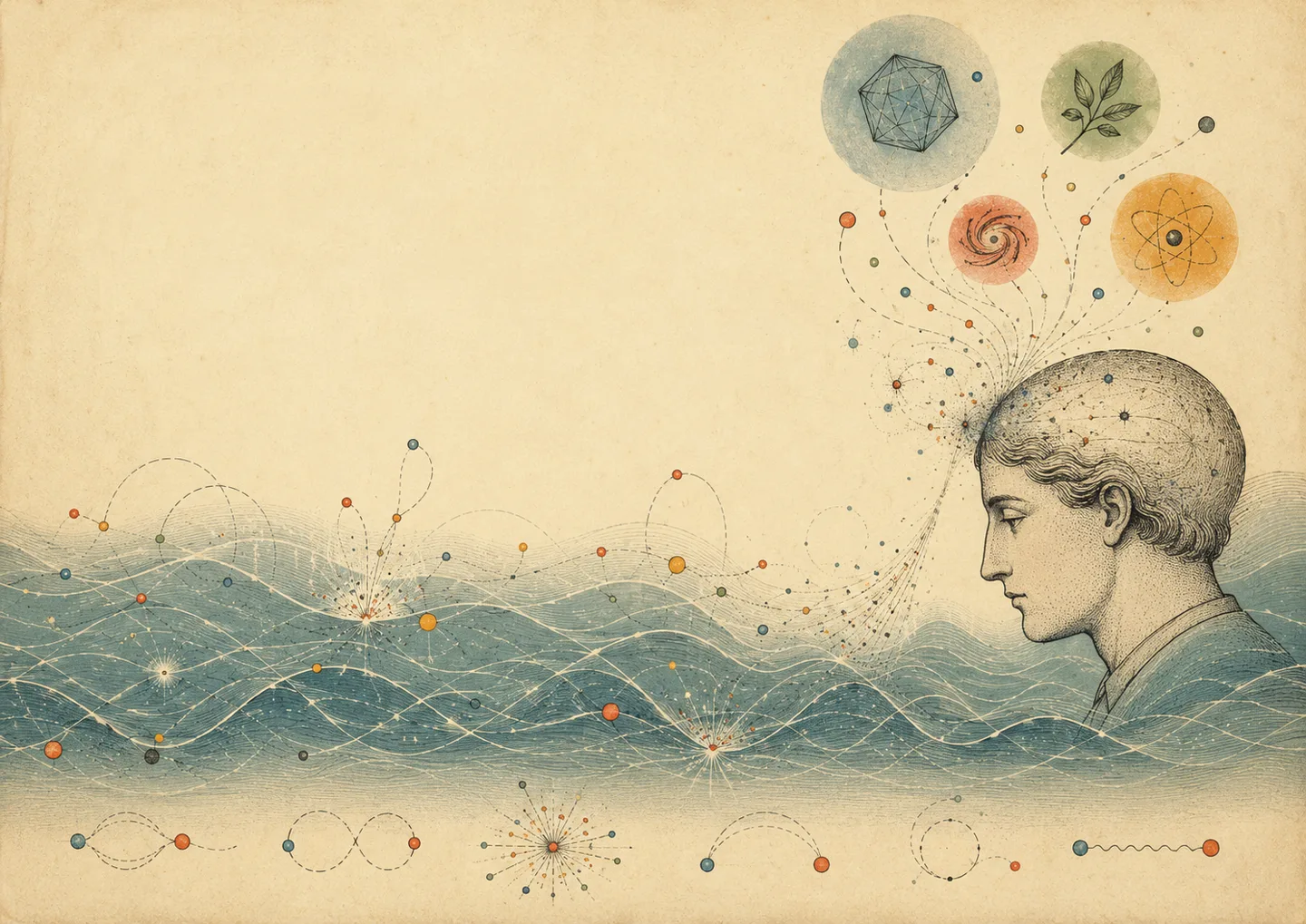
And maybe that is the thread connecting the whole thing. Before a stable particle appears, quantum fields are alive with temporary disturbances: fluctuations, possibilities, virtual happenings. My thinking feels similar. A podcast clip, an AI explanation, a physics concept, a memory of how I read, a joke about wanting “the juice”—they all flicker in and out. Most vanish. Some interact. A few become stable enough to write down.
Maybe thinking is not a straight line.
Maybe it is a field.
And maybe writing is what happens when one temporary disturbance becomes real enough to share.