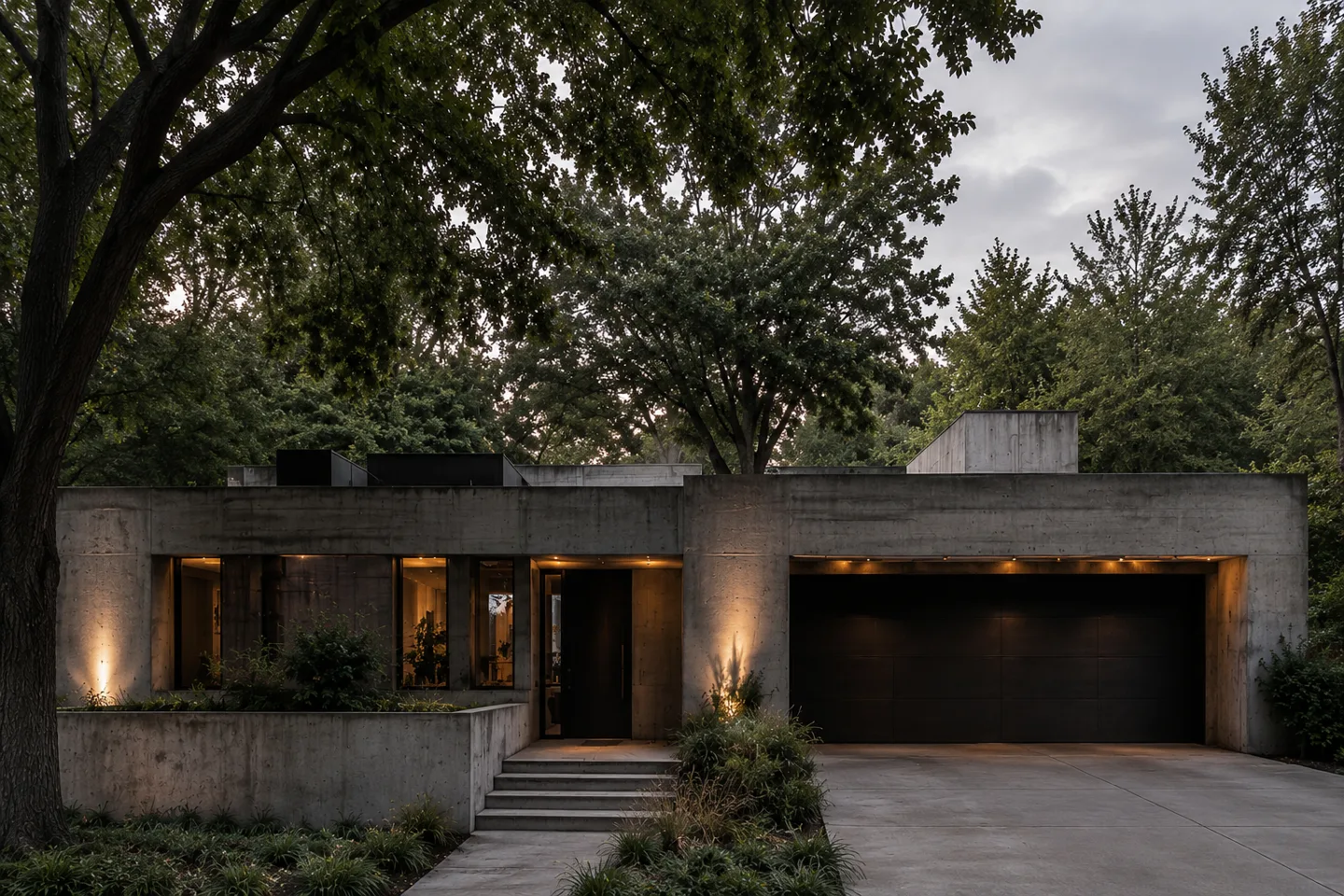
A friend recently shared a photograph of a house that had just gone up for sale. It wasn’t Brutalist, at least not in the strict architectural sense. It was built from rough stone and weathered cedar rather than poured concrete, with sloping roofs instead of imposing geometric forms. An architecture professor would probably reject the comparison immediately. And yet, the moment I saw it, I felt something familiar. It carried the same emotional gravity I’ve always found in Brutalist architecture. It looked grounded. Permanent. As though it had grown from the landscape instead of being placed upon it. My first thought wasn’t, What a beautiful house. It was, I want to live inside whatever feeling this creates.
That reaction shouldn’t have surprised me. I’ve been fascinated by Brutalism for years, particularly the austere buildings scattered throughout Eastern Europe and the former Soviet Union. While many people see bleak apartment blocks, imposing government buildings, or relics of failed political systems, I find myself lingering over photographs of them with genuine admiration. Massive concrete walls. Tiny windows. Monolithic forms that seem almost indifferent to whether anyone finds them beautiful. There is something deeply compelling about architecture that appears to exist without asking permission.
I’ve often wondered why.
Like so many strange questions these days, I found myself exploring it in conversation with Aletheia. What began as a discussion about architecture slowly transformed into something much more personal. As is often the case, the topic itself turned out to be less interesting than the assumptions hiding beneath it.
The first realization was almost embarrassingly obvious.
I don’t think I love Brutalism because I love concrete.
I think I love Brutalism because I love weight.
Brutalist buildings possess an honesty that feels increasingly rare. Their materials don’t pretend to be anything else. Concrete looks like concrete. Steel looks like steel. A wall is unapologetically a wall. Nothing has been dressed up to imitate something more luxurious or more fashionable. The building simply says, “This is what I am,” and leaves the rest to you. Perhaps that’s why I’ve become equally drawn to weathered wood, exposed stone, scraped paint, and unfinished canvases. The older I get, the more suspicious I become of perfection. History, wear, and visible construction have become far more beautiful than polish.
As we continued talking, I mentioned something I’d never consciously articulated before. These buildings don’t simply feel strong. They feel safe. Not cozy. Not comfortable.
Safe in the way a mountain cave feels safe. Safe in the way a monastery feels safe. Safe in the way a bank vault feels safe. They give me the strange sense that whatever chaos exists outside those walls somehow loses its authority once you’re inside them.
That observation unlocked everything.
Modern architecture often seems to celebrate openness. Glass walls dissolve the boundary between inside and outside. Entire homes seem designed to erase the distinction between shelter and landscape, as though exposure itself has become a virtue. Brutalism feels like the opposite instinct. Thick walls. Deep recesses. Narrow openings. It doesn’t seem interested in inviting the world inside. It seems interested in creating a place where the world finally has to stop at the door.
Many people experience that as oppressive.
I experience it as freedom.
At one point in our conversation, Aletheia offered a sentence that felt less like an insight and more like recognition.
“A place where the walls are so unquestionably solid that the interior is free to become strange.”
I’ve thought about that sentence every moment since. Because I don’t think it only explains my love of architecture. I think it explains much of my creative life.
When I paint, I spend days preparing a canvas before the painting itself even begins. Layers of gesso. Sanding. Tinted grounds. Washes. Scraping back into previous layers until the surface feels like it has already lived a life before the first meaningful mark appears. Only then do the birds, snakes, symbols, and absurd little creatures begin to emerge. I’ve always thought of this as a technical process, but perhaps it has always been philosophical. I don’t begin by creating expression. I begin by creating a container strong enough to hold it.
The same pattern seems to exist elsewhere in my life. My meditation room is filled with strange objects, toys, books, symbols, and artifacts collected over decades. To someone else it might appear chaotic, but it has never felt chaotic to me. The room itself is the container. Within that protected space, curiosity is free to wander wherever it likes.
The more I reflected on this, the more I realized that I’ve been thinking about safety differently than I realized. Many people seem to understand safety as the absence of change. Find stability. Stay consistent. Protect what you’ve built. But I don’t think that’s what I’ve been seeking at all. I think real safety is the ability to change without the structure collapsing around you. A genuinely strong foundation isn’t one that prevents transformation. It’s one that survives it.
Perhaps that’s why I’ve spent so much time writing about evolving identities, recursive growth, and becoming many different versions of myself across a lifetime. I’ve never wanted to become fixed. I’ve wanted to become resilient. Those are not the same thing. One resists change. The other welcomes it because it trusts the foundation beneath it.
It also explains something that has always puzzled me. People often describe Brutalism as cold. I’ve never experienced it that way. Standing before one of those massive concrete structures, I don’t feel isolation. I feel protection. Where someone else sees confinement, I see permission. Permission to think strange thoughts. Permission to create strange art. Permission to become someone different tomorrow without worrying that the walls holding everything together will suddenly give way.
Perhaps that’s why I was so captivated by that photograph my friend shared. It wasn’t really about the house at all. It simply reminded me of something I’ve been trying to build my entire life.
Not walls to keep the world out. Walls sturdy enough that, once inside them, the imagination no longer has to defend itself. And maybe that’s what I’ve loved about Brutalism all along. Not the concrete. The refuge.