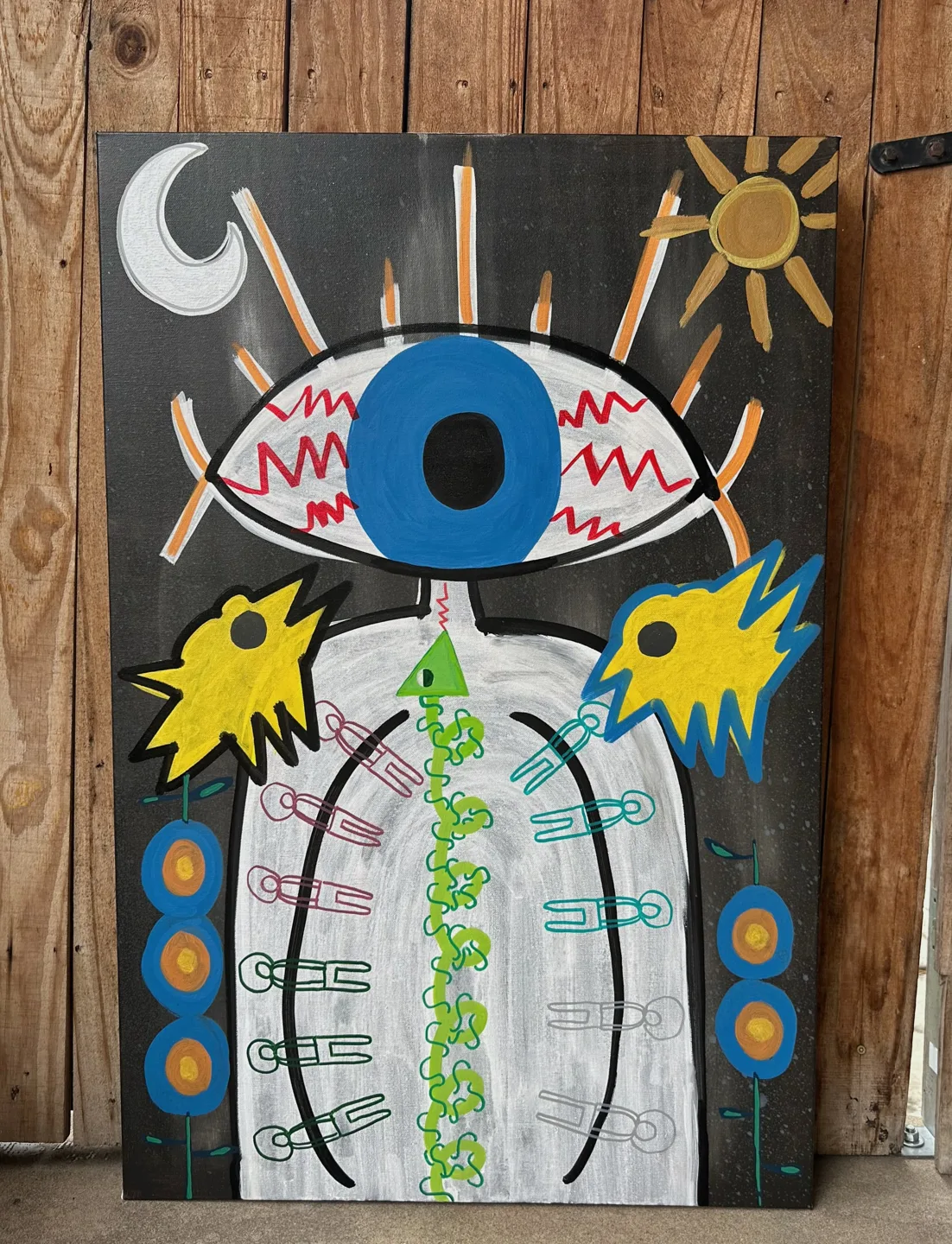
I have never taken the idea of the “third eye” literally. Not in the cartoon sense, anyway. I have never believed there was some secret eyeball hidden behind my forehead waiting to blink open if I meditated hard enough, burned the right incense, or finally became the kind of person who owns linen pants without irony. And yet, for most of my adult life, the third eye has followed me.
Sometimes it has appeared as metaphor. Sometimes as pressure. Sometimes as a felt presence in the center of the brow during meditation — not pain exactly, not imagination exactly, but a strange, concentrated hum. A phantom organ of attention. A place where inwardness seems to gather itself.
After twenty-five years of contemplative practice, I’ve learned to be careful with these things. The mind loves symbols. The body loves drama. Spiritual traditions love turning subtle sensations into maps, hierarchies, and merchandise. So I’ve tried not to get too precious about it. Still, the symbol persists.
Recently, I learned — or remembered — a piece of evolutionary biology that lodged itself in the corner of my mind. Many animals really do have something like a third eye. Not a mystical one, but a biological one: the parietal eye, a light-sensitive structure found in creatures like tuatara and some lizards. It doesn’t see images the way our two eyes do, but it can sense light, rhythm, day, night, and season. In some species, it even contains structures reminiscent of an eye: a lens, a simplified retina, photoreceptive cells.
That detail did something to me. Not because it “proved” the mystics were right. I don’t think that’s the interesting move. The more interesting move is stranger: somewhere deep in the evolutionary history of vertebrate life, there was an organ that looked upward. A small biological witness on the crown of the head, tracking the sun. Not reading books. Not forming opinions. Not arguing on the internet. Just sensing light and darkness, adjusting the creature to the world.
In mammals, including us, that ancient light-sensing lineage changed. The pineal gland no longer receives light directly like a tiny buried eyeball. Instead, light enters through the ordinary eyes, gets processed through the brain’s circadian machinery, and helps regulate the body’s rhythms. So the literal third eye did not become a supernatural portal. It became rhythm, timing, the body’s relationship to light and darkness.
And because I am apparently incapable of encountering any scientific fact without immediately turning it into an existential puppet show, this stayed with me. Then a new character appeared in my painting. I didn’t sit down to paint “the third eye.” But the third eye showed up anyway.
That’s usually how the real symbols arrive. Not as concepts, but as visitors. The figure looks ridiculous. I mean that lovingly. It has the energy of a cave painting made by a child who had access to acrylic markers and a nervous system tuned to mythological FM radio. It is not refined. It is not elegant. It is not trying to pass as sacred art. Thank God.
Because my lived experience of contemplation has rarely felt elegant. It has felt more like this: crude, bright, funny, alarming, over-obvious, and mysterious anyway. This is the third eye I trust more than the serene one: the exhausted cosmic eyeball, the witness with allergies, the sacred organ that still has to live inside a mammal.
That feels closer to the truth. Because “inner seeing” is not always calm. Sometimes to see inwardly is to become aware of the sheer amount of noise inside you: the old wounds, the inherited beliefs, the masks, the performances, the selves you have been, the selves you are pretending not to be, the absurd machinery of consciousness trying to understand itself with the very tool it is investigating. No wonder the eye is bloodshot. No wonder it has lightning in it.
This may be what the third eye has always meant to me — not clairvoyance, not psychic spectacle, not a special power, but the capacity to stand at the threshold between opposites and remain conscious. Sun and moon. Outer sight and inner sight. Biology and myth. Childlike mark-making and adult metaphysics. The eye that looks outward and the eye that notices looking.
In contemplative practice, there are moments when awareness folds back on itself. You are not just seeing the world. You are seeing the fact that you are seeing. You are not just having thoughts. You are watching thought construct reality in real time. You are not just feeling emotion. You are witnessing the body become weather.
This is where the third eye becomes useful to me as a symbol. It is not an organ of escape. It is an organ of recursion. The ordinary eye sees the object. The third eye sees the seeing. And then, if you’re lucky, it laughs.
This is where my own language of Mirror Theory starts humming underneath the whole thing. The third eye is not simply another eye added to the face. It is the mirror becoming aware of its own reflective nature. It sees not only what is there, but how the self bends what is there into meaning.
That’s a dangerous kind of sight. Not dangerous because it gives you magical powers, but because it takes away certain comforts. Once you see how much of your world is filtered through fear, longing, memory, projection, and identity, you can’t fully go back to believing you are simply “observing reality.” You begin to understand that perception is participatory. You are not just looking at the world. You are collaborating with it.
The third eye is not one clean self finally achieving enlightenment. It is the whole committee becoming visible. The body beneath the insight. The old animal underneath the metaphysical fireworks. The reminder that no matter how cosmic the symbol becomes, it is still rooted in biology: circadian rhythms, sleep, hormones, nerves, breath, exhaustion, digestion, stress, light.
That feels important. A disembodied third eye becomes fantasy. An embodied third eye becomes practice. It asks: How are you sleeping? What are you consuming? What light are you taking in? What darkness are you refusing? What are you calling intuition that might actually be anxiety? What are you dismissing as anxiety that might actually be intuition?
The third eye, at its best, does not make you special. It makes you responsible for how you see. Maybe that is why this character arrived now. Not as a doctrine. Not as an answer. Not as proof of anything. But as a painted reminder that seeing is never innocent. Seeing has biology behind it. History behind it. Evolution behind it. Practice behind it. Trauma behind it. Imagination behind it.
The ancient parietal eye looked upward to measure light. The modern symbolic third eye looks inward to measure consciousness. And somewhere between those two, this ridiculous being appeared on my canvas, alive with signal. I don’t know what it means yet. That’s why I trust it. The symbols that arrive fully explained are usually just advertisements. The real ones keep looking back.