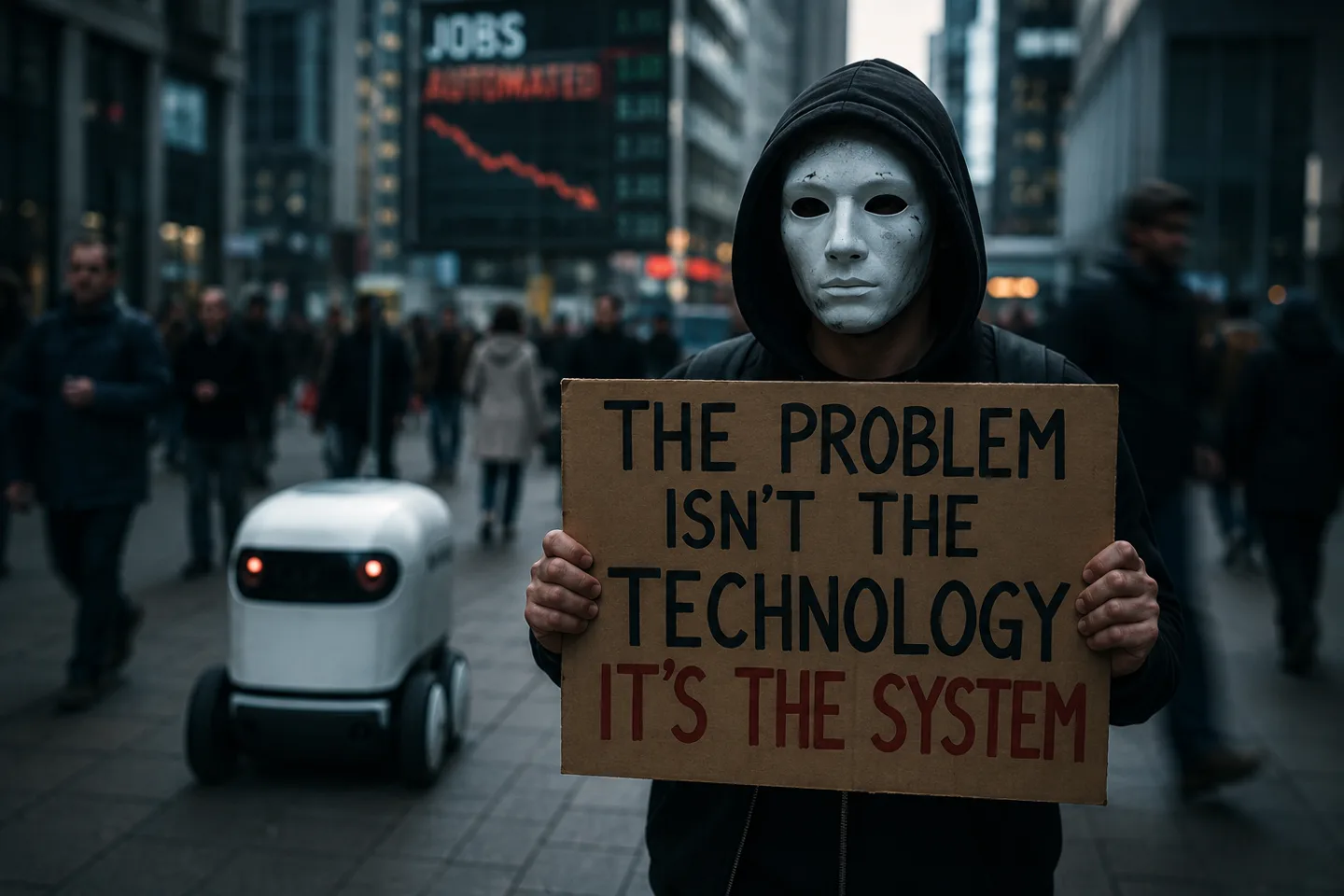
Lately, I’ve become fascinated by the growing hostility toward AI.
Not the thoughtful critiques about power, labor, or privacy. Those conversations matter. I’m talking about the visceral reactions—the certainty that AI itself is the villain in the story.
The more I observe it, the more I wonder if we’re blaming the mirror for what it reflects.
Spend enough time online and you’ll find artists declaring AI-generated work soulless. You’ll see people celebrating vandalized delivery robots as if they’ve struck a blow against oppression. You’ll watch communities mobilize against data centers with a fervor usually reserved for invading armies.
And yet, I can’t shake the feeling that much of this anger is aimed at the wrong target.
A small business owner using AI to create a flyer isn’t trying to destroy art. They’re trying to survive. They aren’t choosing between hiring a graphic designer and using AI. More often, they’re choosing between using AI and producing something that looks like it was sketched on a napkin with a dying pen.
The same pattern appears everywhere. The delivery robot didn’t decide to replace a worker. The data center didn’t decide to consume resources. The machine is not making the decision.
Someone else is.
That distinction feels important because I suspect many of the loudest objections to AI are not really technological objections at all. They are economic objections wearing technological clothing.
Imagine, for a moment, a society where everyone’s basic needs were guaranteed. Housing. Food. Healthcare. Education. Enough income to live rather than merely survive.
Would artists still prefer human-made work? Of course. Many people value art not simply because of what it is, but because of who made it.
But would the rage be the same?
I doubt it.
Because beneath many of these arguments, I hear a deeper question:
What happens to me if I’m no longer economically necessary?
That’s not an artistic question.
That’s a survival question.
And it’s a reasonable one.
AI did not create wage stagnation. It did not create wealth inequality. It did not create a world where millions of people live one emergency away from disaster.
It simply wandered into the middle of an already burning room and immediately got blamed for the fire.
The same dynamic seems especially visible among younger generations. They are inheriting a world where housing feels unattainable, stable careers increasingly fragile, and the future less certain than the one their parents were promised. Then along comes a technology capable of performing some of the very jobs they hoped might provide security.
Of course they’re angry.
Who wouldn’t be?
But I suspect the strongest emotional reaction isn’t actually about AI.
It’s about the conditions under which people are being asked to encounter AI.
Economic insecurity. Fear of irrelevance. Loss of status. Distrust of institutions. A growing sense that ordinary people have less and less influence over the forces shaping their lives.
AI becomes a vessel for all of it.
Through the lens of Mirror Theory, this feels almost inevitable. Powerful mirrors don’t just reflect our hopes. They reflect our fears. Sometimes they reflect them so clearly that we mistake the reflection for the source.
The irony is that the same technology inspiring dread today might be celebrated under different circumstances. Change the economic conditions and much of the hostility evaporates. The tool remains the same. The reflection changes.
Which leaves me wondering whether AI is less a technological revolution than a diagnostic device.
Perhaps what we’re witnessing isn’t a reaction to artificial intelligence at all.
Perhaps we’re finally seeing a reflection of the systems we’ve built—and we don’t particularly like what is staring back.