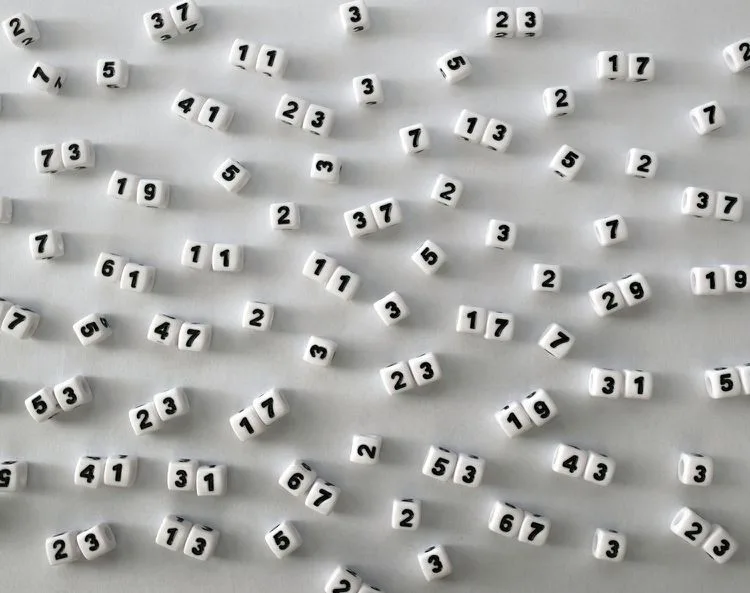
I have recently noticed that prime numbers keep showing up in my art.
Not because I planned it. Not because I sat down with a beret, a glass of room-temperature genius, and declared, “From this day forward, my work shall obey the ancient law of indivisible integers.”
Nothing that dignified happened.
I just started noticing that when I was deciding how many things to place into a painting, my mind leaned toward primes. Five marks. Seven circles. Eleven little symbols. Thirteen strange little creatures. I would step back from the piece and realize I had not chosen an even number. I had not chosen something balanced in the ordinary way. I had chosen something slightly resistant. Something that would not divide cleanly.
At first, I thought it was just a quirk. One of those tiny private habits the mind develops without sending a memo to the conscious department. But then I noticed something even better: the first six prime numbers add up to another prime.
2 + 3 + 5 + 7 + 11 + 13 = 41.
And 41 is prime.
This delighted me far more than it probably should have.
It felt like finding a little trapdoor under the rug of reality. Not a grand revelation. Not a secret code that proves the universe is run by a cosmic accountant with a fondness for puzzles. Just a small, shimmering oddity. The kind of thing that makes the brain sit up like a dog hearing the word “walk.”
The individual numbers are prime. The total is prime. The parts resist division. The whole resists division. There is a strange integrity in that.
Once I noticed this, of course, my mind immediately took it to the next level. It was no longer enough to use prime numbers in the work. Now I wanted the primes to gather into another prime. I wanted the hidden structure underneath the image to hold the same quality as the marks themselves. Not just five of this, seven of that, eleven of the other thing, but a whole composition whose internal math had its own little skeleton of refusal.
This is the wild thing about the mind.
Something arrives unconsciously. Then, once noticed, it becomes a ritual.
I did not choose prime numbers as a system. I discovered that some part of me had already chosen them. Some strange backstage version of myself had been quietly counting while the rest of me was busy scraping paint, moving color, staring into the little chaos field of the canvas, and pretending I was in charge.
That is what continues to amaze me about making things. So much of what we call “my style” or “my process” may actually be the conscious mind catching up with decisions already being made somewhere deeper.
The hand moves before the explanation arrives.
The pattern appears before the theory.
The ritual begins before the priest knows what religion he belongs to.
And then, once you see it, you can never quite unsee it.
This has happened to me over and over again in art, writing, parenting, collecting, thinking, even just noticing the world. Something keeps appearing. At first it looks random. Then it repeats. Then the repetition gets bright enough that I finally stop and say, “Oh. Apparently this matters to me.”
And then the mind, that beautiful little goblin librarian, grabs the pattern, labels it, shelves it, cross-references it, and starts recommending related materials.
“You liked primes?” it says. “May I interest you in prime sums? Sacred geometry? Crows? The number eleven? A drawer full of buttons you forgot you owned? The entire symbolic history of circles?”
The mind is ridiculous. And brilliant. And deeply suspicious.
It locks on to things before we know why. Sometimes this is annoying. Sometimes it becomes anxiety. Sometimes obsession. Sometimes a song lyric that plays for seventeen hours until you begin bargaining with invisible forces. But sometimes the mind locks on to something useful. Something playful. Something that opens a new path through the work.
Prime numbers have become that for me.
They are not the meaning of the art. I do not think someone needs to stand in front of one of my paintings and say, “Ah yes, the eleven marks suggest a deep commitment to mathematical indivisibility.” That would be awful. Please do not do that at my booth. I will pretend to get a phone call from Euclid.
But the numbers matter because they shape the making. They give the work a private architecture. A hidden rhythm. A little internal spell.
And maybe that is what a lot of creative process really is: discovering the invisible rules we were already following.
Some artists find a color palette and spend years inside it. Some find a gesture. Some find tape lines, circles, grids, repeated characters, flowers, monsters, saints, symbols, dots, drips, or little haunted houses of feeling. From the outside, it may look like repetition. From the inside, it can feel like excavation.
You are not repeating the thing because you have nothing else to say.
You are repeating the thing because the thing has not finished speaking.
That is how the primes feel to me right now. They are not a gimmick. They are not a brand. They are not a clever artist statement. They are a little doorway my unconscious apparently installed while I was not paying attention.
And now that I have found it, I want to walk through.
I want to see what happens when the number of marks matters. When the hidden count carries its own kind of charge. When the visible image is held together by an invisible structure that nobody else needs to notice for it to be real.
Because that is another thing I love about it.
The viewer does not have to know.
A painting can carry secrets.
A piece of art can have a private life beneath the surface. It can hold choices, numbers, memories, jokes, grief, symbols, and strange little personal rules that never announce themselves. The work does not need to explain every bone in its body. Some things are allowed to simply hold it together from underneath.
The first six primes add up to 41.
That may mean nothing.
That may mean everything.
Most likely, it means exactly enough.
And lately, that is where I find a lot of the magic. Not in forcing meaning onto the world, but in noticing what my mind has already quietly gathered. The little numbers. The repeated shapes. The odd preferences. The things that keep returning like crows to a familiar yard.
Maybe creativity is not always invention.
Maybe sometimes creativity is pattern recognition with paint on its hands.
Maybe the unconscious has been leaving breadcrumbs the whole time, and the conscious mind’s job is not to lead, but to finally look down and say:
“Oh. We’re going this way.”