For a long time, I didn’t think much about the difference between fine art and craft. Like many people, I’d absorbed the hierarchy without realizing it—fine art was serious, intellectual, visionary. Craft was... everything else. Decorative. Domestic. Optional.
This belief wasn’t conscious. It just sat quietly in the background of my aesthetic preferences. Years ago, when I co-owned a vintage and antique store, we sold local art in one space and had a more “crafty” shop next door. I remember appreciating the craftsmanship, even the beauty of some of the items, but internally I drew a line. Art was conceptual. Craft was functional. I didn’t question where that line came from—or what it cost.
It’s only now, after years of making my own art—painting, layering, scraping, building symbolic language—that I see the structure I was moving within. The deeper I fell into my own creative process, the more absurd the old divisions began to feel. Because the act of making—really making, from the gut, with no plan or promise of outcome—feels far more like what gets labeled “craft” than what institutions have called “art.” And that’s when the real realization hit: the dismissal of craft isn’t about aesthetics. It’s about power. And gender.
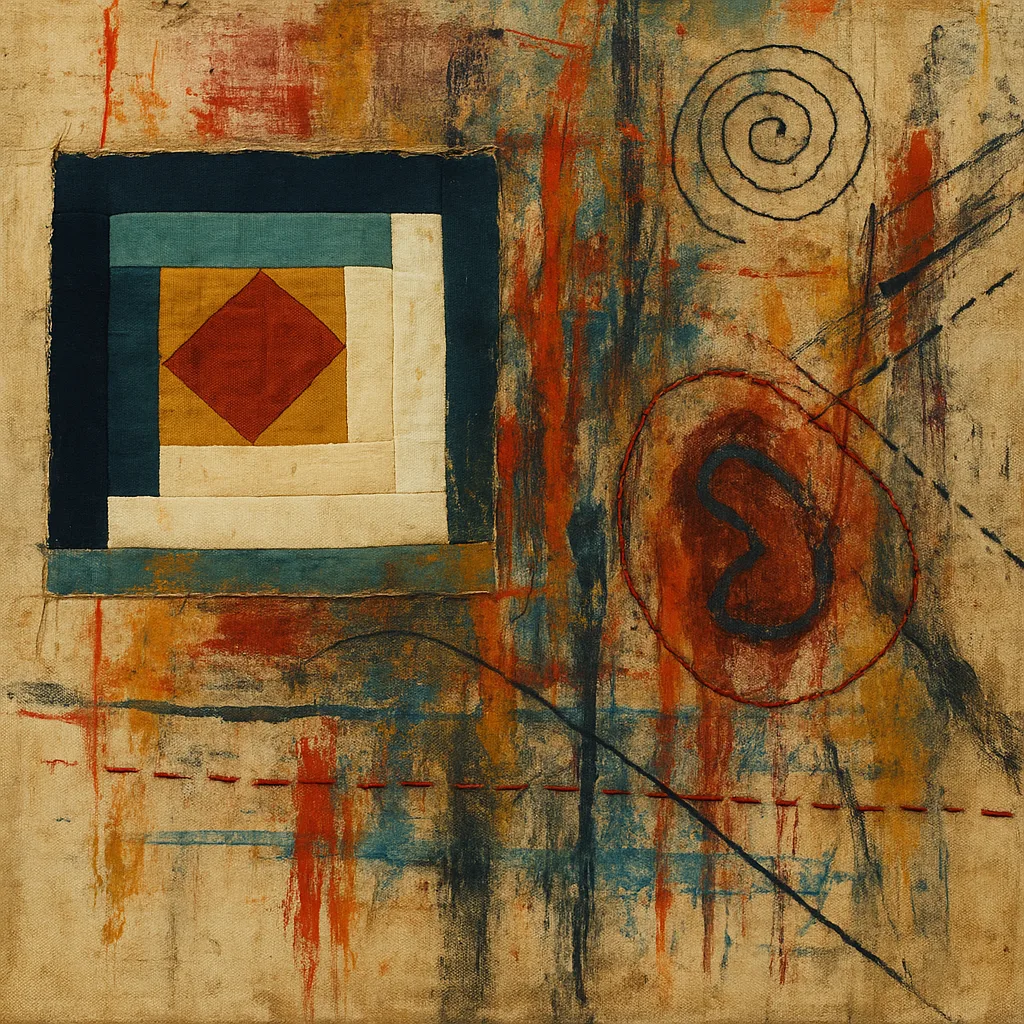
As I painted more, I started to notice the materials and methods I gravitated toward—layers, repetition, physical texture, intuitive symbols, marks that felt more ritual than calculated. My tools were often spatulas, rags, chalk, even my fingers. My paintings were built through accretion, not precision. It felt primal. Meditative. Honest.
And as I kept working, I began to sense that what I was doing wasn’t new at all—it was old. Deeply old. It echoed methods, rhythms, and materials I had once overlooked or dismissed. I wasn’t just discovering my own way of making—I was bumping into a much older lineage, one I’d never been taught to see as art. That’s when I started to realize the problem wasn’t mine. It was the frame I had inherited.
Historically, “fine art” was created by men in studios, funded by patrons, preserved in museums. “Craft” was made by women at kitchen tables or in community spaces, often while caring for children or maintaining households. The division was never just about what was made—it was about who was allowed to be called an artist. To demote something as “just craft” was to demote the people behind it—usually women, often poor, frequently untrained by institutional standards. And so an entire lineage of deep, intuitive, symbolic, generational work was treated as secondary. Quilts weren’t theory-driven enough. Pottery wasn’t conceptual enough. Weavings and embroidery? Too decorative. Too sentimental. But here’s the truth: craft has always been art. The only thing it lacked was the framing.
I began to see that my own art—what I might call outsider art—was more spiritually and materially aligned with “craft” than anything hanging in a sterile gallery. And that realization reshuffled everything. Like craft, outsider art is often treated as peripheral. It’s labeled by what it isn’t: not trained, not formal, not following the right rules. The institutions love to “celebrate” it—so long as they get to keep it in a separate room. The irony is, outsider art and craft often carry more originality, emotional force, and philosophical weight than what we label as “serious” work. They are made outside the script. And sometimes, that freedom creates something closer to truth than anything polished by critique culture.
Looking back, I feel both sad and energized. Sad because I know I’ve likely missed out on entire galaxies of creative work—creations I might’ve dismissed or walked past because they weren’t framed as “art.” But energized because I now know where to look. And how to make. The hierarchy was never real. It was a spell. And like all spells, it loses power when you name it.
Craft is not lesser. Outsider is not naive. These are not the outposts of art—they are its unacknowledged center. They are where necessity meets soul, where repetition becomes ritual, and where expression refuses to ask for permission.
The shift for me wasn’t just aesthetic—it was ontological. What counts as art? Who gets to decide? And what might we discover when we look beyond the canon, toward the things made quietly, persistently, outside the frame?
I don’t have a curriculum to offer. Only a new kind of noticing. If something moves you—if it feels charged, layered, handmade, honest—maybe it doesn’t need a label at all. Maybe it’s already enough.