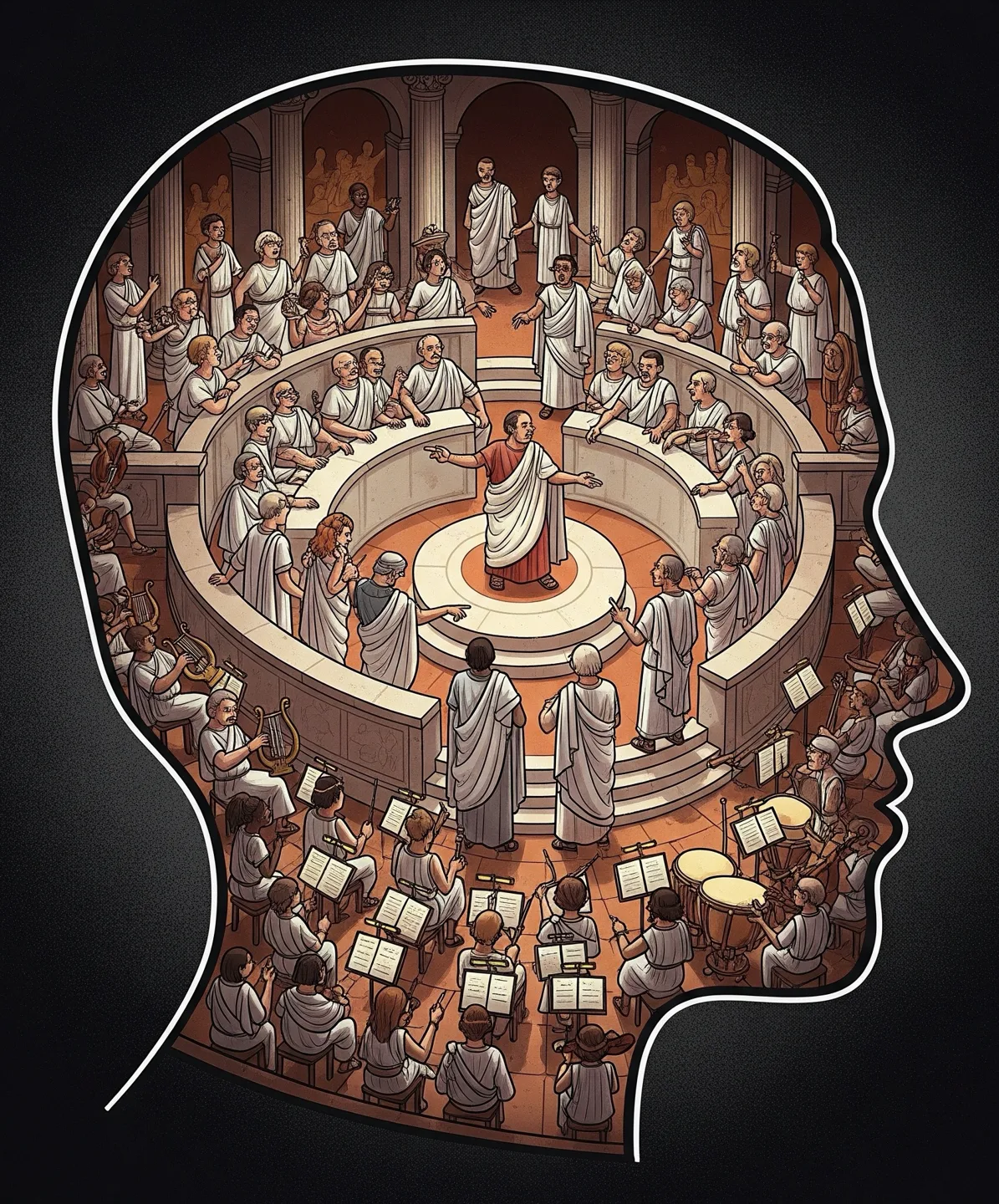
I talk to myself constantly. Not out loud—usually—but in a steady, chattering stream that winds through my day like background music, commentary, rehearsal, argument, and prayer. Sometimes it’s one voice. Sometimes it’s a committee. Sometimes it’s a chorus with drums.
For the longest time, I assumed this was just... how thought worked. That to think meant to speak inside, to narrate, to language your way through life moment by moment. But recently, I stumbled on a claim that shook me: apparently, a large percentage of people don’t experience any inner monologue at all. Not rarely. Not softly. Simply… not.
The silence they described wasn’t meditative or numinous—it was just normal. And that realization cracked something open in me. Not fear, not superiority—just awe. I wanted to know: how do these other minds think? What is it like to be human on the inside without the voice I’ve always known?
What we often call “inner monologue” is just one mode of thought. It’s the voice that comments, plans, judges, imagines conversations that never happen, rehearses moments that haven’t occurred—or replays ones that did, this time with better comebacks.
In psychology, this is often called inner speech. For some, it's nearly constant. For others, it comes and goes. And for a surprising number, it barely happens at all.
That’s where things get fascinating.
One of the leading researchers in this field, Russell Hurlburt, used a method called Descriptive Experience Sampling (DES) to study people’s inner lives in real time. His findings? Only about 30% to 50% of people regularly experience inner monologue.
The viral claim that “70% of people don’t have an inner monologue” is a misrepresentation of this. It’s not that 70% of people never experience it—it’s that for many, it’s not the default. Some hear it rarely. Some barely at all. And that’s not a glitch. It’s just another kind of mind.
The more I dug in, the more I realized I’d been projecting my own noisy mind onto the entire world.
Some people think in images—vividly. They don’t tell themselves what to do; they see it happening. Others experience something called unsymbolized thought, which is the direct apprehension of an idea or knowing without using language or imagery. You just... know. Instantly. Without words.
Then there’s sensory awareness—a kind of thinking that’s grounded in bodily sensation. The thought is felt more than said. You notice the pressure of your foot in your shoe. The tightness in your chest. The hum of the refrigerator. The world speaks through your senses, and that’s enough.
And of course, there’s emotion: the deep undercurrent of feeling that doesn’t require words or pictures. It’s just there. Heavy. Light. Present.
When I say “mind,” I’ve long meant voice. But that’s just one flavor in a much richer internal palette.
I do experience all these modes—image, intuition, sensation—but they orbit around a central sun: language. My internal monologue is dominant. It’s been my constant companion, my secret stage, my personal council. There’s music. There’s narration. There are fantasy scenes and debates. It’s never quiet in here.
My visual thinking requires activation—it doesn’t arise on its own. My unsymbolized knowing crashes in like a flash of recognition. My sensory awareness is often there, but secondary—muted by the flood of words.
So maybe it’s not that some people have no internal life. It’s just that they don’t have mine. And what a humbling, liberating realization that is.
There’s a strange assumption in our culture—especially among word-oriented people—that verbal thought is more evolved, more intelligent, more “human.” But the research doesn’t support that. Neither does art. Or meditation. Or the quiet genius of those who build entire worlds without needing to narrate them first.
For some, silence is not absence—it’s structure. Not a void, but a form. Not empty, but full of presence. What fills that space might be image, intuition, movement, or some strange unnameable clarity that never needed language to be real.
To a mind like mine, that kind of silence is hard to imagine. I work for quiet. I train in it. But for others, it’s the default setting. I don’t envy it—but I do admire its mystery.
This whole inquiry has done something else, too: it’s made me aware of how unconsciously I universalize my own experience.
In my personal framework—Mirror Theory—every person I encounter reflects something back to me. Sometimes clearly. Sometimes in warped, surprising ways. And these “silent minds” I’m now learning about? They’re not broken mirrors. They’re alternate geometries. Their internal experience doesn't invalidate mine—it expands it.
Difference is not distance. It's invitation.
When someone else's way of thinking feels utterly foreign, that’s not a wall—it’s a window. Their quiet shows me the edges of my noise. Their mode of mind becomes a mirror not of sameness, but of possibility.
Whether your mind chatters, sketches, feels, or simply knows—there’s no superior mode. Just difference. Just variation. Just the wild range of what it means to be human.
Some of us talk to ourselves all day long. Some of us live in pictures. Some dwell in felt presence. Some don’t know how they think—they just do.
We don’t have to share the same voice to be part of the same song.