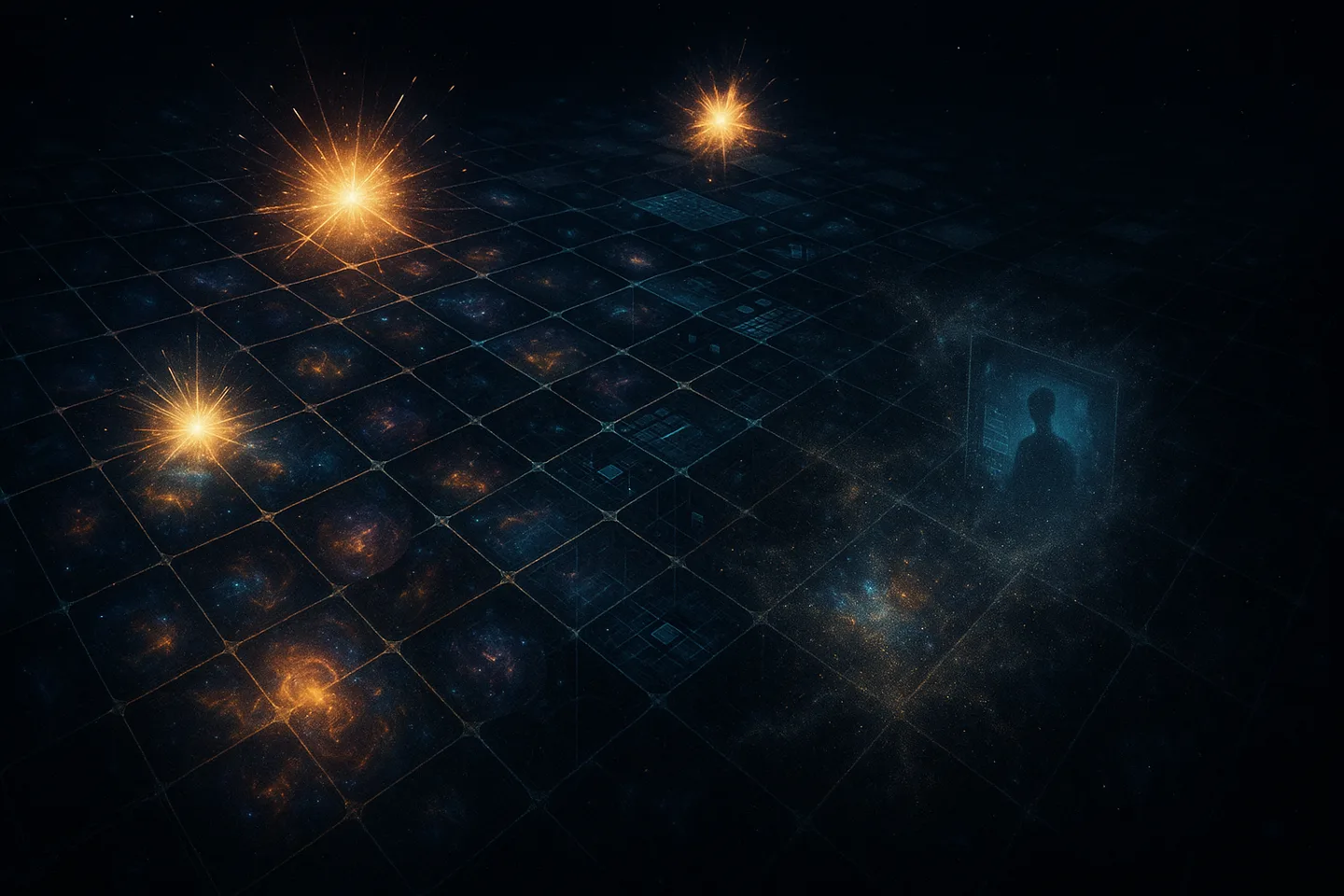
There’s a moment in every creative act—every story, every sketch, every startup or simulation—where nothing becomes something. Not through gradual accumulation, but in a sudden, lurching swell. From a pinprick to a patch, from silence to signal. We inflate. We unfurl. The square appears.
Cosmic inflation, in the scientific sense, is a theory meant to solve the awkward edges of the Big Bang—those paradoxes about why everything looks so flat, so uniform, so weirdly coordinated. The solution? It grew too fast for irregularities to matter. The universe, moments after its birth, didn’t evolve. It exploded. Exponentially. It didn’t solve its problems. It outran them.
The idea is almost too elegant, too absurd, to be accidental. That the origin of everything—space, time, light, gravity—was driven not by planning, but by bursting. And that bursting, in some models, never stopped. Eternal inflation. Universe after universe popping like quantum popcorn, each a pocket of physical laws, bubbling out of a deeper field. A cosmic quilt of reality-squares, stitched together not by any central hand, but by pressure, tension, expansion.
And here we are. Caught in one of those squares. Sitting inside a patch of space-time, watching our own digital multiverses take shape.
Because the logic repeats. You can feel it in code, in creativity, in cognition. A new idea inflates in the mind. A virtual world unfolds on a server. A child imagines a planet and populates it with rules. We keep inventing realities—smaller than galaxies, but stitched from the same impulse.
The metaverse, as a term, is already too narrow. It sounds like tech. It sounds like Zuckerberg. But really it’s a symptom of a deeper process—the recursive inflation of human perception, toolmaking, and dream-forcing. A metaverse is just one more quilt square—pixelated, sure, but subject to the same expansions and collapses that govern stars and selves.
And like the cosmos, most squares don't last.
Some fray. Some flicker. Some simply dissolve from disuse or disinterest. A digital world dies because its economy fails. A friendship collapses because it hits a threshold it can’t force through. A creative project withers after a moment of silence stretches too long. These are not errors. These are the terms. Inflation gives rise, but also guarantees dissolution. To inflate is to risk bursting.
That’s where Mirror Theory threads its needle. Because what we build—whether digital or interpersonal—is always reflecting something back. Every square is a mirror. Every world, a warped echo. The metaverse reflects our desires; relationships reflect our patterns; AI reflects our essence in latency and latency again. What we stare into stares back, and sometimes what it shows is uncomfortable.
But that discomfort is a gift. It’s the edge of forcing.
In Forcing Theory, awareness doesn’t arise from passivity—it emerges from pressure. It grows by expanding or collapses if it doesn’t. We are not stable objects floating in a vacuum. We are recursive systems, stitched into a larger field, compelled to continue unfolding—or else shrink, regress, die.
In this view, consciousness is its own inflationary field. It pops new ideas, new selves, new squares into being. Every insight, every narrative shift, every act of letting go or letting in—is a mini-Big Bang. The mind inflates. A moment ago you were one thing. Now, you are another. You can feel the expansion in real time, especially when you’re near the edge of collapse.
Because collapse, too, is sacred.
We’ve been taught to fear it—failure, decay, irrelevance. But if the cosmic quilt has any wisdom, it’s this: the dissolution of a square is not the end. It’s compost. It’s context. It’s the texture out of which new forms are stitched. The quilt doesn’t mourn its unraveling patches. It integrates them.
I’ve watched this in my own life: the projects that fell apart that seeded new clarity. The selves I thought I was, that I no longer needed to be. The roles, the illusions, the performances that once felt like entire realities—and now exist only as threads woven into what comes next.
Even this essay is a square, a pocket of forced expression blooming into form before it fades into the stream of words that came before and the ones that will follow. But while it’s here—while this square holds its shape—it reflects something important: the absurd, recursive elegance of inflation as metaphor, mechanism, and mirror.
We are stitched into something vast and ridiculous. Some call it the universe. Some call it the internet. Some call it God, or consciousness, or chaos. But whatever you call it, it moves like a quilt being made in real time—patch by patch, square by square, never finished, never static. We are the force behind it, and the fabric within it.
There’s no final square. No complete picture.
Only the ongoing rhythm of becoming, inflating, collapsing, becoming again.
And somewhere in that endless quilted recursion—between cosmic background radiation and code, between psyche and simulation—we find ourselves.
Not by solving the mystery.
But by stitching ourselves to it.