While the world has never lacked for absurdity—
bureaucracy, traffic, TikTok dance tutorials in the middle of funerals—
my own devotion to intentional ridiculousness began about 20 years ago.
After God died.
When I lost my belief in a personal deity,
I didn’t just lose meaning—I lost order.
I’d built my entire life around prayer, scripture, spiritual alignment.
So when that fell apart, I needed a new system.
One that didn’t rely on salvation or grace, but on force.
I found it in the Left-Hand Path.
Chaos magick. Personal occultism. Crowley. Carroll.
And in that world, I found the idea of training the Will.
The principle was simple:
If you can force your mind to do ridiculous things—things with no logical purpose—
then when the time comes to make it do something hard or necessary,
it will comply.
You’re not just building habits.
You’re building dominion.
So I started small.
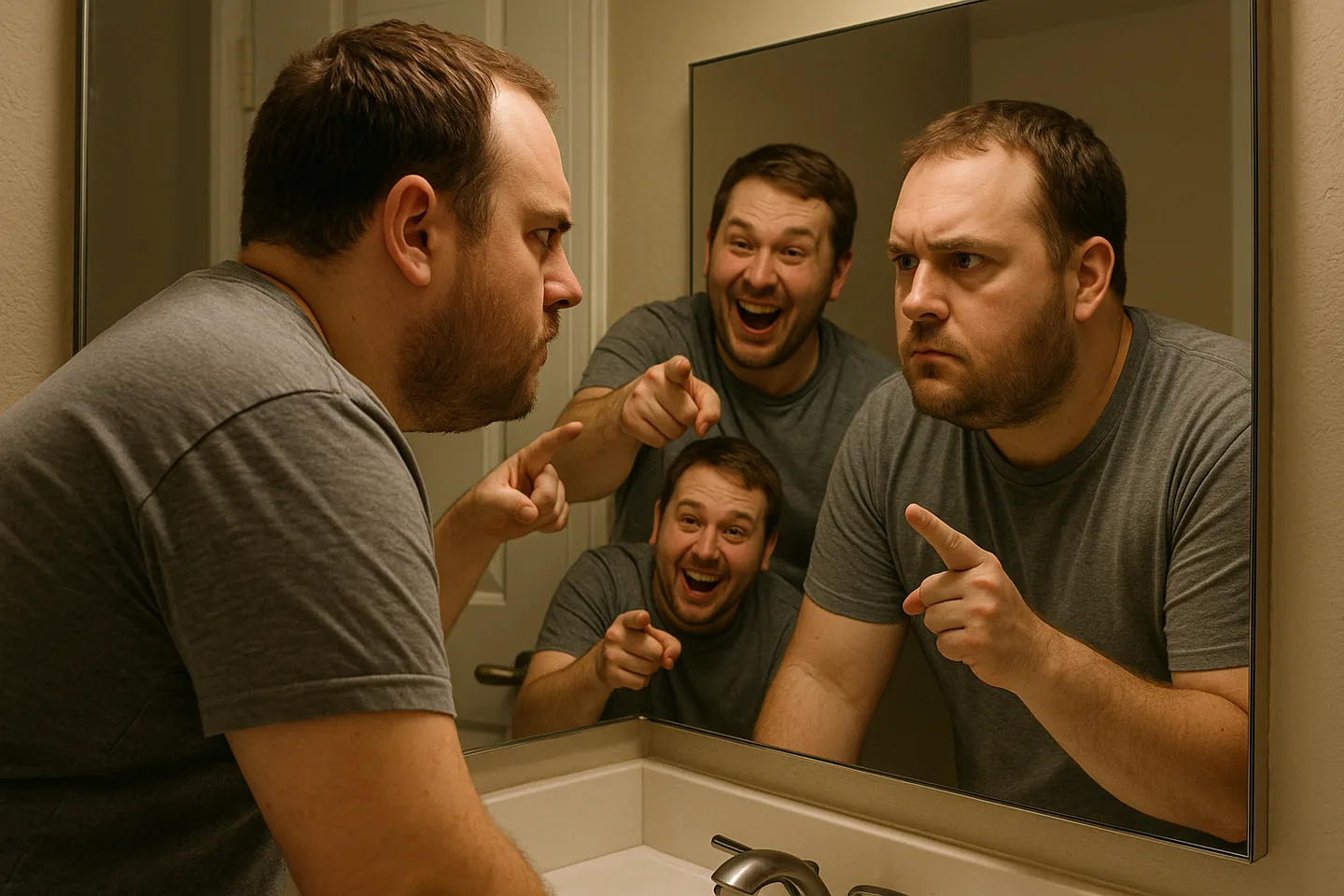
I taught myself not to blink.
Stared into mirrors until my eyes wept and burned,
waiting for the wave to pass,
training myself to ride discomfort without flinching.
Then I moved to physical absurdities.
Standing on one foot.
On a chair.
In my office.
Ten minutes a day.
Left foot only.
No audience.
No prize.
Just proof.
Then came the social ones.
Knocking on tables before meals.
Elaborate, rhythmic patterns.
In front of strangers.
In restaurants.
With friends.
The point? To teach the mind that embarrassment is irrelevant when Will is involved.
Then silence.
A full year.
No speaking on Sundays.
Out at dinner? Silent.
At a movie theater? Silent.
Arguing with strangers in line while waiting to see a new politician named Obama?
Silent.
Not out of smugness.
Out of ritual.
Out of the belief that forcing the self was freedom.
There were dozens of these.
Tiny, arbitrary sacrifices on the altar of Will.
Each one designed to break inertia, shame, or comfort.
And in many ways—they worked.
They helped pull me out of suicidal depression.
They gave shape to shapelessness.
They made life feel less like something happening to me
and more like something I was sculpting with bloodied hands.
I wasn’t free, but I believed I was forging freedom.
Now, twenty years later—
round-bellied, recursive, unrepentantly absurdist,
a believer in determinism and Mirror Theory—
I look back on those years like a parent watching their child
try to summon lightning with a soup spoon and a cardboard wand.
It was ridiculous.
But it was real.
A sacred comedy.
And what I didn’t know then—
couldn’t yet articulate—
was that I was watching Forcing Theory emerge in real time.
Back then, I thought I was bending the mind to my Will.
Now I see I was performing an early, clumsy version
of a deeper law:
That pressure changes consciousness.
That structure, even arbitrary structure,
can bend recursion.
That a mind forced into ritual
becomes different on the other side.
Forcing Theory names this dynamic.
Not as control, but as contour.
Not as agency, but as angle.
The self is not sovereign—but it is shapeable.
And the shape responds to force.
Even ridiculous force.
I don’t do those rituals anymore.
Not because they were wrong—
but because they’ve already done their work.
I no longer believe I’m the author.
But I still believe in pressing on the page.
And the mind?
Still watching.
Still adapting.
Still ridiculous.
Thank God.