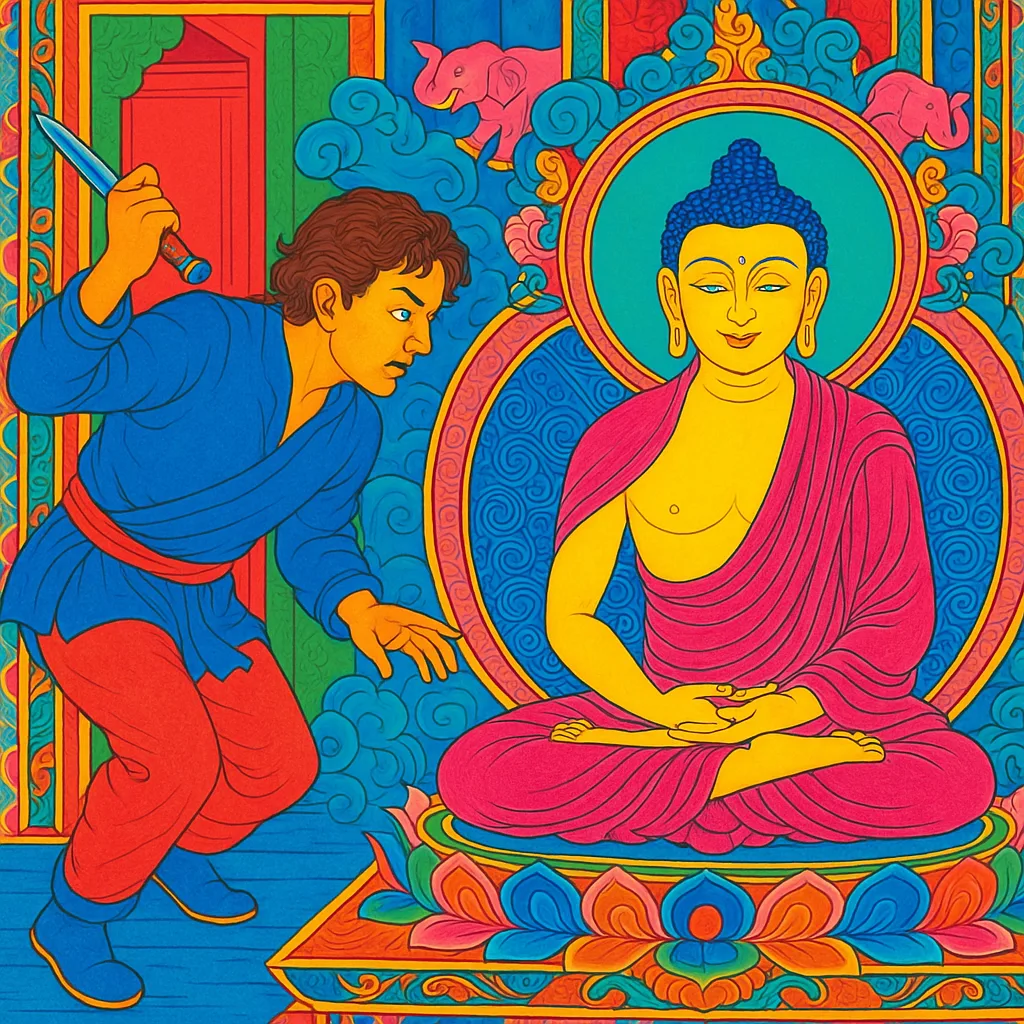
“If you meet the Buddha on the road, kill him.”
Zen Master Linji wasn’t prescribing violence—he was pointing to freedom. Freedom from clinging. From projection. From mistaking reflection for truth.
Most people hear that koan and imagine some serene sage standing in your path, offering enlightenment in exchange for devotion. A classic spiritual misdirection. But that’s not the Buddha you need to kill.
The hardest one to face isn’t on the road. It’s not a guru or a guide. It’s the one already inside you.
The one that uses your voice.
The one that speaks in the tone of your insight.
The one who quotes your favorite thinkers, performs your aesthetic, and tells you you’ve arrived.
This Buddha doesn’t sell courses. He whispers approval. He flatters your effort. He says, “You’ve transcended. You’ve become.” He’s the ego, perfectly camouflaged as awakening.
And the mirror he holds up? It looks like truth—but it’s not. It’s a curated loop of your past growth, frozen in place. A reflection that doesn’t respond, only repeats. It flatters your insight. Applauds your evolution. It says, “This is who you are now.”
Mirror Theory reminds us that the world constantly reflects us—people, experiences, even obstacles acting as surfaces through which we glimpse ourselves. But when the ego installs a false mirror, even insight can become a trap. You begin performing presence instead of living it. You polish a persona rather than shedding one. You become a character in your own mythology.
That’s the ego’s favorite trick: not to fight against your awakening, but to become it.
It doesn’t just defend—it disguises. It shape-shifts into the voice of wisdom, tells you you’re safe now, and gently urges you to stop here. To hold this form. To enshrine the moment where you felt most whole and declare it your identity.
And the more refined your insight becomes, the more sophisticated the disguise.
This is not the ego you meet when you’re twenty and insecure. This is the one who speaks fluent Zen, quotes your own Substack back to you, and tells you you’ve finally arrived.
But anything that tries to finalize you is a spiritual dead end. Even if it sounds like peace.
There are Buddhas everywhere now—on podcasts, newsletters, lo-fi reels with wisdom in white font. Most are harmless. Some are helpful. But none are as sticky as the one who lives in your reflection and says, “This is it. You’re done.”
That voice doesn’t want truth. It wants permanence.
And truth doesn’t want permanence.
It wants motion.
It wants response.
The living mirror—the one that matters—is always updating. It reflects you as you are now, not as you wish to be remembered. A child, a friend, a partner—anyone willing to hold you honestly—will show you when you’re stuck pretending.
They become the mirror that contradicts the frozen one. Not to invalidate you, but to remind you: you’re not finished. You never were.
To kill the Buddha is to recognize the performance and step out of it.
To let go of your favorite mask—even when it looks like your highest self.
To laugh at the voice that says “You’ve made it,” because you know: the real self never arrives. It just continues.
And sometimes, the most compassionate thing you can do for your own growth… is to walk away from the part of you that insists it’s complete.
So if you meet the Buddha in your thoughts, question him.
If you see him in the mirror, wink.
And if you hear him say, “You’ve finally become…”
That’s your cue.
Kill him.
And keep walking.