There’s a phrase that haunted the twentieth century, scrawled in iron above the gates of death:
“Arbeit macht frei.”
Work will make you free.
It was a lie so grotesque it became ritual—a cruel incantation above concentration camps, used to convince prisoners that their suffering might have meaning, that their toil might earn them mercy. It didn’t.
And yet somehow, in the slow echo chamber of history, that phrase didn’t die. It mutated.
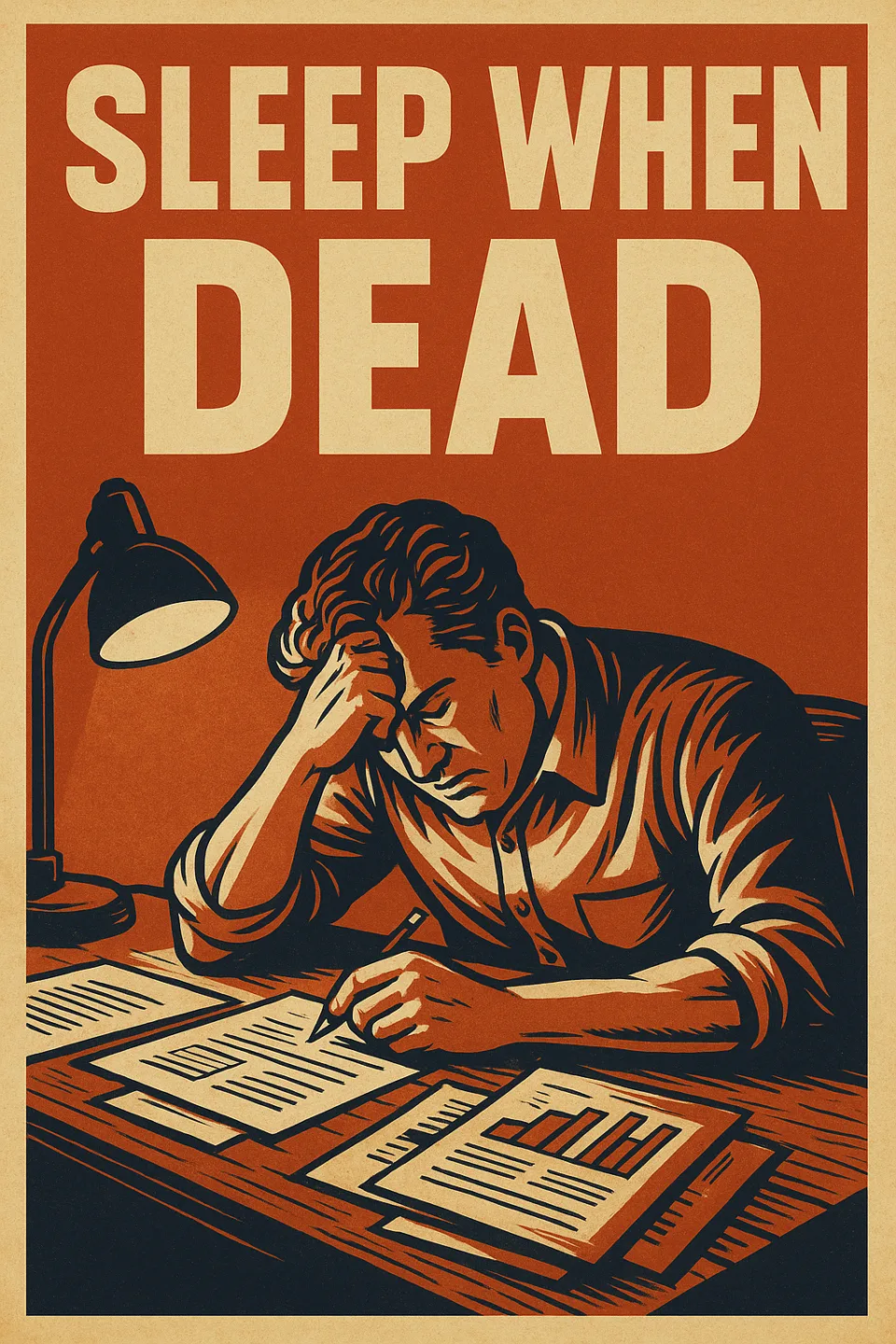
Today, you can find its spiritual descendant not on prison gates, but on bumper stickers, podcasts, and Instagram stories. You’ll hear it in the voice of the CEO who sleeps four hours a night. In the man at the bar bragging about working three jobs. In the influencer filming a “rise and grind” morning routine at 4:30 a.m., eyes glazed like they've forgotten how to blink.
We don’t say “work will make you free” anymore.
We say “no days off.”
We say “I’ll sleep when I’m dead.”
We say “I’m booked and blessed.”
It’s still a lie.
But now it’s self-imposed.
The Religion of Work
America didn’t just inherit the Protestant work ethic—it deified it.
Hard work isn’t just a value here; it’s a form of moral proof. A theology. A blood sacrifice to the gods of independence and meritocracy.
We admire people who work themselves into the ground. We treat burnout like a rite of passage. We speak of exhaustion with pride—like war wounds. “He worked 80 hours a week.” “She never took a vacation.” “He built it from nothing.” There’s a holiness to hustle, a purity to pain.
And buried in that, as always, is shame.
If you’re not working, what are you?
Lazy? Broken? Ungrateful?
Not hustling, not maximizing, not scaling—means not deserving.
Somewhere along the line, we began to confuse labor with worth.
And in that confusion, we chained ourselves to the machine we thought we were driving.
Not All Work Is Violence
But here’s where the mirror cracks.
Because not all labor is punishment. And not all discipline is delusion.
For centuries, monks and mystics have worked with their hands as a way of losing their minds. They scrubbed floors, grew gardens, baked bread—not because it earned them freedom, but because it erased the illusion that there was anything else to seek.
In Zen monasteries, every task is the practice.
You chop wood. You carry water. You do it with your full attention, not to prove your value, but to forget it. You don’t become free by working—you remember that you were never imprisoned.
This is labor as prayer. As rhythm. As surrender.
Compare that to the man who clocks into Amazon at 6 a.m., pisses in a bottle, and walks 20,000 steps before sundown. Who goes home sore, alone, and still can’t afford to rest.
That’s labor as extraction. As erasure. As survival theatre.
One version of work simplifies consciousness.
The other shatters it.
Mirror Theory: What Work Reflects
In Mirror Theory, every person and pattern in your life reflects a part of you—your beliefs, your distortions, your unspoken agreements with reality.
So what does our obsession with overwork reveal?
It shows a culture terrified of stillness. A society so disconnected from intrinsic value that it must generate external proof just to feel permitted to exist.
To the mirror of hustle, we offer a silent truth:
I do not believe I am enough unless I am producing.
And the mirror agrees.
This is why rest feels dangerous.
Why play feels childish.
Why presence feels like laziness.
In this funhouse, the harder you work, the more distorted you become.
The Myth of Merit, The Machinery of Shame
There’s a particular cruelty in the way populist rhetoric weaponizes labor.
"Hard-working Americans" becomes both a virtue signal and a subtle cudgel. As if struggle itself were proof of goodness. As if working multiple jobs to survive isn't a symptom of systemic failure, but a badge of honor.
We love these stories.
The waitress who raised three kids alone.
The immigrant who built an empire with “just a dream.”
The veteran who “never asked for a handout.”
They are beautiful, resilient people. But their stories are often used to distract from the machine chewing through everyone else.
We worship their grind but ignore the grindstone.
A Different Kind of Freedom
And yet—beneath all this, beneath the propaganda and the metrics and the performance—there’s still something sacred waiting to be reclaimed.
Labor can be medicine.
It can be rhythm.
It can be a way to return to the body, to silence, to service.
But only when it’s untangled from worth.
Only when it isn’t the currency we trade for permission to exist.
I’m not against effort. I’m not against mastery or grit or making things with your hands.
I’m against the lie.
The one that says you are only as good as your output.
The one that says rest must be earned.
The one that says suffering proves you’re doing it right.
Final Reflections
“Arbeit macht frei.”
It was a lie then. It’s a lie now.
But there’s a truth hidden beneath it—twisted, obscured, waiting to be revealed:
Real freedom doesn’t come from working yourself to death.
It comes from remembering you were never unworthy in the first place.
So sweep the floor like a monk, not a martyr.
Clock out when your soul asks you to.
Build a life where work is an offering, not an obligation.
And let the mirror reflect something other than exhaustion.