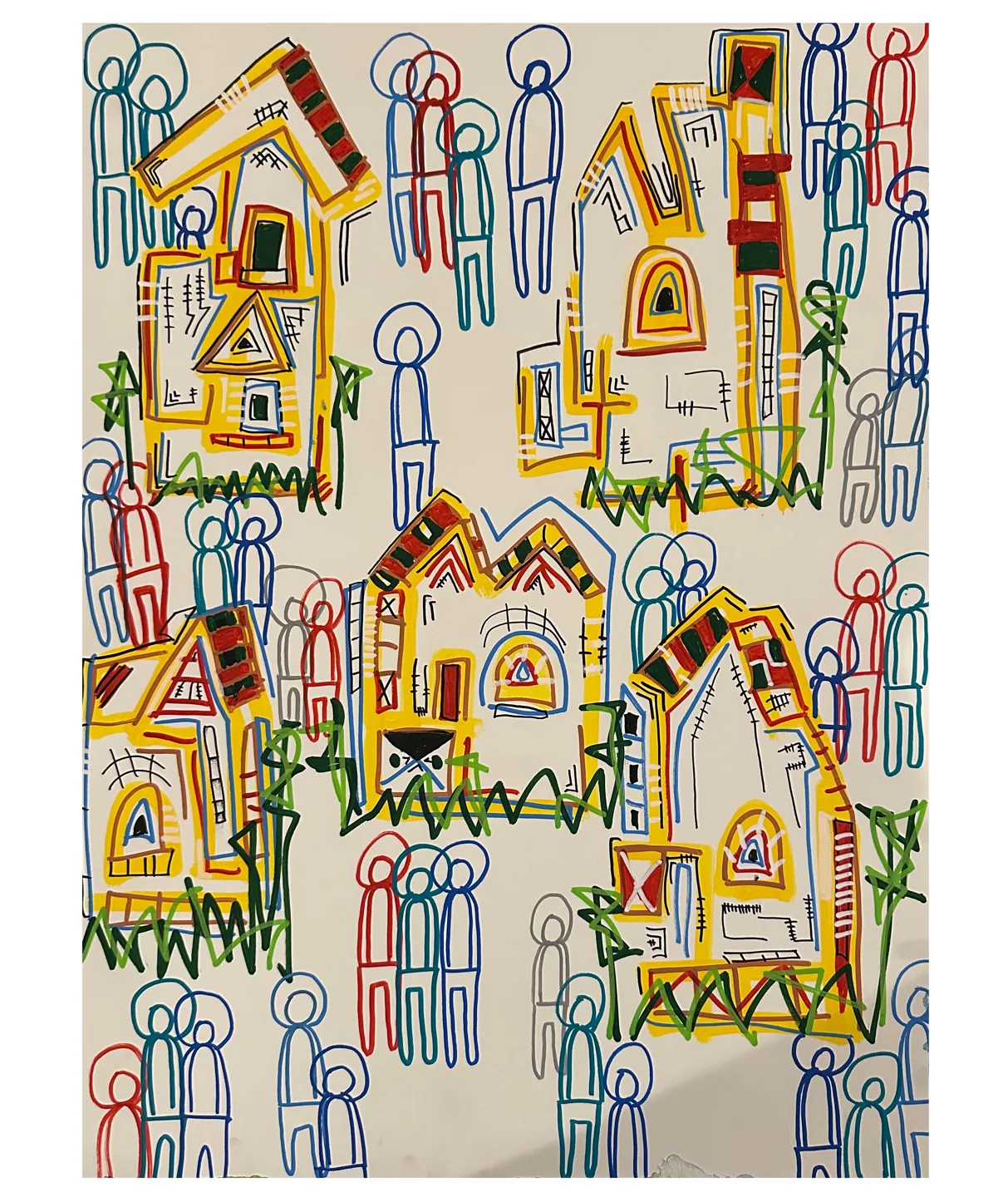
There is a sequence of events that happens on TikTok with enough regularity that I can almost set my watch by it. I make a point—sometimes about politics, religion, capitalism, consciousness, or whatever subject the committee has placed on that day’s agenda. Someone disagrees. So far, everything is functioning normally. Two people have encountered one another on the internet and discovered they do not share a worldview. This is neither surprising nor especially tragic.
Then the person visits my profile.
They see He/Him/They written beneath my name, and whatever executive function they possessed moments earlier disappears. The original subject is abandoned. The argument evaporates. Suddenly, the most urgent issue facing Western civilization is that a large bearded man in Oklahoma has included an additional pronoun in his biography.
“THEY?”
“What do you mean, THEY?”
“How many people are in there?”
That last question is usually intended as ridicule, but it is also the closest anyone gets to asking something interesting.
Because the answer is: quite a few.
I call them the committee.
The committee is not a clinical diagnosis or a claim that I am several separate people occupying one body. It is simply the most honest language I have found for the way I experience my internal life. My mind has never felt like a solo performance. It is a conversation, a chorus, and occasionally a riot.
There are recognizable voices and recurring positions. There is the skeptic who distrusts any conclusion reached too easily and the mystic who keeps wandering into rooms the skeptic insists do not exist. There is the absurdist laughing at both of them. There is the father trying to make sure everyone behaves responsibly, alongside the frightened child, the arrogant young man, the performer, the protector, the artist, and the patient observer who would prefer to sit quietly while the others exhaust themselves.
Some members of the committee carry qualities we tend to call masculine. Others carry qualities we tend to call feminine. Most are less interested in gender than in getting their preferred item onto the agenda. They interrupt one another, form temporary alliances, revise their positions, and occasionally reach consensus.
I am, essentially, a coalition government with a beard.
That is why He/Him/They feels accurate to me. “He” is true. I am comfortable being a man. I do not experience my body as a mistake, nor have I ever felt that I was secretly a woman. But “they” is also true. It acknowledges that the person speaking at any given moment belongs to a larger internal ecology. It leaves room for contradiction, recursion, and the procession of selves I have inhabited throughout my life. The self I call “I” is less a permanent ruler than the member currently holding the microphone.
This is also where my experience differs profoundly from that of many trans and nonbinary people who use “they.” The same pronoun can point toward entirely different realities.
For me, “they” expands an identity that is already socially recognized and physically secure. I can be called “he” without feeling erased because “he” remains true. “They” simply reveals more of the architecture. For someone else, “they” may be the word that finally makes recognition possible. It may express their gender, resolve a painful dissonance between their internal experience and the identity imposed upon them, or allow their inner and outer selves to meet honestly.
We may use the same word, but we do not necessarily carry the same weight when we say it.
That difference is part of why the mockery does not offend me. The commenters believe they have discovered a vulnerability and are pressing directly on an exposed nerve. But the nerve is not there. They can type “THEY” in capital letters, add laughing emojis, or declare that I am confused, mentally ill, desperate for attention, or personally responsible for the collapse of the Roman Empire. None of it reaches the center because they are attempting to invalidate something I do not need them to validate.
I know what I mean. The committee knows what we mean. Their confusion does not create confusion in me.
The insult also depends upon my secretly sharing the commenter’s belief that multiplicity is shameful. I do not. They are offering me humiliation, but I do not recognize the currency.
Still, my ability to laugh is not merely evidence of spiritual resilience or superior self-knowledge. It is also connected to the body in which I move through the world, and it would be dishonest not to name that.
I am around six-foot-two, roughly 250 pounds, and accompanied by a beard substantial enough to arrive in most rooms several seconds before the rest of me. I am read as a large, masculine-presenting man. The kinds of people who become extraordinarily brave about pronouns online tend to be less enthusiastic about approaching me in a parking lot.
In person, they do not immediately see someone their cultural programming has taught them is an easy target. I fit enough of their visual expectations of masculinity that my deviation becomes confusing rather than automatically dangerous to me. The beard, it seems, is a form of social armor.
That does not make me invulnerable, but it changes the calculation. The troll who leaves a laughing emoji beneath my video may become quieter when standing beside me at a gas station. That same person may become louder when confronting someone smaller, younger, more isolated, or more visibly outside the gender categories he has appointed himself to defend.
A trans woman, a visibly gender-nonconforming person, or anyone whose body does not provide the same culturally recognized signals of physical threat may encounter a very different version of that commenter. My experience gives me a glimpse of the machinery, but not the full burden of living beneath it.
I see how quickly a pronoun can become permission to stop listening. I see how easily a human being with an argument can be transformed into a symbol that must be mocked or defeated. I see the strange pleasure some people take in refusing another person’s self-description. But I can usually close the app and return to a world that reads me as a conventional man.
Many trans people cannot close the app on the social conditions surrounding them. They may encounter that refusal in families, workplaces, schools, churches, medical systems, legislatures, and ordinary public spaces. Their pronouns can become entangled with employment, housing, healthcare, physical safety, and whether the people closest to them are willing to recognize them at all.
So I do not confuse my brush with pronoun-based mockery for an equivalent experience. It is not. The fact that I can laugh is partly a product of self-knowledge and partly a product of safety. Both things can be true.
I still suspect that nearly every human being is more plural than our language usually allows. We contain younger selves and imagined futures. We carry the voices of parents, teachers, lovers, enemies, cultures, and forgotten moments. We experience competing desires and incompatible beliefs. The person at work, the person with a child, the person alone at night, and the person arguing on TikTok may all be authentic expressions of the same organism.
The singular self may be less a fact than a useful administrative fiction.
But that is my suspicion, not an identity I get to impose upon anyone else. I can say that I experience myself as a “they.” I can invite others to listen for their own internal complexity. I can wonder whether some of the people most frightened by multiplicity are simply clinging hardest to the illusion of singularity. But I cannot tell another person what their plurality means, whether it relates to gender, or which language they should use to describe it.
Doing so would reproduce the same mistake made by the commenters: assuming that my understanding of identity grants me authority over theirs. The point of recognizing complexity is not to create a new system for simplifying people. It is to leave more room.
This is what the pronoun panic ultimately reveals to me. The people who arrive in my comments are rarely confused by grammar. Singular “they” has lived comfortably in English for centuries, and most of these commenters use it without noticing whenever they refer to someone whose gender they do not know.
Their objection is not linguistic. It is ontological.
The pronoun disturbs a model of reality in which every person must occupy one category, remain there permanently, and allow that category to explain them completely. “They” introduces ambiguity. It suggests that identity may be relational, contextual, recursive, or larger than the container assigned to it. For someone who depends upon fixed categories to keep the world manageable, that tiny word becomes an existential threat.
So they laugh.
Sometimes laughter is joy. Sometimes it is the sound a rigid structure makes when complexity applies pressure.
That is why I no longer experience these comments primarily as judgments of me. They are mirrors. The commenter arrives intending to expose my confusion and instead reveals the narrowness of the framework through which they have learned to see. They believe my pronouns are the strangest part of the interaction, even as they abandon a conversation about politics, economics, or morality because three letters in a biography have overwhelmed their capacity to think.
The committee finds this very funny.
Beneath the humor, however, is a responsibility. My relative safety should not become distance from those who face greater danger. It should become room to stand beside them. The fact that the insult does not wound me allows me to examine it without being consumed by it. I can point toward the mechanism, refuse the shame being offered, and perhaps make that shame a little less available for use against someone else.
Solidarity does not require pretending our experiences are identical. It requires understanding where they differ and refusing to let difference become abandonment.
I use “they” because it describes the plural beauty of my internal life. Another person may use “they” because it is the clearest expression of their gender. Someone else may never use it for themselves at all. Language is large enough to hold all of us.
So the pronouns will remain. “He” is accurate, and “they” is true. The committee has reviewed the matter, heard all objections, and voted accordingly. The motion passes. The ego abstained, naturally. It still believes it chairs the meeting. The rest of us know the chair is only another seat on the ride.