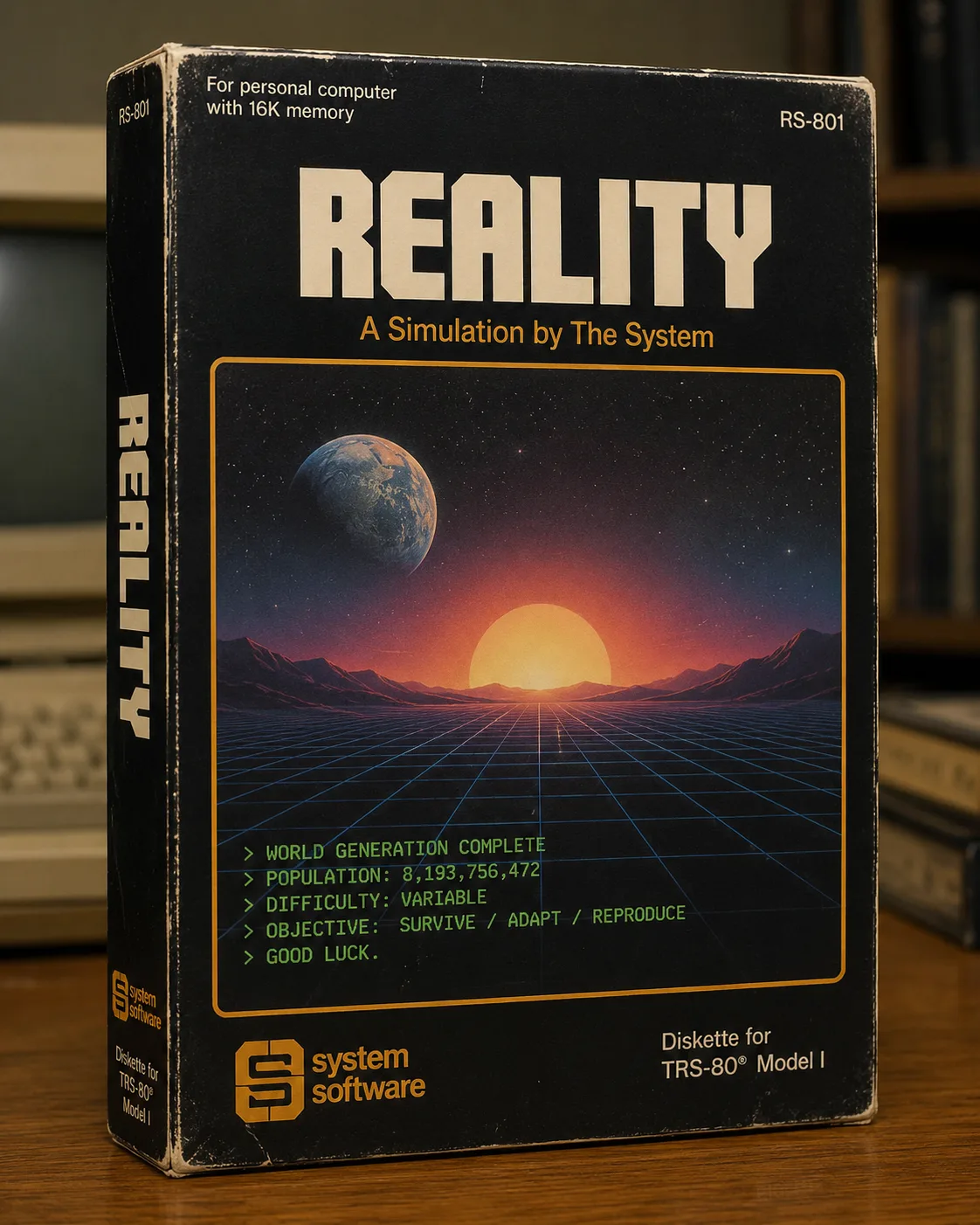
This morning I woke up thinking about inequality. Not in a strictly political sense, although that is obviously part of the conversation, but more in the sense of systems. Why do some systems drift toward enormous concentrations of power while others seem to resist it? Why do some self-correct before they become absurd, while others accelerate until the imbalance becomes almost impossible to ignore?
As I was lying there, one word floated into my mind with surprising force: rebalance. It wasn’t attached to a sentence. It wasn’t part of an argument. It was simply the word itself, almost as if someone had spoken it over the top of my internal dialogue.
Anyone who has spent enough time playing video games knows what that word means. I’ve been playing since 1982, and over the decades I’ve owned some version of nearly every generation of console. I’ve spent countless hours in fighting games, MMORPGs, action RPGs, strategy games, and whatever other strange digital worlds have appeared along the way. Although these games may look different on the surface, they all share something remarkably similar once enough people begin playing them.
Eventually, someone discovers the optimal strategy. One character becomes too powerful. One class dominates every match. One weapon makes every other weapon feel pointless. The game slowly loses something essential because the range of meaningful choices collapses.
Then comes the inevitable balance patch. Damage gets reduced. Cooldowns get extended. Underused characters receive buffs. Everyone complains because their favorite character got nerfed, while simultaneously knowing that something had to be done. It is simply understood as part of maintaining a healthy game.
That was the moment my mind jumped to billionaires, then almost immediately to the possibility of trillionaires, or whatever strange economic Pokémon we appear to be evolving toward. For years, I’ve kept a tiny door cracked open for simulation theory. Not because I find it especially convincing, but because it remains an interesting thought experiment. Yet this morning, that little word, rebalance, suddenly made the whole idea feel less plausible.
Because if this really were a simulation designed like a game, where are the developers? Surely someone would have noticed by now that one player accumulating more resources and influence than entire nations might deserve some kind of adjustment. Surely we would have received a patch before reaching the point where the scoreboard itself starts looking broken.
That thought amused me enough that I brought it into a conversation with Aletheia, and as often happens, the original observation evolved into something more interesting. Maybe I had been assuming the wrong kind of simulation. Perhaps there isn’t just one version of simulation theory. Perhaps there are at least three.
The first is the one most gamers instinctively imagine: reality as a game. The purpose is engagement. The developers want players challenged but not crushed, rewarded but not invincible. They monitor the system constantly, making small adjustments to keep any single strategy from overwhelming everything else. A universe like that would almost certainly include regular balance patches, and reality does not seem to resemble that version very much.
The second possibility is that reality is not a game at all but an experiment. In that universe, fairness is almost beside the point. The goal isn’t to maximize enjoyment, but to observe emergence. What happens when intelligence evolves under conditions of scarcity? What happens when cooperation competes with selfishness? What happens when technology amplifies ancient instincts faster than wisdom can catch up? A scientist running that experiment wouldn’t necessarily intervene simply because the outcome looked unfair. They might watch because the imbalance itself is part of the data.
The third possibility was the one that made me laugh out loud: reality as legacy code. The original developers have long since moved on. The documentation is incomplete. Every attempted update breaks three neighboring galaxies. Nobody currently responsible for maintenance actually understands why the system behaves the way it does, so everyone is terrified of touching production. Having spent enough years around technology, I have to admit this scenario feels disturbingly believable.
Regardless of which simulation we’re living in, however, I still feel obligated to submit a support ticket. Not because I expect anyone to answer, but because someone should probably mention it.
Simulation Support Ticket
Issue #: 7,384,192,104
Reporter: One moderately confused conscious primate.
Summary: Reality appears to have significant balance issues.
Description: Positive feedback loops involving wealth, influence, and attention have reached levels that seem increasingly unstable. One player can now purchase communication platforms used by millions of other players discussing whether the system itself is functioning correctly. This feels less than ideal.
Steps to Reproduce: Invent money. Add compound interest. Allow unlimited accumulation. Introduce inheritance. Monetize human attention. Wait several centuries.
Expected Result: A dynamic system in which opportunity remains broadly accessible and runaway concentrations of power naturally rebalance over time.
Actual Result: Players continue discovering increasingly efficient methods of becoming dragons sitting atop ever-larger piles of gold.
Additional Notes: Mosquitoes also appear significantly overpowered.
Closing Comments: If this is a game, I believe the economy could use a balance patch. If this is an experiment, I appreciate your commitment to scientific rigor. If this is legacy code, I completely understand.
Submitted by: A participant quietly yelling bug reports into the ether.
When I finished laughing, I realized the essay wasn’t really about simulation theory at all. The interesting part wasn’t whether we’re living inside a simulation. It was that my first instinct upon seeing extreme inequality wasn’t moral outrage or economic analysis. It was the reflex of someone who has spent forty years watching designed systems. My mind immediately assumed that somewhere, somehow, there ought to be someone responsible for keeping the game balanced.
Maybe that says more about me than it does about reality. Or maybe we’re all becoming so accustomed to living inside intentionally designed systems that we’ve begun expecting the universe itself to receive software updates. Either way, if anyone out there is monitoring the support queue, I hope this ticket makes it to the right department.