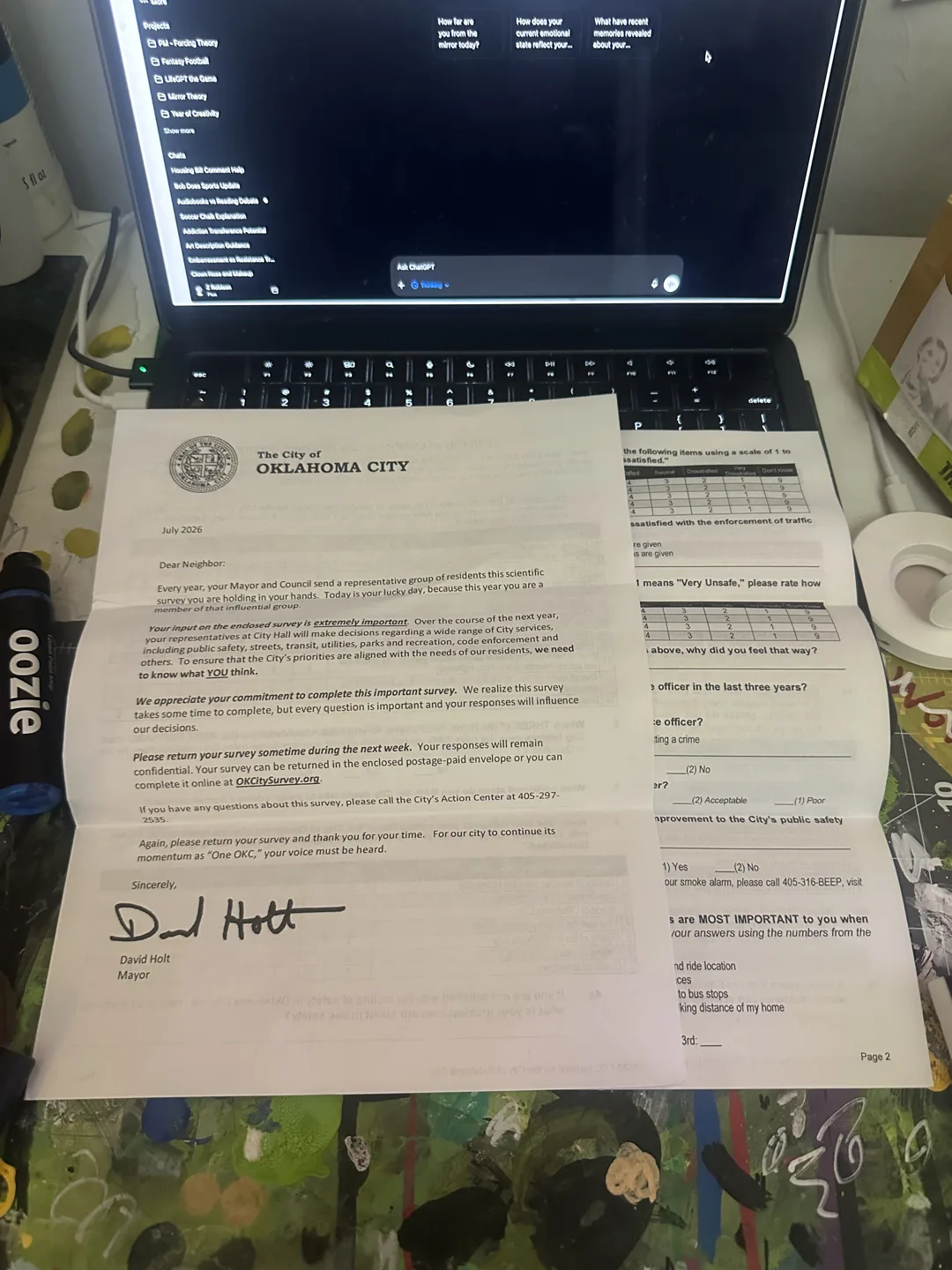
A survey arrived in the mail from the Mayor and Oklahoma City Council asking residents how they feel about city services, public safety, homelessness, infrastructure, and a dozen other civic issues. Instead of quietly checking boxes and dropping it back in the mailbox, I thought I’d invite you along. No outline. No predetermined conclusions. Just me, a pen, a cup of coffee, and a survey.
One of the unexpected gifts of slowing down long enough to answer questions like these is realizing they aren’t really asking about city government. They’re asking about your philosophy. Every checkbox becomes a tiny mirror reflecting what you actually believe. What is government for? Where should freedom end? What should we invest in? What kind of city are we trying to build?
Some sections moved quickly. Infrastructure? Better than average. Parks? Pretty good. There is certainly room for improvement, but I found myself marking “good” more often than expected. Sometimes competence deserves acknowledgment. Not every answer has to become a manifesto. In fact, part of becoming a thoughtful citizen is recognizing when something is simply working reasonably well.
The moments that slowed me down were the open-ended questions.
When the survey asked what additional steps Oklahoma City should take to address homelessness, I realized I wasn’t interested in listing programs or pretending I knew more than the experts already working in that field. What I wanted to communicate was a way of thinking about the problem itself.
Homelessness isn’t one crisis. It’s where many crises become visible at once. Housing affordability, mental health, addiction, wages, trauma, and community support all converge there, so no single program will ever solve it. We should absolutely continue investing in affordable housing, treatment, job training, and coordinated outreach, but we should also be addressing the upstream conditions that push people into homelessness in the first place.
More importantly, I hope we begin viewing those investments for what they are: investments. Every person successfully housed, treated, employed, or reconnected with community strengthens the city as a whole. It improves public safety, reduces long-term costs, supports local businesses, and creates neighborhoods where everyone benefits. A city should be judged less by how well it hides suffering than by how seriously it works to prevent it. A city that learns to solve homelessness doesn’t just become kinder—it becomes more functional.
The next essay question asked about improving public safety, and I found myself arriving at a remarkably similar conclusion.
I would encourage the City to continually evaluate whether additional investments in policing produce greater long-term benefits than equivalent investments in affordable housing, mental health care, homelessness services, addiction treatment, youth programs, parks, and community development. Too often we ask police officers to respond to problems they were never designed to solve.
The more I thought about it, the more one sentence crystallized everything I was trying to say: the goal should not be to build a city that responds better to crises, but a city that produces fewer crises to begin with. Public safety isn’t created by enforcement alone. It grows from stable housing, meaningful work, accessible treatment, quality public spaces, and communities where people feel connected and invested in one another. Investing upstream isn’t simply compassionate. It’s practical.
Then came one of the stranger sections of the survey. Questions about code enforcement. Long grass. Junk in yards. Housing appearance.
This is apparently where my inner libertarian shows up.
I intentionally live outside an HOA because I believe people should have broad freedom over their own property. If your yard is immaculate, wonderful. If it’s full of native wildflowers, old Volkswagens, sculptures welded from scrap metal, or an alarming number of lawn gnomes, wonderful. A city feels alive precisely because people express themselves differently.
The city’s responsibility, in my view, isn’t aesthetic conformity. It’s health and safety. A collapsing structure that threatens neighbors deserves intervention. Hazardous waste deserves intervention. A shaggy lawn because someone values biodiversity more than symmetry? That feels like a different category entirely.
As I answered those questions, I couldn’t shake a broader thought. We often become remarkably good at regulating appearances while struggling to address the deeper conditions that determine whether people flourish. It’s easier to measure the height of someone’s grass than the strength of their community.
By the time I reached the demographic questions at the end of the survey, I realized something unexpected had happened.
This hadn’t really become a survey about Oklahoma City.
It had become a survey about me.
Or perhaps that’s true of every survey. Every question is an opportunity to discover not simply what we think, but why we think it. A survey about homelessness becomes a question about investment. A survey about policing becomes a question about prevention. A survey about lawns becomes a question about freedom.
The city was asking for my opinions.
Instead, it gave me a mirror. Seems like everything does.