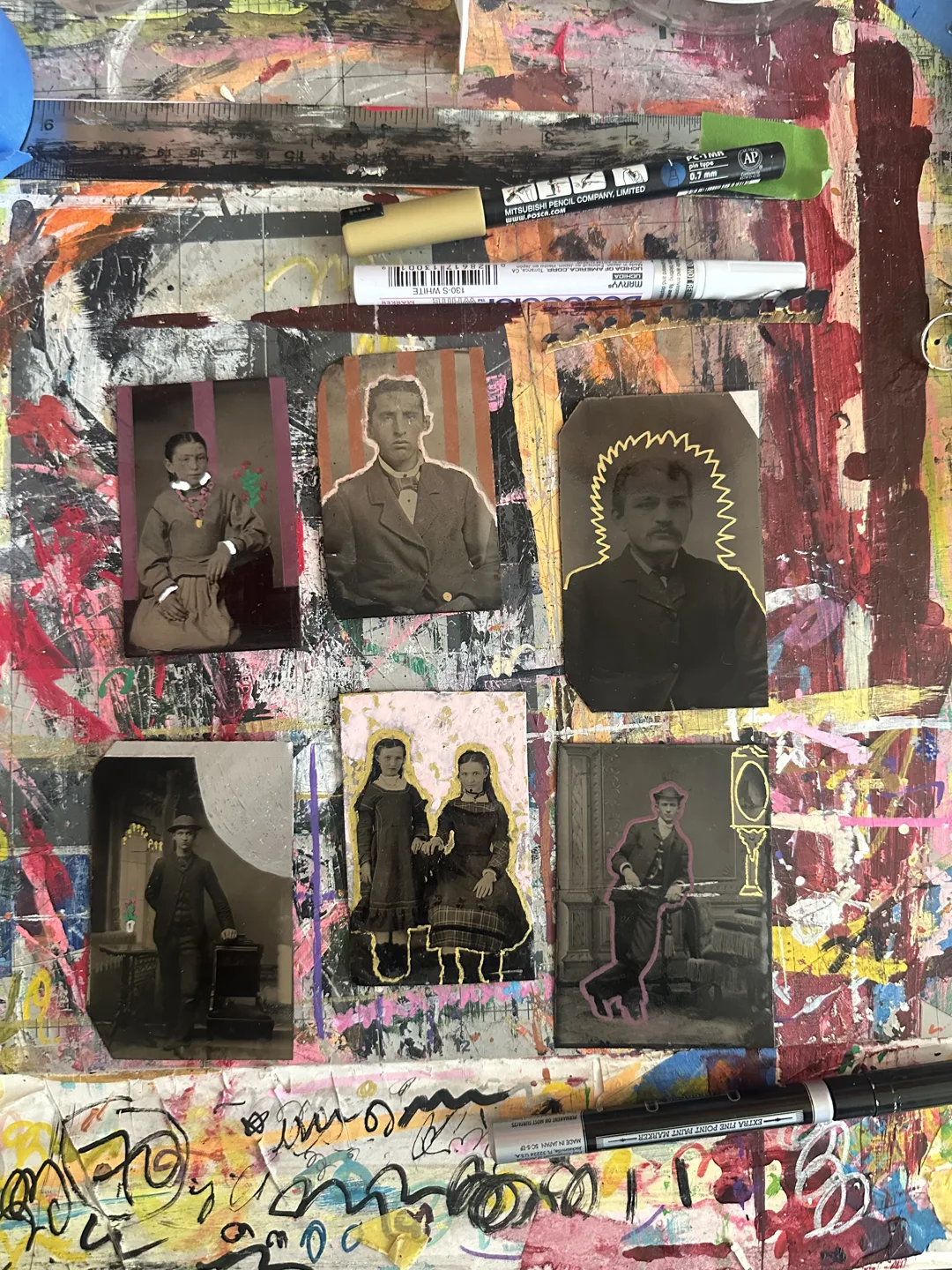
I’m working on a new project for the art markets and shows coming up next month: I’m taking vintage tintype photographs and painting over them—not on the figures, not on the faces, not in a way that violates the person inside the image. I’m leaving them intact. What I’m doing instead is adding a background, a pop of color, a bird, a snake—small pieces of my own visual language placed into the past like a signal flare. The tintype remains the center of gravity, and my paint becomes the atmosphere around it.
I fell in love with tintypes years ago when I owned my small vintage shop in Boulder County, Curating the Cool. There was something about them that always felt different from other photographs, even other antiques. They’re delicate and hard at the same time—thin metal carrying a presence that refuses to become only an object. A tintype doesn’t feel like a “picture” so much as a held moment. A life pressed into a surface. If you’ve ever held one, you know what I mean when I say they contain a kind of inherent magick. Not magick in the Halloween sense—more like the subtle uncanny of being seen by someone who has been dead for a hundred years.
Back then, I wasn’t just selling objects—I was curating them. Choosing what to place in front of people. Deciding what deserved another round of attention. In a strange way, this project feels like that same gesture looping back on itself. Only now I’m curating something more intimate: my own interventions. Not replacing the object’s story, but arranging a new relationship around it, and letting the tintype remain the unquestioned authority in the room.
After I closed the shop and eventually moved away from Colorado, I kept a collection. For a long time they stayed stored away, preserved and sleeping. During the pandemic, though, I participated in a daily art prompt series run on Instagram by a local gallery called DNA Galleries. I was making digital pieces constantly—quick experiments, strange little visual rituals. One day a prompt (I can’t even remember which) pushed me to photograph some of the tintypes and alter them digitally. The results landed somewhere between cyberpunk and the 1870s: neon and decay, glitch and history, the past wearing a future skin. I loved that series, and then time moved on and the files lived quietly in the background of my mind.
Recently, while thinking about the upcoming shows, I remembered that digital project and realized I wanted to make it real. Not screen-real—hand-real. Paint-real. I wanted the object itself involved, not just the image of it. So I pulled the tintypes out of storage, and the moment they were in front of me I knew I’d found the right project.
Part of what makes it perfect is practical: these are smaller pieces, approachable for market settings, a way for people to take home a fragment of my world without needing to commit to a large canvas. But the deeper reason is that it combines multiple versions of me in one act. The Z who owned an antique shop. The Z who makes art. The Z who practiced magick. The Z who still believes certain objects aren’t inert if you approach them the right way. Every time I place a mark, all of those selves are present, layered together like the paint itself.
There’s also something about working on a tintype that immediately changes the rules. A digital canvas offers infinite undo, infinite options, infinite “maybe.” A tintype doesn’t. A tintype has physical constraints and a literal history. It comes with a person inside it who lived, stood still long enough to be captured, and then disappeared into whatever came next. Because of that, it’s impossible to treat the surface as neutral. It has its own gravity, and you either respond to it or you don’t.
This is where the project starts to feel like an embodied version of what I’ve been calling Forcing Theory. In my own shorthand, Forcing Theory is the idea that constraint isn’t merely limitation—it’s an engine. A boundary that generates motion. A forcing function that demands choice. When I paint digitally, I can drift. When I paint on a tintype, the object forces commitment. It silently insists: you don’t get infinity. You get this. This person. This shape. This era. Now respond.
And the constraint isn’t only space or surface—it’s will. Not in a spooky, cinematic way, but in the way a human presence can persist as pressure. The face refuses to become background. The posture sets terms. Even the decision not to mark the figure becomes part of the negotiation. It can feel like a subtle, uncanny game of chicken: how close can I get without crossing the line? How much can I add without overwriting? The tintype doesn’t move, but it doesn’t yield either.
That’s where Mirror Theory enters the room. Mirror Theory, for me, is the recognition that we don’t encounter reality directly; we encounter it through mirrors. People, experiences, beauty, conflict, memory—each one reflects something back at us. Sometimes the reflection is clean. Sometimes it’s warped like a funhouse mirror. Sometimes it’s painful. But it’s always telling, if you’re paying attention. Tintypes are a specific kind of mirror: they reflect you through someone else, and they do it across time. The “other” in the mirror is separated from you by a century, and that distance creates a strange intimacy. You can’t fully know them. You can’t complete their story. You can’t claim them. You’re forced to respect the boundary of their unknowability.
That boundary is part of the collaboration. By refusing to mark their faces, I’m making a pact: I won’t overwrite you. I won’t turn you into my character. But I will respond to you. I’ll build a world around you. I’ll place my symbols near your silence. I’ll let my modern myth-language orbit your stillness. In that way, it becomes less like painting-over and more like painting-with—an agreement between my present and their past.
The most unexpected part of this project has been what happens in my mind while I work. I’ve been having conversations with the subjects. Not in a theatrical séance way—more like fleeting transmissions. I’ll hover over a piece and suddenly a color feels requested. A line insists. A shape arrives with the emotional certainty of intuition. It isn’t a full narrative, and it isn’t constant, but it’s frequent enough that it’s changed how I think about the process. I’ve been bouncing between thirty tintypes, giving each one a few minutes, then moving to the next as if another “voice” is asking for its turn. It’s like managing a room full of quiet people who each want to be heard without being interrupted.
If you zoom out, it’s kind of hilarious: a grown man in the present negotiating with 19th-century strangers about whether they want a teal stripe or a golden aura. But while it’s happening, it doesn’t feel ridiculous. It feels like listening. Like the art isn’t coming from me alone.
Maybe that’s the truest form of the magick here. Not in believing ghosts are literally talking, but in what happens to me when I treat the object like it has agency—when I approach the tintype as a living constraint instead of a dead surface. It shifts my relationship to creativity from control toward dialogue, from performance toward presence. And because I’ve lived multiple versions of myself, this project feels like a convergence ritual: a place where all those selves can show up without being forced into one tidy brand.
Underneath it all, there’s also a quiet tenderness toward the unknown. These people were once real enough to be photographed. They had hands. They got tired. They laughed at something. They worried about money or weather or babies or illness. Their lives were vast to them and anonymous to me, and now they’re in my hands. By not marking their faces, I’m admitting I can’t know them. But by painting around them, I’m also saying: you’re still here enough to change the present, and I’m here enough to answer.
So I keep moving between these small metal portals, letting each one have its turn. A bird here. A snake there. A line of gold like a halo. A pop of neon like a glitch in the timeline. Little pieces of my art placed into the past. And somehow, the past keeps placing pieces of itself into me.