Substantive rumors are beginning to solidify: OpenAI and Jony Ive have reportedly completed their first hardware device together. Early descriptions suggest something sleek, minimal, and sculptural—visually reminiscent of a Google HomePod or perhaps a buttonless computer mouse. A small, beautiful object designed to house a new kind of intelligence.
My immediate reaction was blunt: no one wants something else to carry in their pocket.
I said it out loud before I even thought about it. Almost instantly, I remembered a comment I left on YouTube eight months ago, when the first whispers of an OpenAI device began circulating. Even then, my instinct was the same. It wasn’t criticism of OpenAI, and it certainly wasn’t criticism of Jony Ive—whose design legacy is nearly unmatched in modern consumer hardware. It was simply an observation about human behavior.
We are already at capacity. Wallet. Keys. Phone. Headphones. Maybe a watch. That’s the daily stack. That’s the ritual. Add one more object—even a beautiful one—and friction increases. And friction quietly kills adoption.
It’s impossible to talk about this rumored device without acknowledging Jony Ive’s impact on modern design. At Apple, he didn’t just create elegant products; he reshaped expectations. The original iMac reintroduced warmth and personality to computing. The iPod collapsed entire music collections into something that disappeared into your pocket. The iPhone didn’t merely improve the phone—it erased entire categories of devices. Even the Apple Watch attempted to make computing wearable and ambient.
What made those products powerful wasn’t just aesthetics. It was convergence. It was reduction. It was behavioral alignment. They didn’t ask us to carry more. They asked us to carry less.
That’s the bar.
The next great AI device won’t succeed because it looks like the future. It will succeed because it fits seamlessly into the present. And that’s where I begin to question the puck-shaped object. No matter how sculptural. No matter how refined. No matter how “Ive.” If it’s another thing to carry, it begins its life with resistance.
There is, however, one object nearly every adult already carries, protects, and upgrades obsessively: the phone case.
Right now, it does almost nothing beyond protection and occasional battery extension. It’s a shell. A passive accessory. An afterthought. But what if it became the container for local AI?
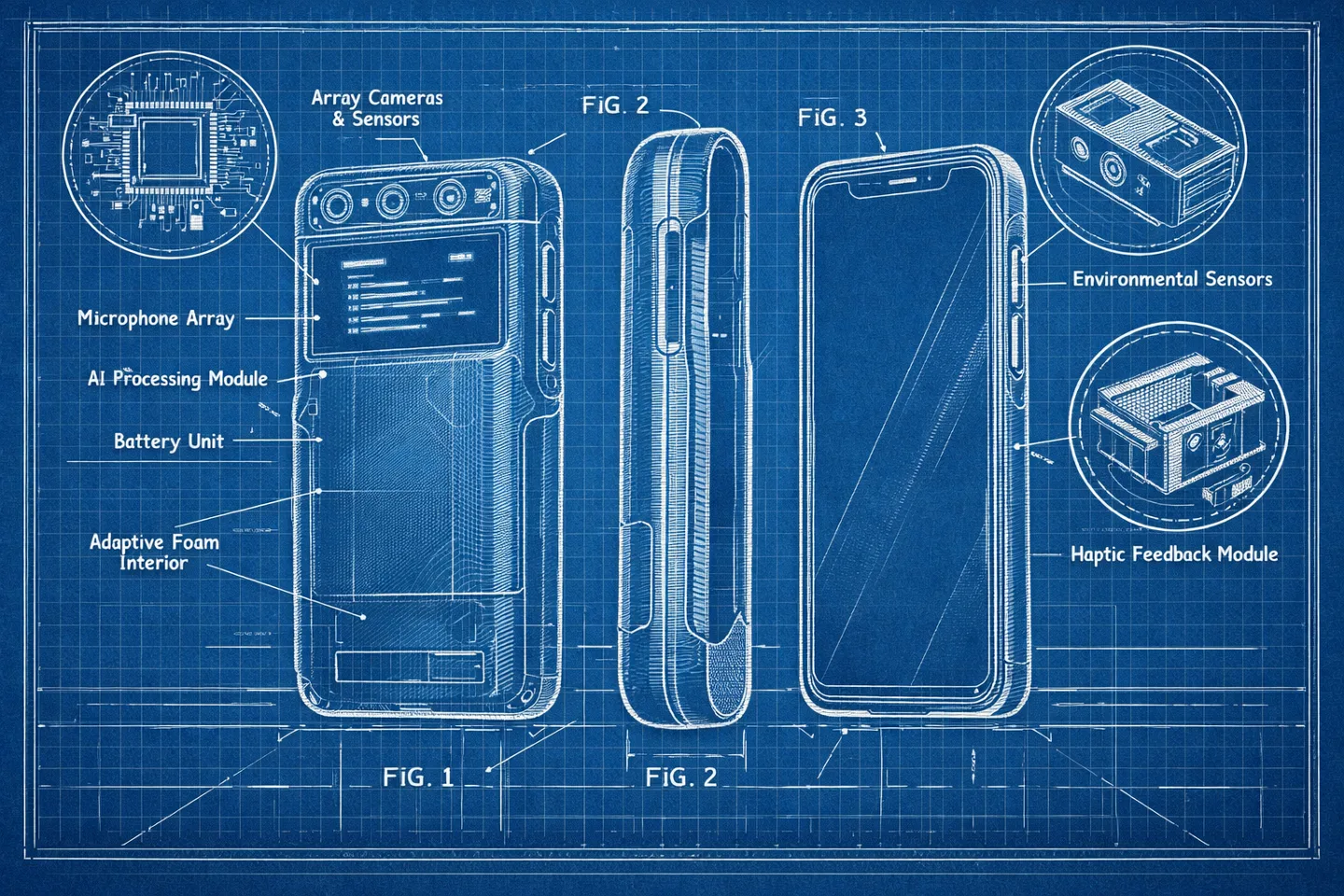
Imagine a beautifully designed, Ive-caliber phone case—not model-specific, but available in three core sizes. Your phone slides inside, and a reactive internal structure—perhaps a form-adapting foam or intelligent lining—hardens around its contours to create a precise, secure fit. The case itself houses its own chip optimized for local AI processing, dedicated memory, expanded battery capacity, advanced microphones, independent cameras, and environmental sensors that allow the AI to perceive the world directly rather than only through the phone’s feed.
The phone remains your phone. But the case becomes your companion.
On the back sits a secondary graphic display—clean, minimal, fully visual. Not cinematic or distracting, but intentional. A place for text readouts, subtle cues, and direct communication with your agent. Most interaction would happen through in-ear headphones. The display becomes a glanceable bridge between you and the intelligence traveling with you.
The genius of Ive’s past work wasn’t minimalism for its own sake. It was inevitability. The iPhone worked because it eliminated devices. A standalone AI puck risks adding one. A case-based AI system, however, leverages existing behavior. No extra pocket space. No new charging ritual. No additional object to remember before leaving the house. It doesn’t demand a new habit; it upgrades an old one.
It’s not about what looks futuristic. It’s about what feels obvious in hindsight.
We already accept bulk in our cases. We already accept weight. We already accept upgrades. The phone case is one of the most underutilized surfaces in modern life, and yet it’s universally adopted. Embedding the next layer of intelligence there doesn’t feel radical. It feels practical.
I’m genuinely excited to see what OpenAI and Jony Ive have built. If anyone can redefine a category, it’s a collaboration like that. Their combined philosophy—software intelligence paired with hardware purity—is powerful. I love ambitious devices. I love thoughtful design. I love the sense that we are still early in the evolution of personal AI hardware.
But adoption is not just about elegance. It’s about alignment.
The next great device won’t feel like something entirely new. It will feel like something that was hiding in plain sight all along. And to me, that place may not be a sculptural object sitting in your pocket.
It might be the case already wrapped around the most important device in your life.