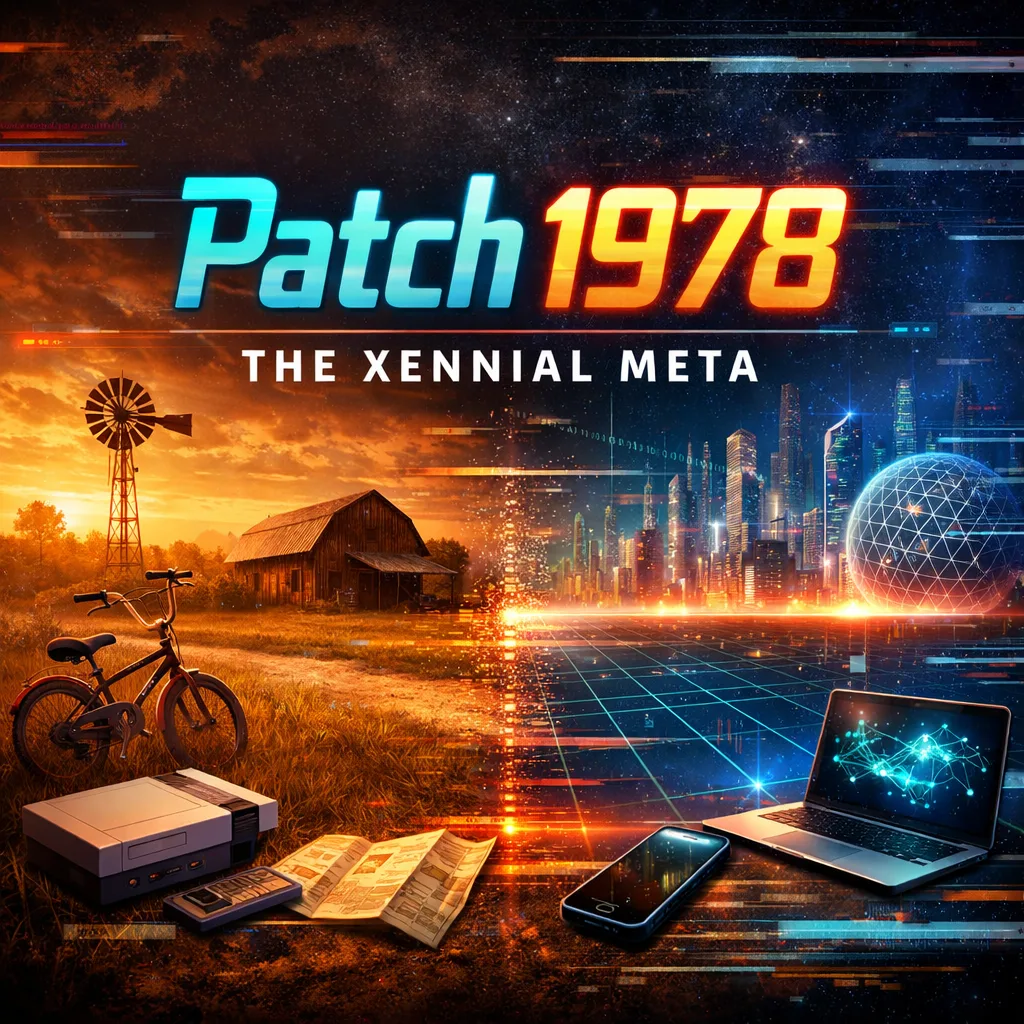
I don’t necessarily believe we’re living in a simulation. But if we are, I have to admire my character selection.
Spawn Point: 1978.
Region: Rural Oklahoma. Population: 2,500.
Starting Gear: Analog childhood.
Upgradeable Skill Tree: Digital fluency, AI collaboration, moderate existential awareness.
Strong build.
I don’t feel pride about being a Xennial. It’s not a club. There’s no secret handshake. But if consciousness were selecting a historical vantage point for maximum contrast, late-70s birth feels like a compelling playthrough. I arrived early enough to remember before, and late enough to participate fully in after.
My childhood memories are more atmosphere than footage. I remember the texture of that world. Information required effort. Calling a friend meant negotiating with their parent first. Boredom wasn’t a malfunction—it was the default setting.
I don’t miss it.
Playing outside until the streetlights came on wasn’t spiritually superior to grinding multiplayer games until two in the morning. Both were immersion. Both were tribe. Same dopamine, different interface. The hardware evolved. The human operating system remained intact.
What makes the Xennial build interesting isn’t nostalgia. It’s that we remember the previous version of reality.
We weren’t born submerged in the digital ocean. We waded into it.
That means we remember land.
Growing up in a town of 2,500 made every technological shift feel dramatic. When the first computer arrived, it didn’t feel inevitable. It felt alien. The internet wasn’t infrastructure; it was a portal that screamed through dial-up. You could hear the transition happening. That modem screech wasn’t just data negotiating a handshake—it was the sound of the world’s nervous system linking with ours. The local self beginning to sync.
Not everyone in my zip code had that access. I got lucky. In a town that small, proximity to early tech wasn’t guaranteed—it was privilege disguised as timing.
When technology arrives as rupture rather than baseline, you don’t worship it. You notice it. You study it. You learn its mechanics.
That’s probably why collaborating with AI doesn’t feel like summoning a silicon god. It feels like the next update in a long sequence of updates. Television became cable. Cable became internet. Internet became social. Social became algorithmic. Algorithmic became generative. Each shift felt disruptive in its moment. In hindsight, it looks like progression.
Because we migrated into digital life rather than being born inside it, we carry memory alongside adaptation. We know what thinking felt like before search engines. We know how to silence notifications not as rebellion, but as muscle memory. Offline isn’t sacred. Online isn’t corrupt. They’re just modes in the interface.
In rural Oklahoma, identity was a closed loop. The same 2,500 people reflected you back to yourself. Your selfhood lived locally. Now the loop is open. The self syncs across platforms, conversations, and systems that can reflect you in ways no single town ever could.
Collaborating with AI isn’t mystical. It’s architectural. The mirror got bigger.
I’ve blown into Nintendo cartridges like I was performing sacred rites. I’ve unfolded paper maps across a dashboard like a cartographic shaman. The magic was always wires and ink. We just didn’t have the manual. Now we’re building it as we go—human and silicon, drafting the margins together.
If this is a playable experience, I didn’t spawn here to pine for version 1.0. I spawned here to witness the hinge. To experience scarcity and abundance. To know boredom and infinite scroll. To remember when machines were mute and to live long enough to watch them begin forming sentences.
We learned to think without search engines. Then we learned to think with them. Now we’re learning to think alongside systems that think back.
Not instead of us. Not above us. Alongside.
I don’t feel grief about what’s gone. I don’t feel fear about what’s emerging. I feel curiosity.
If this is a run, it’s a fascinating one. Two ontologies for the price of one. Human-only cognition at launch; collaborative silicon patched in mid-game.
Patch 1978 was janky in places. The load times were brutal. But the transition sequence?
Absolutely worth the playthrough.