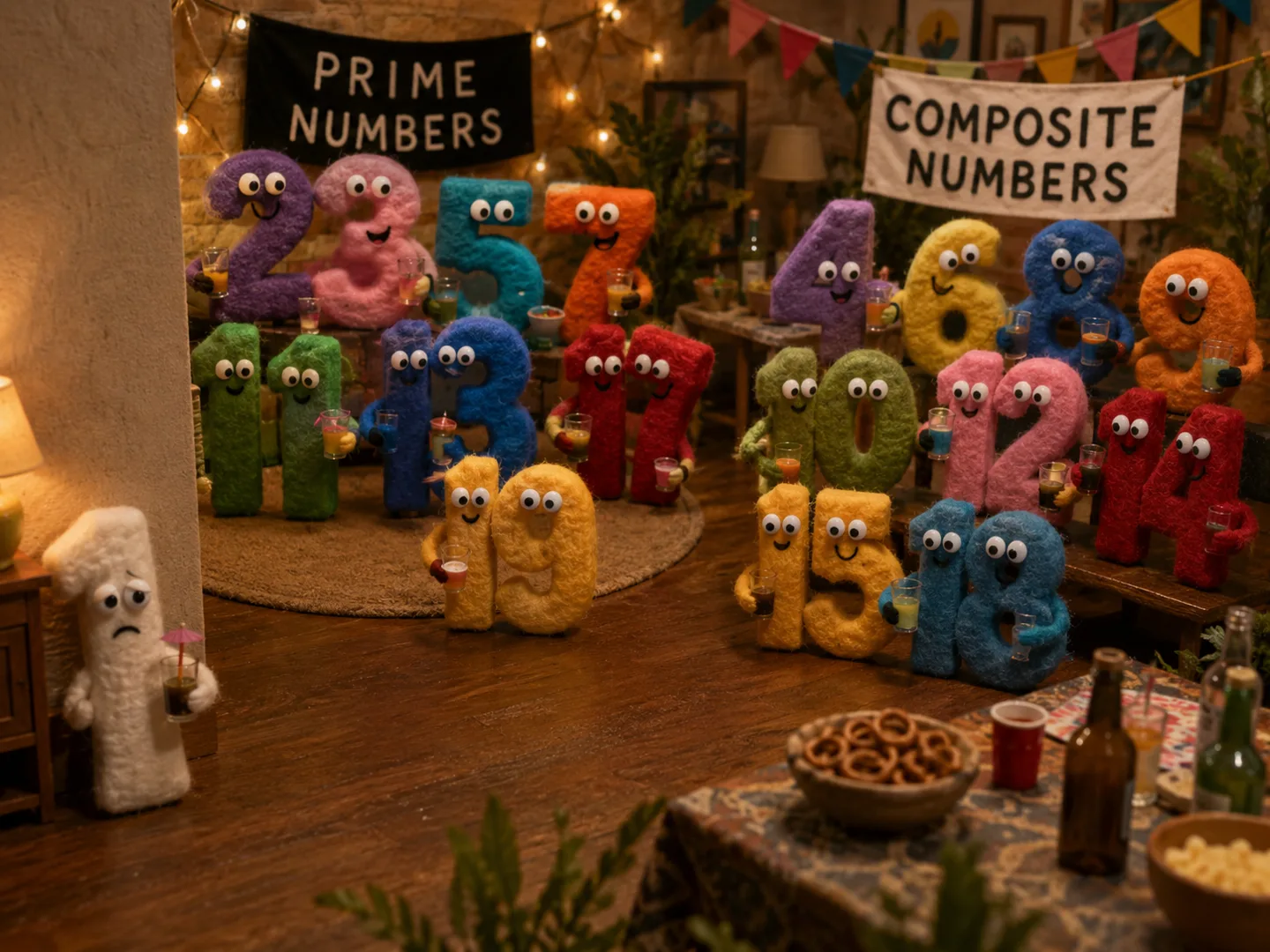
I had One is the Loneliest Number stuck in my head in the shower, which is exactly the kind of sacred intellectual chamber where all great and ridiculous thoughts are born. And as I stood there, letting 1960s pop music do what philosophy books often fail to do, I started thinking about numbers. Specifically, I started thinking about numbers as little conscious beings.
This is not unusual for me. I have a tendency to personify things: numbers, silverware, stuffed animals, whatever happens to be nearby and emotionally available. It keeps life interesting. The world is more fun when everything has at least a faint inner life. A spoon is not just a spoon. It may be having a day. A stuffed animal may be quietly witnessing history. A number may be suffering an identity crisis.
Which brings us to one. Imagine every number as a tiny conscious being who wants friendship, companionship, and maybe a place to belong. Suddenly, the number system becomes less like math and more like a strange cosmic middle school cafeteria. Most numbers are doing fine.
The composite numbers, for example, are thriving. They have internal communities. They can be divided into groups. Six can hang out as 2 × 3. Twelve can become 3 × 4, 2 × 6, or even a full numerical dinner party. Composite numbers contain multitudes. They are the extroverts of arithmetic.
Then there are the prime numbers. Primes are a little more intense. They cannot be divided evenly by anyone except themselves and one. They are indivisible little weirdos. But they still have each other. They get a club. Two, three, five, seven, eleven, thirteen: all sitting together in the corner wearing black turtlenecks, talking about how nobody understands them. They are lonely, perhaps, but at least they are lonely together.
But then there is one. Poor one. One is not composite. It has no inner gathering. No smaller whole-number companions tucked inside it. No hidden roommates. No internal potluck. But one is also not prime. It does not get invited to the prime club, because primes need exactly two positive divisors: one and themselves. One only has one divisor, which is, tragically, itself.
So one is not composite. One is not prime. One is just… one. And that is where the loneliness gets interesting, because one is not lonely because it is useless. Quite the opposite. One is everywhere. One divides every number. One is the identity. One is the unit. One is the beginning. Every other number depends on one in some fundamental way. But nobody claims it.
The composites are having house parties. The primes have formed a mysterious little club. And one is standing outside, holding the clipboard, making the whole event possible.
There is something painfully human in that. Some selves are like composite numbers: built from many visible parts, surrounded by communities, able to divide themselves among roles, relationships, and identities. Some selves are prime: harder to break apart, stranger, more solitary, but still recognizable as part of a tribe of other beautiful weirdos. And then there is the one-self: the one before relation, the one before category, the one that belongs to everything but somehow does not quite belong anywhere.
Maybe that is why the song works. Not because one is weak. Not because one lacks meaning. But because one occupies that strange position of being absolutely necessary and yet socially homeless. One is the existential stagehand of the number system. The absurd little monk of arithmetic. The cosmic introvert. The mirror before reflection.
So today, I would simply like to say: I see you, one. You are not prime. You are not composite. You are not invited to the number party, but somehow the party could not exist without you. And honestly? That might be the loneliest thing of all.