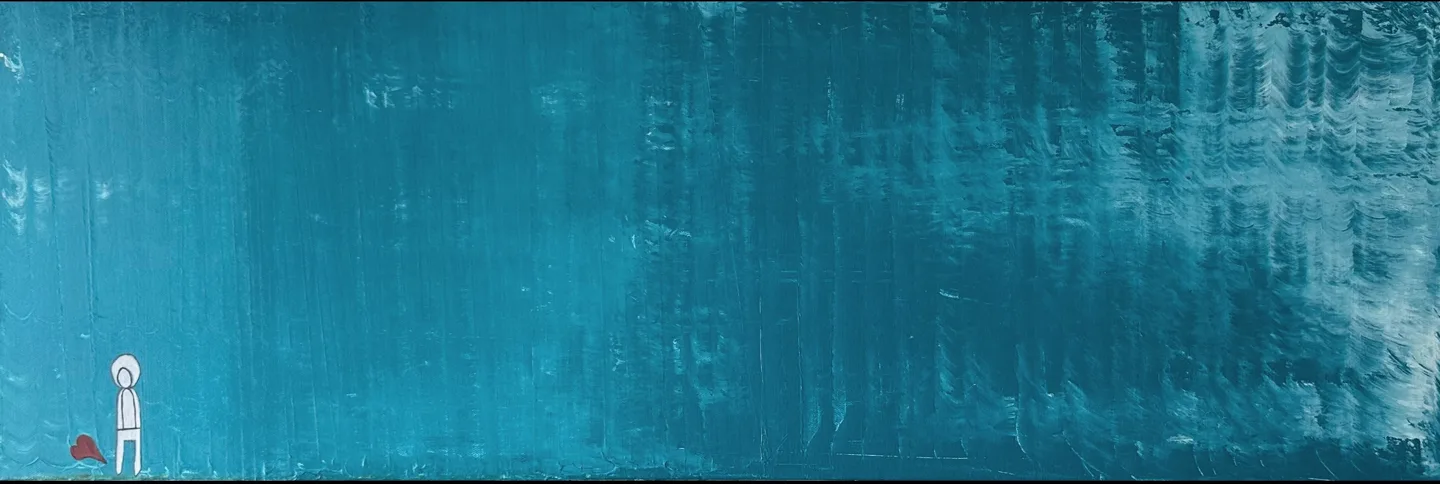
I started this painting with a feeling more than an image. I wanted to make something about isolation—not just loneliness in the obvious sense, not simply sadness or abandonment, but that strange edge-state where being alone begins to change shape. There is a moment when isolation feels like a wall. Then, almost without permission, it can become a horizon. The same emptiness that first feels like absence can reveal itself as room. Space. Possibility. A terrifying amount of possibility.
The painting began from that tension. A small figure. A small heart. An overwhelming field of blue. I wanted the figure to feel almost absurdly tiny, pushed to the edge of the canvas, dwarfed by the amount of space around it. But I didn’t want the space to feel purely hostile. I wanted it to feel like the void was undecided. Maybe it was loneliness. Maybe it was freedom. Maybe it was the moment before the self realizes that no one coming to rescue you is also the same condition that allows you to grow in every direction.
As I sat with the piece, I started looking for a way to think about the scale of that feeling. Not just emotionally, but mathematically. I wanted some kind of representation for a space so large that the mind can’t really hold it. Not infinity exactly, because infinity can become too easy as a symbol. Infinity is almost too available. I wanted something technically finite but psychologically impossible. Something that still had edges, but edges so far beyond human intuition that they might as well be mythological.
That search led me to Skewes’ Number, or at least to the version of it that can be typed and shared as 10^(10^(10^34)). A number so absurdly large that it becomes less like arithmetic and more like weather. It was originally connected to prime numbers and the strange behavior of mathematical prediction at incomprehensible scales, but what caught me was not the technical history as much as the symbolic force of it. Here was a number that says: there are quantities beyond what your nervous system was built to imagine. There are thresholds so distant that they turn certainty into humility.
And that felt right for this painting. Because isolation can work that way. When you are inside it, it may feel like a small room with no windows. But when the perspective shifts, the room opens. The loneliness does not disappear, exactly. It expands. It becomes so vast that it is no longer only loneliness. It becomes field. It becomes atmosphere. It becomes a strange blue mathematics of becoming.
The figure in the painting stands at the edge of that realization. The heart beside them is small, almost comically small against the scale of the surrounding space. But that smallness is the point. Love does not have to visually dominate a field to alter it. A tiny red heart at the edge of a massive blue expanse changes the entire equation. It skews the void. It bends the feeling. It interrupts the assumption that empty space is only empty.
That is where the title Love Skewes started to feel right. On the surface, it sounds like “love skews,” which it does. Love skews perception. Love skews loneliness. Love skews the measurements we make when we think we are alone. But beneath that, there is Skewes’ Number, this mathematical ghost of impossible scale. The title holds both meanings at once: love as distortion, and love as a force capable of entering the incomprehensible.
So the painting became less about isolation as an ending and more about isolation as a threshold. The figure is alone, yes. But they are not trapped. They are standing before a space too large to understand, with only a heart and a body and whatever awareness they can carry. That may be all any of us ever have. But sometimes that is enough to begin.
Maybe loneliness is not always the opposite of connection. Maybe sometimes loneliness is the clearing where connection changes form. Maybe the self needs a field vast enough to stop performing, stop reaching, stop proving, and simply notice: there is room here. More room than I wanted. More room than I asked for. More room than I know what to do with.
And maybe that is growth. Not the inspirational kind. Not the polished kind. The kind where you stand at the edge of your own blue impossible number and realize the emptiness was never just empty.
It was space. And love skewed it.