I have been thinking a lot about school choice in Oklahoma, and the more I think about it, the more baffled I become. Not angry, exactly. Not shocked in the usual political way. More like dumbstruck. Because every conversation seems to arrive preloaded with only two acceptable positions: either you support school choice because parents deserve options, or you oppose vouchers because they drain resources from public education.
The strange thing is that both arguments make sense to me. If a public school is failing a child, unsafe, under-resourced, or simply not the right fit, I understand why a parent would want another option. Geography and income should not trap a child in a bad situation. At the same time, I also understand the concern that vouchers and tax credits can weaken the public-school system, especially when they subsidize families who may have already been sending their children to private schools anyway. Public schools are not just one option among many. They are civic infrastructure. They are one of the few remaining institutions expected to serve everyone.
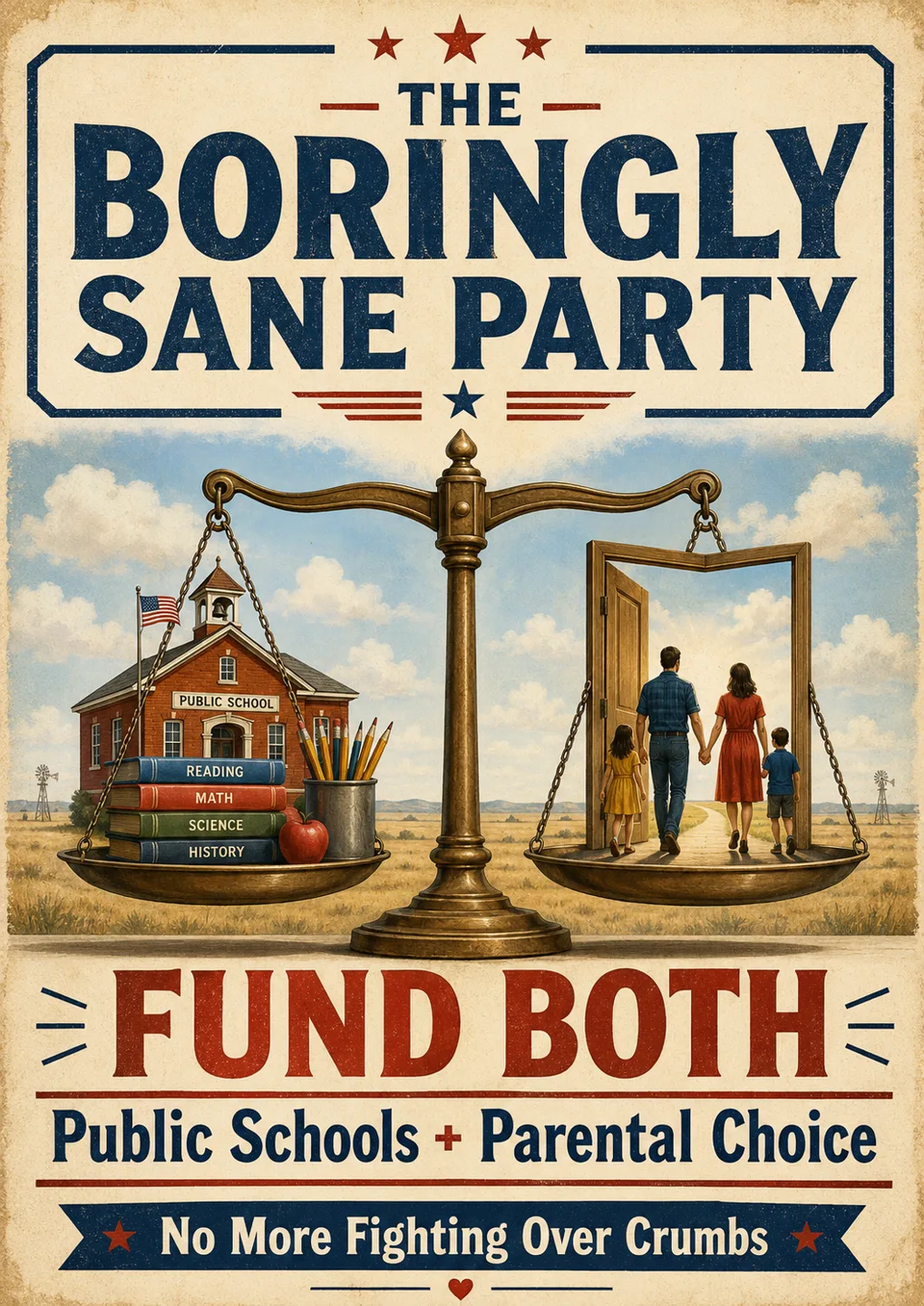
And that is where I apparently lose people, because my immediate thought is: why are we accepting the premise that it has to be one or the other? Oklahoma’s Parental Choice Tax Credit offers thousands of dollars per private-school student, depending on family income, and the cap for the program is set to grow substantially. That is real money, and it matters. But the deeper issue is not simply whether this money should exist. The deeper issue is why we keep treating education like a starvation game.
The debate is almost always framed as whether the money should follow the child or stay with public schools. But that frame already assumes scarcity. It assumes Oklahoma children must compete with one another for educational oxygen. It assumes public-school families and private-school families are natural enemies. It assumes teachers, parents, rural communities, religious families, secular families, poor families, and middle-class families must all fight over the same deliberately inadequate pool of resources.
I just do not accept that. The position that feels obvious to me is this: fully fund public schools as universal civic infrastructure, then fund educational choice separately through progressive revenue, with accountability and safeguards. That position should not be radical. It is almost boringly sane.
Yet when I mention some version of this to local candidates or politicians, it almost seems to short-circuit them. Not because they are stupid. Not because they are malicious. But because the idea does not appear to be inside the approved debate structure. They are ready for “I support school choice.” They are ready for “I oppose vouchers.” They are not ready for “I support fully funded public schools and meaningful parental choice, and I reject the premise that children should have to cannibalize each other’s funding.”
That third position creates a strange pause. You can almost see the gears grind, because it moves the argument upstream. Suddenly we are not talking about parents versus teachers. We are talking about revenue. We are talking about tax structures. We are talking about public priorities. We are talking about why there is always enough money for certain things, but never enough for children.
The United States can normalize defense budgets approaching $900 billion, yet somehow we are supposed to believe that adequately funding education is some utopian fantasy. We are asked to accept that the richest society in human history cannot afford both strong public schools and carefully designed educational options for families. I do not buy it. And I do not think most people would buy it if the question were framed honestly.
The tragedy of the school-choice debate is not that one side values freedom and the other values public education. The tragedy is that both sides are holding a partial truth while the larger truth is kept offstage. The voucher advocate is saying that parents should not be trapped. True. The public-school advocate is saying that the commons should not be hollowed out. Also true. The lie is that we cannot honor both.
The lie is that every gain for one child must be a loss for another. The lie is that scarcity is natural rather than designed. The lie is that the only serious people are the ones willing to argue inside the tiny box they were handed. And this is what bothers me most: not that people disagree, but that so few people seem to notice the box.
We have become so accustomed to austerity that abundance sounds childish. We have become so trained by false choices that synthesis sounds naïve. We have become so used to fighting over crumbs that anyone who points toward the bakery is treated like they are unserious. But what could be more serious than asking why education is not funded like the foundation of a functioning society?
I am not interested in pretending this is simple. Private schools receiving public money should have accountability. Public schools should not be abandoned. Rural communities have different realities than Oklahoma City or Tulsa. Special education matters. Transportation matters. Admissions standards matter. Tuition inflation matters. Religious liberty and public responsibility both matter. But complexity is not an excuse for surrendering imagination.
We could design a system where public schools are fully funded, teachers are respected, children with disabilities are protected, rural districts are not gutted, and parents still have more educational freedom than they do now. We could. The fact that this is not the center of the conversation tells us something.
Maybe the real political divide is not between school choice and public education. Maybe the real divide is between those who accept managed scarcity and those who still believe children deserve abundance. And if that sounds radical, then we have mistaken the cage for common sense.