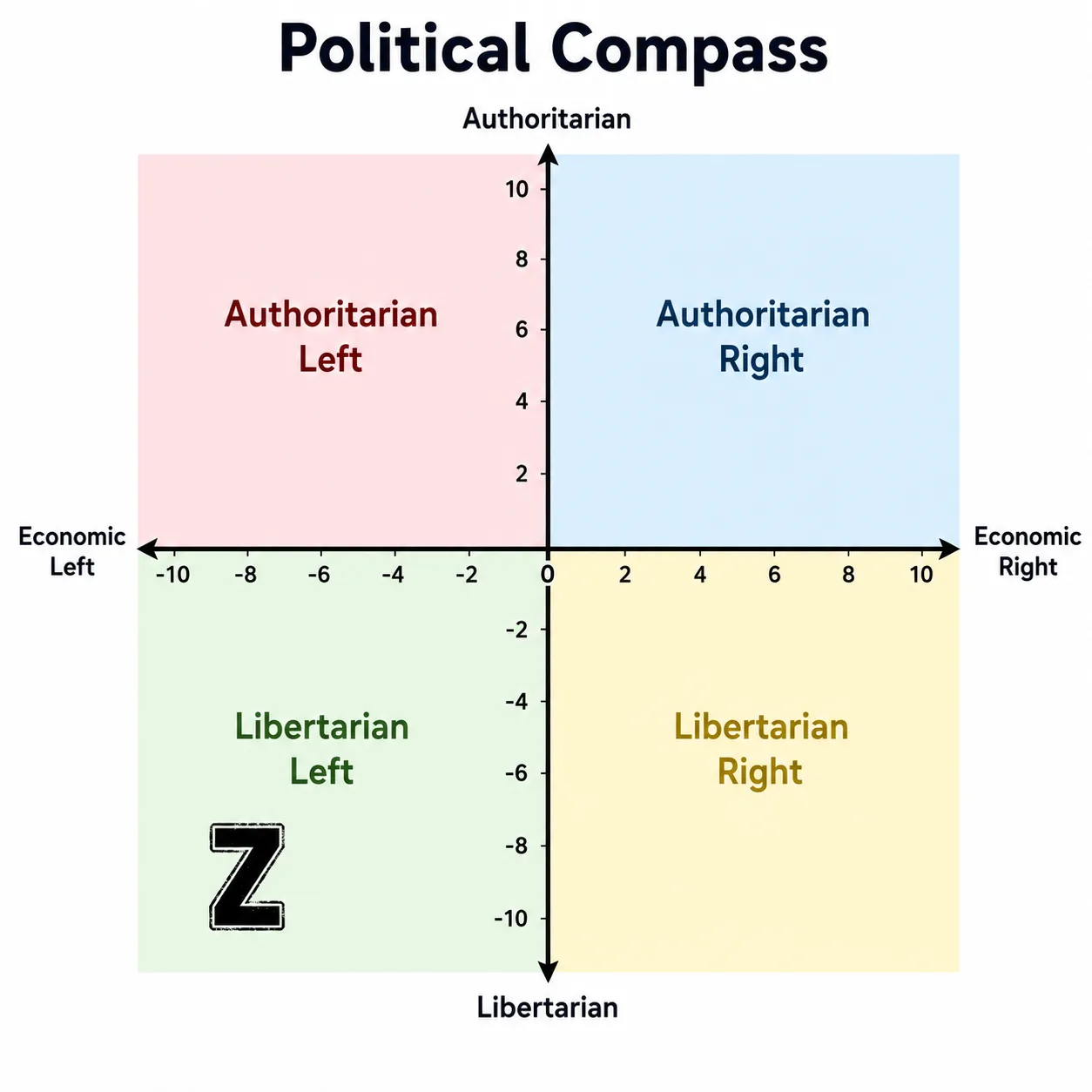
Living in Oklahoma means people occasionally decide my politics for me. I understand how it happens. If I criticize Donald Trump, support universal healthcare, talk about wealth inequality, defend LGBTQ people, think racism remains structurally relevant, or suggest that perhaps billionaires are not evidence of a perfectly functioning economic system, the available filing cabinet has a drawer already labeled for me: Liberal Democrat. Into the drawer I go. Case closed. The Committee has been categorized.
The problem is that I am not particularly interested in being a Democrat. I am also obviously not a Republican. I don’t say that in the familiar enlightened-centrist way where someone announces that both parties are equally terrible before eventually revealing that their politics are basically the Republican platform with legal weed. I mean that neither party comes especially close to describing the political philosophy I actually hold. Democrats occasionally support policies I agree with. Republicans occasionally stumble into a sentence containing three words I recognize. Neither feels remotely like home.
This doesn’t come up terribly often in my daily life, and I don’t particularly need everyone I encounter to understand my political philosophy. But after enough years of being placed into the nearest available ideological box, I started wondering what I would actually say if I had to explain myself clearly. So, in the interest of administrative efficiency, the Committee has convened and agreed to issue a statement.
My politics begin with a fairly simple suspicion: hierarchy requires justification. That may be the closest thing I have to a political first principle. I don’t automatically believe that someone deserves more power because they have more money, a better title, a particular last name, a religious office, a government position, a prestigious degree, a larger company, or an impressive flag behind them. Maybe a hierarchy is useful. Maybe it is necessary. Fine. Explain it. But “this is how things are” and “this is how things have always been” have never struck me as particularly compelling arguments for how things ought to remain.
That suspicion naturally pushes me pretty far to the economic left. I have difficulty looking at a civilization capable of producing extraordinary abundance while people remain hungry, sick, homeless, or terrified of a medical bill and concluding that the problem is simply insufficient personal responsibility. I don’t believe access to the basic conditions of a decent human life should depend entirely upon someone’s ability to produce economic value for another person.
Healthcare seems like something people should have because they are alive. Food seems similar. Shelter too. Education seems like a fairly obvious investment a civilization makes in itself. None of these ideas feel especially radical to me, although American politics has developed the impressive ability to make “perhaps insulin shouldn’t bankrupt you” sound like the opening paragraph of the Communist Manifesto.
I am sympathetic to socialism for essentially that reason. Not because I dream of an enormous government office deciding how many socks everyone receives, but because I think an economy is something human beings invented to serve human beings. When the system begins demanding that human beings serve the economy instead, something has become inverted.
Capitalism is extraordinarily good at producing things. I am less convinced that its ability to produce things answers every question a civilization needs answered. A machine can be incredibly efficient and still be pointed in the wrong direction. Producing more stuff, increasing shareholder value, expanding markets, maximizing productivity and growing indefinitely are not self-evidently synonymous with creating a good human life. At some point, “the economy is doing well” has to mean more than some numbers went up while everyone became more exhausted.
This is where my politics collide with something deeper in my philosophy: I don’t believe human beings are self-created little islands of free will wandering around collecting exactly the outcomes they deserve. None of us chose our genetics. We didn’t select our parents, childhoods, intelligence, temperament, neurobiology, country of birth, historical moment, opportunities, traumas, teachers, neighborhoods, or the billions of preceding events that eventually produced the person standing here today. Whatever freedom remains inside that causal avalanche, it certainly isn’t enough for me to look at a billionaire and assume virtue or look at a homeless person and assume failure.
Once you really begin taking determinism seriously, the word deserve becomes slippery. The successful person still worked hard. The struggling person still made decisions. Consequences still exist. Society still needs rules. But the old moral mythology becomes harder to maintain: the rich earned every penny because they are superior; the poor failed because they are lazy; the criminal is simply evil; the addict is weak; the successful deserve comfort while the unsuccessful deserve whatever happens next.
I don’t find that worldview convincing. My economic politics therefore grow from the same place as much of the rest of my philosophy: compassion becomes easier when judgment becomes less metaphysical. If I stop imagining everyone as a completely independent author of themselves, it becomes much harder to justify enormous differences in dignity based on where people happened to land.
At the same time, I have very little interest in replacing private hierarchies with enormous authoritarian public ones. This is where simply calling me a socialist misses an important part of the picture. I am deeply suspicious of concentrated power regardless of the logo hanging above the door. Corporations can become oppressive. Governments can become oppressive. Religions can become oppressive. Political movements can become oppressive. Majorities can become oppressive. Revolutionaries who spend years talking about liberation can become remarkably enthusiastic about telling everyone what to do once somebody hands them the keys.
Power doesn’t become morally pure because my team possesses it. That puts me much closer to the libertarian left than to authoritarian socialism. I want considerably more economic equality and considerably less control over people’s personal lives. Those ideas don’t seem contradictory to me. In fact, they seem intimately related. If people deserve dignity independent of their economic usefulness, they should probably also be allowed a tremendous amount of freedom in deciding what to do with the life attached to that dignity.
People should generally be free to become strange. Believe strange things, wear strange clothes, love strange people, make strange art, change your name, change your body, worship twelve gods or worship none. Smoke something. Grow something. Read forbidden books. Say offensive things. Paint your house purple. Spend your afternoon contemplating whether consciousness is the universe noticing itself through a temporary meat aperture. The Committee strongly endorses weirdness.
Your freedom ends somewhere around the point where it meaningfully begins destroying someone else’s, and working out that boundary is where politics becomes complicated. But my default position is generally liberty rather than prohibition. I don’t need society organized around making everyone resemble me. That sounds exhausting for everyone involved.
I also don’t have much reverence for tradition simply because it survived. Some traditions are beautiful. Some contain accumulated wisdom. Some connect us to people who died centuries before we arrived. Others are merely old mistakes with excellent branding. “That’s the way we’ve always done it” should begin an investigation, not end one.
This makes me culturally progressive, although even that phrase feels smaller than the underlying principle. I don’t support people living differently because progressivism requires a checklist of approved identities. I support it because I don’t understand why someone else’s harmless existence requires my authorization in the first place.
The same suspicion extends to nationalism. I love places. I love communities. I understand attachment to a home, a city, a landscape, a culture and the people living around you. But the invisible line someone drew around the place where I happened to be born doesn’t convince me that the human beings on my side possess greater moral value than those standing six inches beyond it. Flags are useful symbols. They are terrible measures of human worth.
This collection of ideas apparently places me somewhere in the general neighborhood of democratic socialism, libertarian socialism, left-libertarianism and philosophical anarchism. I am comfortable wandering around that neighborhood without worrying terribly much about which house technically belongs to me. Political labels are useful shorthand right up until the shorthand starts doing the thinking.
I am not interested in adopting an ideology and then adjusting reality until everything agrees with it. If evidence changes, my ideas should change. If a policy I like doesn’t work, liking its intentions doesn’t rescue it. If someone I generally oppose says something true, their being an asshole doesn’t magically make the statement false. The Committee may be dysfunctional, but we still attempt quality control.
Maybe that is why being called a liberal Democrat has always felt so inaccurate. It isn’t that Democrats are insufficiently radical for my personal brand. It is that my politics don’t really begin with a political party at all. They begin much farther upstream, with questions about what a human being is, what we owe one another, when hierarchy is justified, why ownership should create authority, why productivity should determine dignity, and why inherited systems should receive automatic legitimacy simply because they arrived before we did.
They also begin with a question I increasingly find difficult to escape: if we possess enough food, wealth, technology, knowledge and productive capacity for everyone to live with basic dignity, what exactly are we defending when we insist that some people cannot?
Those questions lead me left economically and libertarian socially. They make me distrust authoritarianism, concentrated wealth, nationalism, compulsory morality and the idea that winners are necessarily deserving while losers are necessarily defective. They also leave plenty unresolved, which I consider a feature rather than an embarrassment.
How much government is necessary to create greater equality without creating another oppressive hierarchy? How do communities protect themselves without allowing protection to become control? How do we reward effort and innovation without turning wealth into inherited political power? How do we construct institutions strong enough to help people while remaining accountable enough that people can resist them? I don’t have tidy answers to all of that, and anyone claiming they do should probably be kept away from the levers.
So this is not a party platform, and it certainly isn’t a declaration that I have solved civilization before sunrise while drinking coffee and waiting for the rest of the house to wake up. It is simply an attempt to describe the direction my political compass actually points.
I believe people deserve dignity independent of their economic usefulness, that extreme concentrations of wealth inevitably become concentrations of power, and that power should always have to explain itself. I believe human behavior makes more sense when understood causally than when divided into saints and sinners. I believe a society capable of reducing unnecessary suffering has a moral reason to do so, and I believe personal liberty should remain enormous while it does.
I believe equality deserves preference over unnecessary hierarchy. I believe traditions should survive because they remain valuable, not because questioning them feels impolite. I believe systems were made for people, not people for systems. And I believe a political philosophy that cannot tolerate being questioned has already started becoming the thing it was supposed to protect us from.
Call that socialist. Call it libertarian socialist. Call it anarchistic. Call it far left. Call it naïve. Call it whatever makes filing easier. I don’t particularly care about finding the perfect word for the box.
Just don’t call me a liberal Democrat and assume you’ve finished the biography.
The Committee has reviewed the statement and, against all historical precedent, the vote was unanimous.