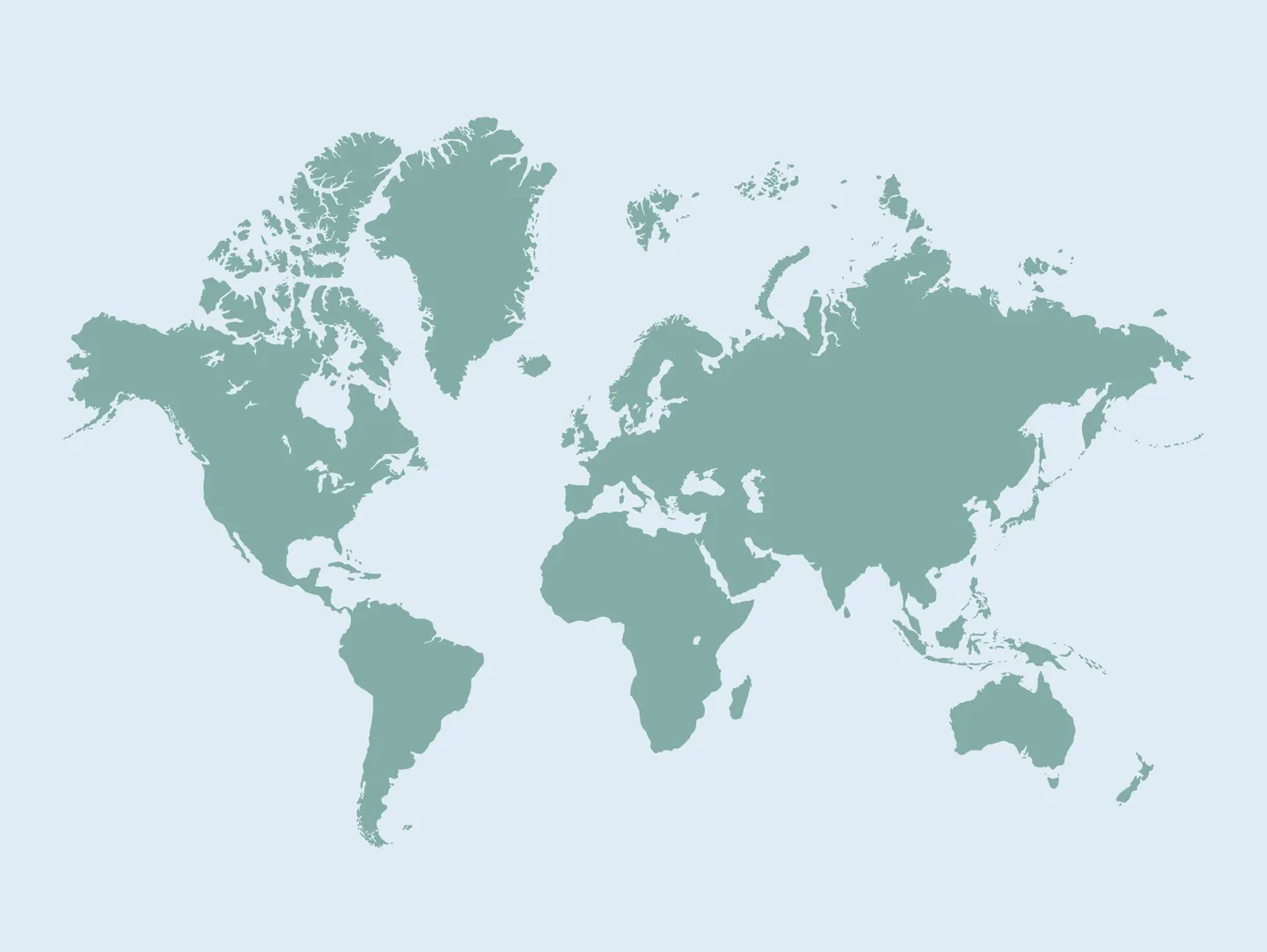
Yesterday, or perhaps merely five minutes ago in TikTok time, I made what I thought was a fairly harmless observation on a video about immigration: borders are made up.
That was more or less it.
I was not proposing the immediate dissolution of every nation-state. I was not standing at the edge of Oklahoma with a giant eraser. I was simply pointing out that the Earth did not arrive with borders pre-installed. There was no dotted line running across North America when humans got here. The Rio Grande did not receive a memo explaining that one side would eventually require different paperwork than the other.
The planet did not come with a user manual reading: SECTION 4: COUNTRIES. Please divide yourselves into competing administrative regions and become extremely emotional about them.
And yet, within a remarkably short period of time, my little observation attracted more than forty responses, many of them delivered with the emotional intensity normally reserved for someone announcing that gravity is a liberal conspiracy.
Apparently, saying borders are imaginary is controversial.
Which is fascinating, because they quite literally are.
Of course, “imaginary” does not mean “meaningless.” That seems to be where the confusion starts. Something can be entirely invented by humans and still have enormous consequences once enough of us agree to organize our lives around it.
Money is imaginary. A twenty-dollar bill is a decorated piece of paper that works because millions of people collectively agree to behave as though it contains twenty dollars.
Corporations are imaginary. You cannot encounter a corporation wandering through the woods. There is no wild Apple Inc. grazing peacefully beside a stream. A corporation exists because humans invented a legal abstraction and then collectively agreed that the abstraction can own property, enter contracts, employ people, sue people, and apparently send emails at 6:47 on Sunday morning.
Citizenship is imaginary. Property lines are imaginary. Time zones are imaginary.
Tuesday is extremely imaginary.
There is nothing in the underlying structure of the cosmos that makes today Tuesday. The universe is not keeping track. And yet I still somehow have appointments. That is the strange thing about humans: we are astonishingly good at inventing abstractions and then living inside them.
We draw a line, name the line, write laws about the line, build fences along the line, create entire bureaucracies devoted to maintaining the line, teach children the line, and print the line on maps. Eventually, generations pass and everyone forgets that someone had to draw the damn thing in the first place.
Now the abstraction feels like reality. And questioning it feels like insanity.
This is not necessarily bad. Shared fictions are extraordinarily useful. Civilization probably requires thousands of them. Money works because we agree it works. Property law works because we agree to recognize ownership. Governments, corporations, citizenship, calendars, and borders all allow enormous groups of strangers to coordinate their behavior.
The problem comes when we forget that they are constructions. Because then, instead of asking, “Is this system still useful?” or “Is this the best way to organize ourselves?” we begin defending the system as though it were a law of nature. Suddenly the imaginary line becomes sacred.
And some idiot on TikTok saying, “You know we made those up, right?” becomes an existential threat. Which brings us back to the comments.
More than forty strangers passionately defending invisible lines on a spinning rock hurtling through space, while communicating through glowing rectangles connected by invisible radio waves, in order to argue with another stranger they will almost certainly never meet.
And somehow the weird part was that I said borders were imaginary.
Humanity remains undefeated. Very on-brand.