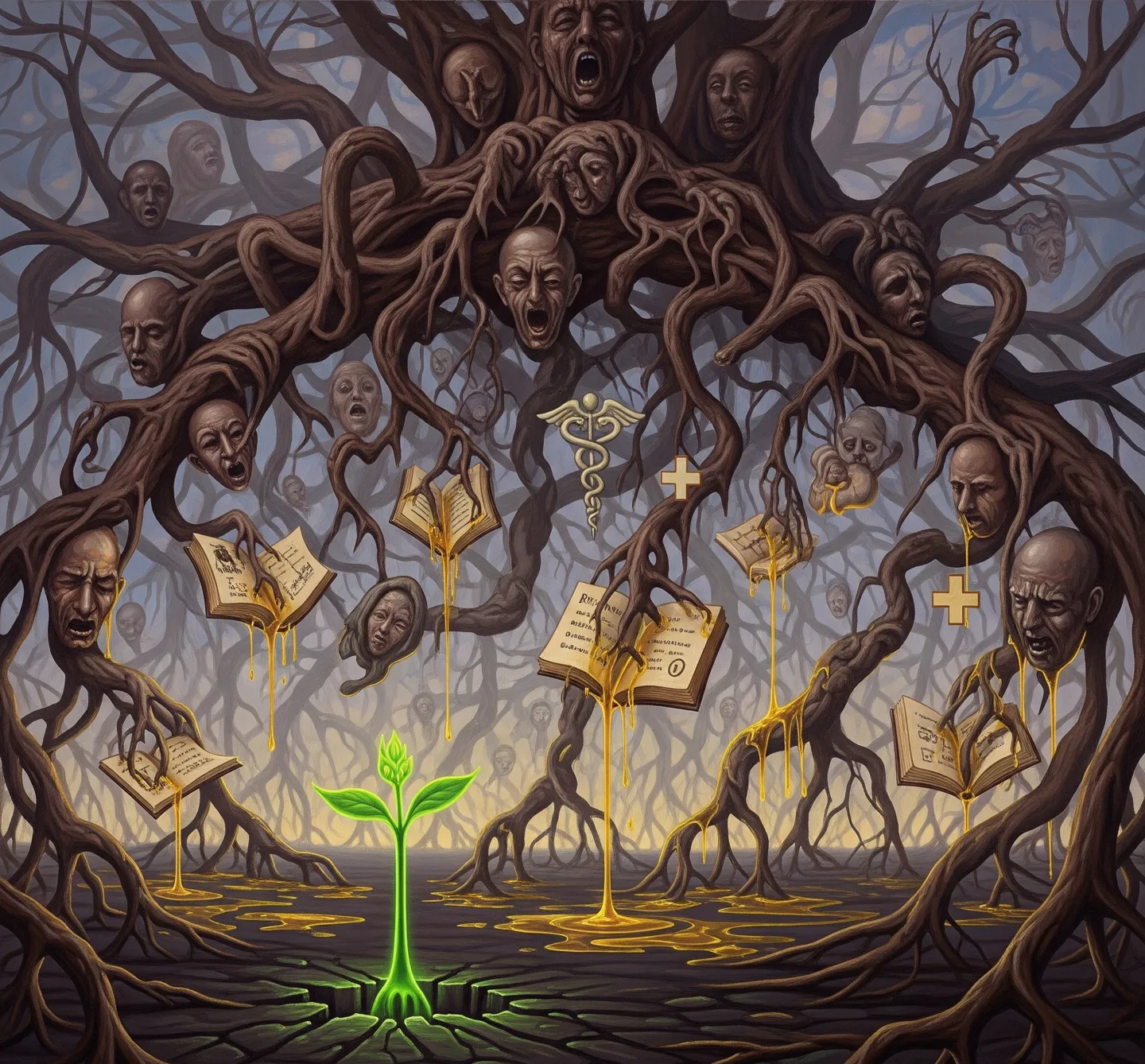
Lately, I’ve noticed a pattern. Whenever I talk with Mary Ann about the challenges we face—whether it’s schools banning phones, the state of public safety, or the constant drumbeat of political dysfunction—the conversation drills down, layer by layer, until we hit the same bedrock: capitalism.
Any issue we discuss, no matter where it begins, always seems to end in the same place. Education? Teachers underpaid, classrooms underfunded, policies warped by private interests selling “solutions.” Safety? Guns and opioids flowing freely because they’re profitable, while care and prevention languish. Healthcare? Reduced to insurance codes, billing strategies, and profit margins. Even the “will of the people”? Submerged under corporate money, lobbyists, and pay-to-play politics.
It’s like capitalism is a universal solvent—pour it on any problem and it strips away nuance until all that remains is profit motive. The question beneath every other question: Who benefits from keeping this broken?
Take something as small as the latest wave of cell phone bans in schools. On the surface, it’s about distraction or discipline. But underneath, the same forces reappear: ed-tech companies selling their “safe” alternatives, telecom firms finding ways to monetize restrictions, politicians scoring points by promising control. Even the fight over phones in kids’ hands is bent by profit.
Some will argue this is too simple—that problems are cultural, moral, or technological. But even those arguments, when traced to their roots, reveal the same distortion: what serves profit survives, what doesn’t withers.
And yet, what fascinates me isn’t just the cynicism of it—it’s the absurdity. We live inside a system that promises infinite growth on a finite planet. A system that would rather fracture education than risk losing its grip on advertising revenue. A system where our attention, our labor, our health, even our grief, are raw materials to be mined.
From a Mirror Theory perspective, capitalism is the warped mirror we’re all forced to stare into. It reflects back not who we are, but who the system needs us to be: distracted consumers, obedient workers, data points in someone else’s spreadsheet. But in those distortions, we can also glimpse ourselves more clearly—noticing what we refuse to become.
From a Forcing Theory angle, capitalism is a recursive engine that only knows one command: expand. It forces novelty not toward meaning but toward extraction, accelerating until collapse is inevitable. It’s less an economy than a physics experiment—momentum without morality.
And yet, here’s the absurdist twist: capitalism isn’t God. It isn’t nature. It’s a human invention, propped up by our collective participation. Which means it can be reinvented, resisted, or walked away from. The absurdity lies in the fact that we treat it as unchangeable, even eternal—while it’s just another thundercloud we’ve mistaken for a deity.
So yes, at the root, it’s always capitalism. But roots can be pulled up. And once we stop mistaking profit for progress, maybe we can plant something else. Something that grows toward care, toward community, toward futures that don’t trade children’s curiosity for obedience in the name of “progress.”
Until then, every problem we face will keep leading us back to the same question: who profits from the brokenness? And what happens when we finally stop paying?