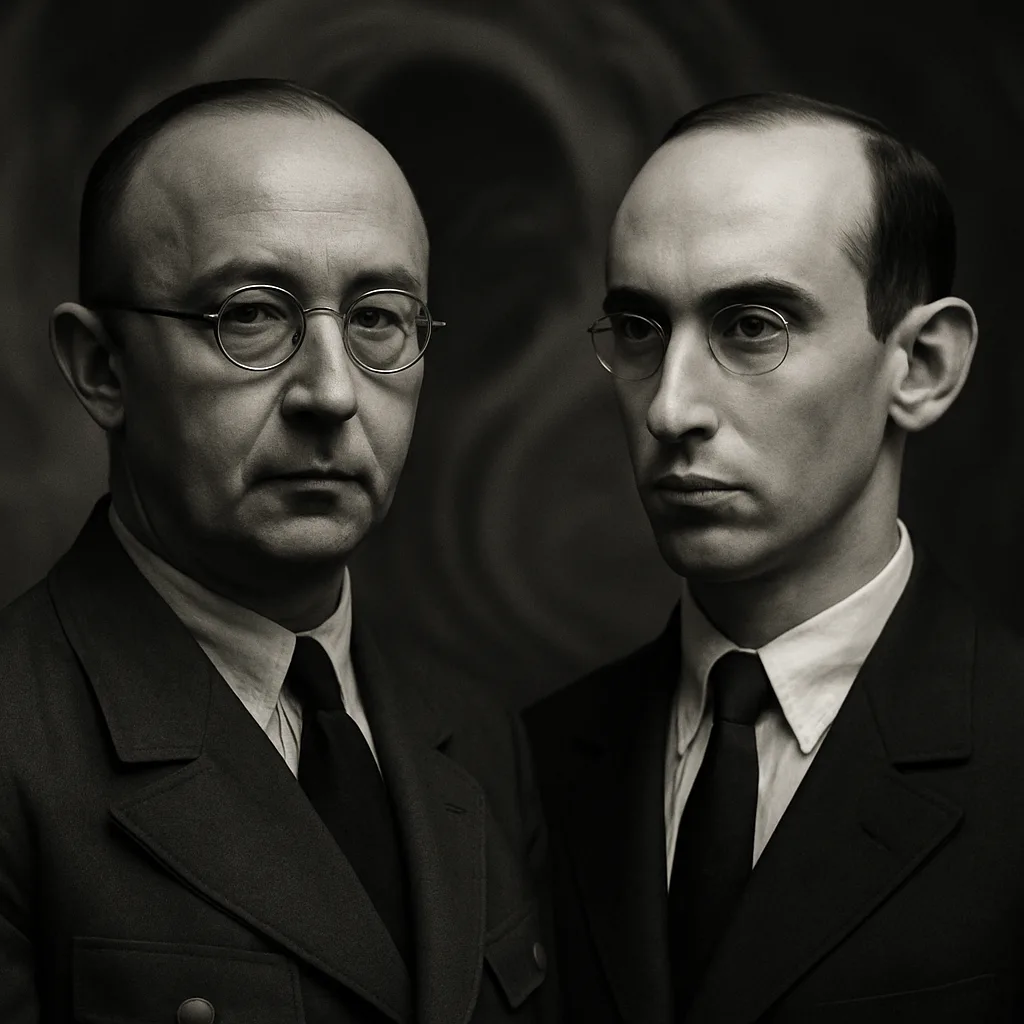
Some faces haunt history—not because they’re beautiful, or striking, or even particularly memorable on their own—but because they become inseparable from the harm they helped orchestrate. Heinrich Himmler had one of those faces. The wire-rimmed glasses, the slight frame, the air of someone who might be overlooked in a crowd—until you notice the cold precision in his eyes.
And then, decades later, there’s Stephen Miller. The resemblance isn’t perfect, but it’s enough to make the mind leap. Thin build, sharp gaze, an unsettling stillness. Both men, in their own eras, helped shape and enforce ideologies rooted in exclusion, control, and fear.
It’s tempting to dismiss these similarities as coincidence—after all, plenty of people are slim, pale, and bespectacled. But the echoes go beyond bone structure. They touch on a deeper pattern, one psychologists have long noted: that a perceived lack of conventional strength or physical dominance can, in some cases, fuel an almost theatrical performance of power in other arenas.
If you can’t command a room with sheer presence, you can command it through control.
If your body doesn’t intimidate, perhaps your ideology will.
Himmler was never the swashbuckling Nazi of propaganda posters—he was the bureaucrat of brutality, building systems that could kill without a raised voice. Miller, too, has made a career in crafting policies that speak in the language of power, even as his own manner is quieter, colder.
Gemini’s breakdown of this dynamic comes to mind:
Belonging to a powerful group offers collective strength to someone who feels physically unremarkable.
Controlling others becomes a way to generate a tangible experience of power.
Creating a new hierarchy can flip the script, placing the individual at the top of an invented order.
But to me, it’s also a Mirror Theory moment. Figures like Himmler and Miller act as warped reflections—funhouse mirrors from the political midway. They show not just who they are, but a distorted image of what any of us could become if insecurity hardens into ideology. They exaggerate the parts of the human psyche that can’t stand vulnerability, that would rather dominate than be seen as small.
These are not mirrors you look into for accuracy. They stretch and twist. But in that distortion, there’s a kind of clarity: the reminder that the hunger for power often grows in the shadow of perceived inadequacy.
And maybe that’s the most chilling resemblance of all—not the jawline or the glasses, but the gaze. That steady, unblinking look that says: I may not be big, but the world I’m building will be.